

 GMA Brandtalk
 Tracking
 Archives

'The Lord of the Rings: The Rings of Power' arrives from Middle-earth to Earth

LOS ANGELES — Get ready for the heroic legends of the fabled Second Age of the Middle-earth's history are coming. In fact, they already arrived on the red carpet in Culver City.
The much-awaited "The Lord of the Rings: The Rings of Power," an epic drama set thousands of years before the events of J.R.R. Tolkien's "The Hobbit" and "The Lord of the Rings," follows an ensemble cast of characters as they confront the long-feared re-emergence of evil to Middle-earth.
We met the cast members of this amazing ensemble on the red carpet at The Culver Studios.
Headlining this ensemble cast are Cynthia Addai-Robinson ("The Accountant"), Robert Aramayo, ("Game of Thrones"), Owain Arthur ("Casualty"), Maxim Baldry ("Mr. Bean's Holiday"), Nazanin Boniadi ("Homeland"), Morfydd Clark ("Saint Maud"), Ismael Cruz Córdova ("Ray Donovan"), Charles Edwards ("The Crown"), Trystan Gravelle ("Mr. Selfridge"), Sir Lenny Henry ("The Witcher: Blood Origin"), Ema Horvath ("What Lies Below"), Markella Kavenagh ("True History of the Kelly Gang"), Tyroe Muhafidin ("Caravan"), Sophia Nomvete (Award-winning UK Theatre actor), Lloyd Owen ("Apollo 18"), Megan Richards ("Wanderlust"), Dylan Smith ("Maze Runner: The Death Cure"), Charlie Vickers ("Medici"), Leon Wadham ("Go Girls"), Benjamin Walker ("The Golden Compass"), Daniel Weyman ("Silent Witness"), and Sara Zwangobani ("Monarch Cove").
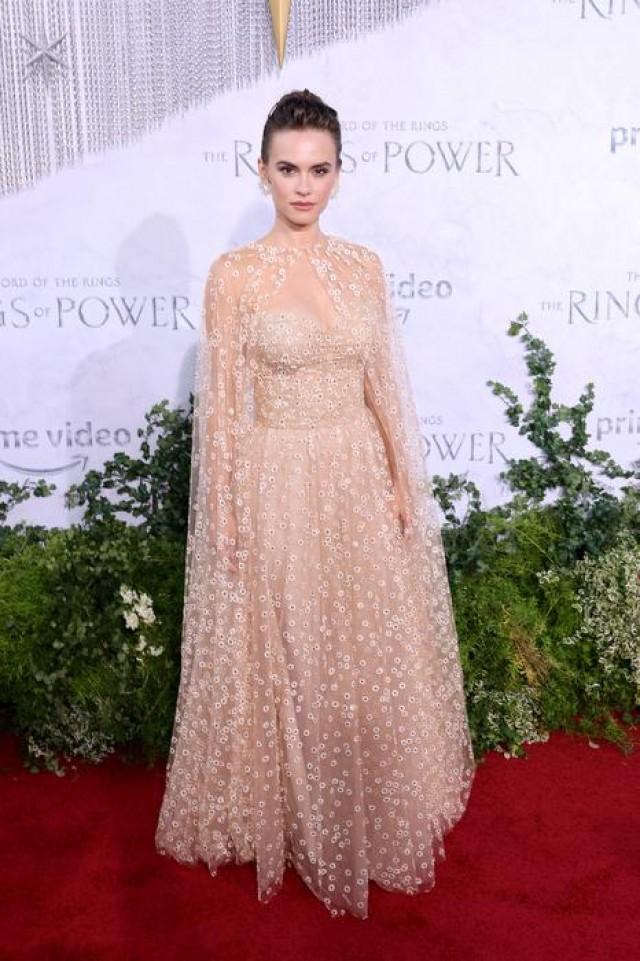
Ema Horvath, dressed in a Monique Lhuillier gold shimmery off-shoulder gown with a cape, was looking very much like royalty. Horvath said she hasn't met the Cebuana fashion designer yet, but she has worn her before and she is a great fan. Horvath confessed that she is nervous about the night's premiere, as it's her first red carpet. "But I can't wait for people to see the series," she said.
Also doing his first red carpet was one of the youngest members of the cast, Australian actor Tyroe Muhafidin. Wearing a silver snake choker necklace to bring to Middle-earth his more formal blue green blazer, Muhafidin confessed that the experience has been "crazy for me. I feel so blessed just to be here. I really cannot describe it."
The series, which will premiere exclusively on Prime Video in more than 240 countries and territories around the world in 32 languages on September 2, will take viewers back to an era in which great powers were forged, kingdoms rose to glory and fell to ruin, and unlikely heroes were tested.
In one of our rare back to in-person interviews since COVID-19 and the lockdown, we were able to sit down and interview some of the cast members and below are excerpts of our conversations.
Sara Zwangobani (Marigold Brandyfoot), Cynthia Addai-Robinson (Queen Regent Miriel) and Robert Aramayo (Elrond)
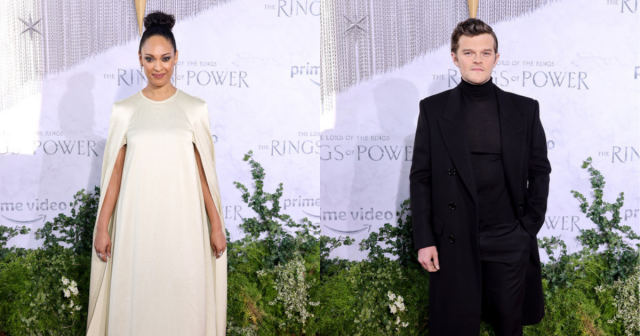
Congratulations on being part of this series. Talk about first, your characters and why it is so exciting to be part of this project.
Sara Zwangobani: My character is Marigold Brandyfoot. She's a Harfoot. She's a matriarch. She's parent to Nori and Dilly, and surrogate mom to Poppy and wife to Largo. And she, her main goal in life is to protect her family and to protect her migratory nomadic tribe. But she is facing some challenges in that department lately, thanks to her inquisitive daughter Nori. And to be part of this project is quite literally a dream come true. I'm a big lover of fantasy, have been all my life, and it's like stepping into one of my books. It's completely magical.
Cynthia Addai-Robinson: I play Queen Regent Miriel, and she is the leader of the island kingdom of Númenor. Númenor is essentially Tolkien's take on the legend of Atlantis. So, it's a civilization that is very advanced at the height of its power, but ultimately has a tragic ending. And she is someone who is thoughtful, has a strong moral center, and really wants to maintain the peace and stability and guide her people through the changes in society.
Robert Aramayo: I play Elrond. And I think that the most exciting thing about being involved with Tolkien or enjoying Tolkien is the fact that it's limitless. It is a truly massive world. And I think what people love so much about Tolkien is the way that he writes. It's kind of observationist. Sometimes when you're reading, especially in the first stage, it's like looking through the crack in the door. And he's kind of describing something, but it gives you the opportunity to come to his work. I love reading Tolkien. And I love how it sets your imagination off. So, it's a real gift to be part of anything that's associated with him.
What was your reaction when you were on the set filming, and you saw all the costumes and they built all these amazing sets?
Sara Zwangobani: For me, stepping on the set was incredible, but it was actually, even before that, stepping into Kate Horley, our amazing designer. She has this incredible room, which is like a museum to all things Tolkien, and to our show, "The Rings of Power." I remember, I think it was my first day meeting everyone when I got to New Zealand and walking into that room. Seeing the vision that she had for our show, seeing all the sets and the costumes, but also some of the discarded ideas, that still was so rich and full of life. I could have stayed in there all day. I thought it was astonishing, the depth of her imagination and her scope, and what we were about to embark on. I mean, I remember going, "This is like a dream." It was amazing.
Cynthia Addai-Robinson: I remember my first day. I had a very unique first day of filming because I got to film on top of a mountain. I was helicopter-ed to a mountaintop. I just remember, we had to work very quickly on this mountain obviously, but I remember looking all around, looking at the landscape of New Zealand. I just could not believe that I, not only that I was on top of this mountain, but that I was a part of this, and this is how I was going to get to embark on this journey. It was really phenomenal to have the New Zealand landscape as part of our sets as well.
Robert Aramayo: I remember driving into one of the studios and seeing something going on over there in the distance. I was like, "What's happening over there?" It's like, "Oh, they're building a city." I remember being like, "Okay." Númenor is just breathtaking. When you watch it on the screen, when you see it, you know it's real. People are going to be really excited about Númenor.
And you got goosebumps when you found out it was your set.
Robert Aramayo: Well, it, wasn't my set. That's the thing. When it's your own set, you have a relationship to it. So, you can't really afford too much wow, because you have to live in it. That's true. But when it's somebody else's set, you can, especially when they're building a dock, which ships flow to get in, you can sort of allow yourself a bit more...
What were the challenges of filming in New Zealand and there's COVID-19 and all the restrictions?
Cynthia Addai-Robinson: We were really fortunate because at the time that we were there, or at least for me, because I came a little bit later in filming. I went from being in lockdown in the US. And when I arrived in New Zealand, they had managed to really keep COVID-19 at bay. And so, in the community, there were no COVID-19 cases. Occasionally if there were, there would be a snap lockdown, and then things would resume, but we were very, very fortunate to really be able to lead what felt like normal life, and in the process, be able to do this work and work in a way that we're accustomed to, which is very intimate and being close together. We were really, really lucky, but definitely a challenge in order to be able to do that. New Zealand had a closed border. So, once we were there, we were there for the duration. There was that challenge of not having family or friends being able to come and visit or being able to leave. But I think that allowed us to really hone in on this work and be in this Middle Earth bubble, really.
Sara Zwangobani: For me, the challenge was being away from my family, which was a very long time. But then I, as Cynthia has said, that meant that we were working together much more closely than we might otherwise have done. Then this wonderful group of people became my family. And so that was incredible. And that was actually a benefit to the show too, I think. The other challenge for me personally was the mud. We had a lot of mud in the Harfoot set. We were constantly in mud with our feet and, yeah, mud was a thing. And so that was another challenge. But again, it became part of our world because that's what the Harfoots would actually have to be living in and walking through. And so, what first was a challenge actually became a massive benefit to the creation of the characters.
Benjamin Walker (High King Gil-galad), Trystan Gravelle (Pharazon), Leon Wadham (Kemen), Sophia Nomvete (Princess Disa)
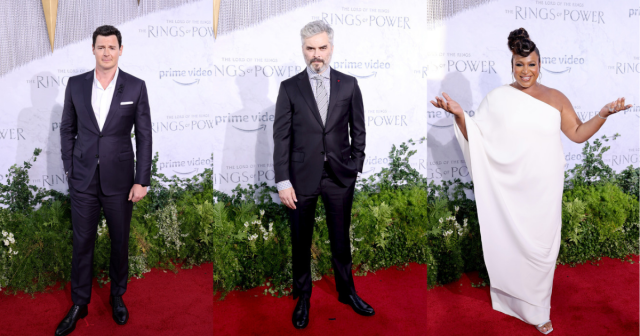
Can you please tell us a little bit about your characters and why you are so excited to be part of this series?
Benjamin Walker: That's an easy one for me. I play High King, Gil-galad. I am King of the Elves. And the second answer is I'm King of the Elves. And why did I take the part? Because I'm King of the Elves. He is a phenomenal character, historically, in Legendarium. He served and was the last High King of the Noldor. He had the longest reign and also presided over the longest period of peace in Middle-earth, but also being Tolkien, we know there's some strife along the way.
Trystan Gravelle: I'm playing Pharazôn, and he's of the island kingdom of Numenor. He is chancellor of Numenor, consult to the queen regent, Queen Marielle. He's also head of the Gillsman. He does everything basically. He's high up in Numenorean society, a very powerful figure. He has a son, Kemen, who, I guess, is going to be part of his legacy that he's leaving behind.
Leon Wadham: Kemen admires his father; he wants to follow in his footsteps. He'd love to be a political figure himself, but he doesn't really understand what that means at this point. His dad's seen a lot. He's been forged by a lot of difficulty in Numenor, whereas Kemen has only known comfort. So, when we meet him, he's just enjoying being young and having no problems, but problems are on the horizon.
Sophia Nomvete: I play princess, Disa, our first female dwarf to kind of have a poignant space on television within the series. It feels great. She's a wife, she's a mother, she possesses some magical and very powerful gifts. It's great to see her journey with her husband, Prince Durin IV. And of course, her own individual journey of serving her kingdom as a princess.
And you have musical background as well, and you get to sing.
Sophia Nomvete: I do, I do! I have musical background, which is wonderful, theatrical musical background, which I feel are such brilliant transferable skills into such an epic theatrical piece of television, actually. You will certainly hear my diaphragm and vocal pipes do some work for sure.
That's great. Talk about filming in New Zealand, and what were the challenges during COVID-19 and everything?
Benjamin Walker: It was challenging to be so far from home for so long, to be away from your place of comfort and, for many of us, away from family and friends. But in spite of that, the country of New Zealand and the people of New Zealand welcomed us and made us feel so at home. I mean, that's to say nothing of the excellent work ethic of the crew and the artistry of the craftspeople there. Just the disposition of the country kind of fueled our joy and artistic spirit the entire time we were there. We were very fortunate to have had that opportunity.
Trystan Gravelle: Do you know what I found, as well, from being so far away from home? Is that in some conversations that you had with family, you connected more. Because sometimes when you go and see family, you're all used to each other's company, you love each other better. "Oh, hey man, how are you doing? You're all right there. When are you going back? Okay, how long are you down for? Okay, great, lovely." But because you're at the other end of the world, you're on these Zoom meetings. You're like, "Hey! Tell us how everything's going." All of a sudden, you're really connecting. You're having these really wonderful conversations that lasted for a couple of hours sometimes, and that was really lovely. I thought, "Oh wow, this is good." With some people you go like, "Oh, I haven't done that in a while." You know? Not because you don't like each other or anything, of course you love each other, but like you don't connect with them because of that distance. All of a sudden there was this wonderful connection, these wonderful conversations.
And Leon, you are from New Zealand.
Leon Wadham: I am from New Zealand.
So how is it? You're just right in your home.
Leon Wadham: Oh, yeah. I mean, I feel like we could have only started this journey here. It's such a special place and obviously we've got a real connection to talking. And I felt proud that I could host a lot of people from all over the world in such a special place. No question.
How did you prepare for your roles? Were there a lot of physical training, dialect coaching, and that kind of stuff?
Benjamin Walker: All of it. From research to dialect to late-night discussions in our personal homes about our theories, about Tolkien and the visions of his work that we wanted to implant in our work, and it is ongoing. Luckily those texts are so dense and beautiful that there's so much to draw from them that you can keep returning to that source material, and every time you do, it gives you something back. I feel the same way about the people we're working with, that there are kind of these infinite wells of artistry, and we can steal from each other, frankly.
Maxim Baldry (Isildur), Charlie Vickers (Halbrand), Tyroe Muhafidin (Theo)
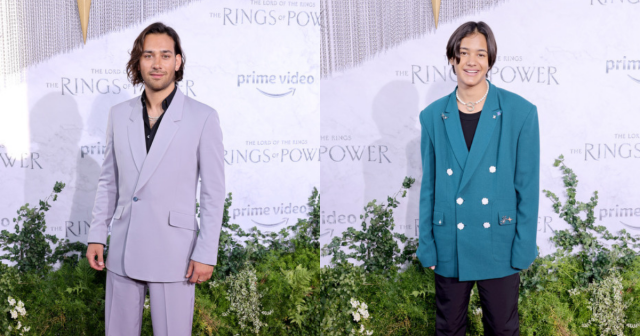
Please introduce your character and tell us why you are excited to be part of this series.
Maxim Baldry: I play a character called Isildur who is from the island of Numenor, which is a never-before-seen island that is like tall kings Atlantis, which is to the west of Middle Earth. You see it at the peak of its civilization. My character is a sailor who's got a strenuous relationship with his father and he's just trying to find himself. Maybe what he's doing isn't really what he wants to do, so there's a yearning for something else out there, and maybe it's not on the island.
Charlie Vickers: I play a character called Halbrand. He's a human from the Southlands and we meet him when he's at a point in his life where he's starting fresh, he's leaving his old life behind him. Then as the story unfolds, you see him question things about his past, about his future. It's really exciting to be a part of the show.
Tyroe Muhafidin: I play Theo who, much like Halbrand, is a human but also has a lot of questions about his past and his future. He lives in the Southlands and isn't happy with the quality of life that they have and the fact that they are patrolled by the elves. The relationship that his mother has with an elf he's not happy with, and I think it is portrayed in the first few times we see him. But I think throughout the season, once he lets his guard down, we get to see the real Theo, and he's really just a sweet young lad who cares about his family and his home.
What were the challenges of filming in New Zealand with COVID-19 and everything?
Maxim Baldry: No challenges, really. New Zealand was functioning without Corona, which was a relief and a blessing because the world was a dark place during those years, we were filming, but New Zealand is built for Middle Earth. Everywhere you look, there's a beautiful landscape and scenery and it was inspirational for us, and for me, just to step onto whatever location I was on and just be transported into this Middle Earth world.
How did you prepare for your roles? Talk about the physical training and dialect coaching.
Charlie Vickers: Both Leith and Lara our dialect and movement coaches respectively, were amazing. I credit them with a huge amount of the work that I was able to do through developing the character. You work from the scripts obviously, but then you have the beauty of being part of something like this. You have endless amounts of source material to read, which I had a good crack at, but there's so much there that you could read forever, and never ever learn it all, but I'll try.
What was your reaction when you saw the set and the costumes and everything?
Maxim Baldry: I thought holy moly or what have we got ourselves into. I think a deep sense of gratefulness and I think the whole setup of the sets and the creative people, we were working with created a safe space for us to work in and just the attention to detail everywhere you looked. In my world in Numenor, there was even graffiti covered up by Numenor, which was just such a specific thing to create. Even in our costumes, things that you don't even see, but we know as actors are there, as our characters are there just deepen and create this richer kind of texture for the tapestry of the world that we're creating.
And going to New Zealand, what was the first thing you did when you were there?
Charlie Vickers: The first thing I did was probably go to the supermarket so I could get some food for our flat, but New Zealand was such an amazing country to spend two years in. There are countless amazing things that we were able to do traveling all over the North and the South Island, travel and spending time in nature was one of the greatest privileges for me because I think one of the greatest characters in the show is nature and they are also connected to the world around them. New Zealand is the best place in the world for that, for us to connect to the natural world.
Patrick McKay (showrunner, creator) and Lindsey Weber (executive producer)
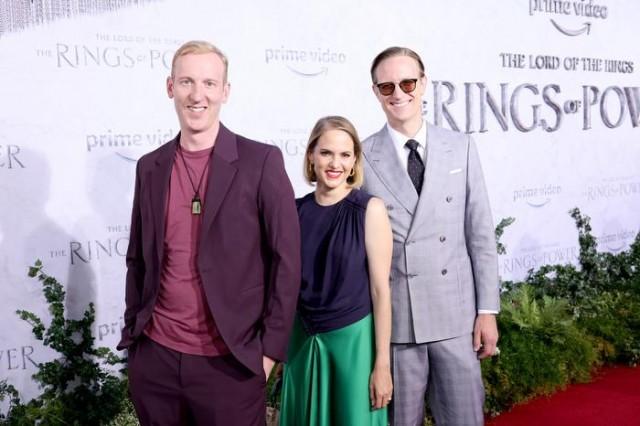
Patrick, can you please tell us why you decided not to do a spinoff or a side story about this?
Patrick McKay: Sure. So, J.D., my co-writer and I, have been working together for 25 years. We have an enormous love of great epics and imaginative worlds, because of that Tolkien's World and his work has been important to us all our lives as people and as writers. When we heard that Amazon had acquired the rights to Lord of the Rings, and were going to put together a show, we immediately raised our hands as loudly and as high as we could and just knocked on the door and knocked on the door until they let us in the room, because we felt that there was this incredible, never before film story in the books. That's this backstory to the Lord of the Rings, right? It's the story of the forging of the rings, the rise of Sauron, the epic of Numenor, the battle of the last Alliance, where the world banded together against Sauron, it's this incredible epic in its own right, that also happens to have some of the same familiar faces. Galadriel was around she's immortal. Elrond was around he's immortal, Sauron, obviously. We felt like, well, that's the show as fans we would want to see. What's unique about it as well is this was a place in Tolkien's work where he left a lot unsaid, and he left a lot of blank space in between these big tent pole moments. He wrote a lot in his letters about wanting to the aspiration of hoping that other minds and hands might one day add their own piece to the tapestry he was weaving. We reckon that this might be potentially a grand and ambitious way to do so and have been trying to be worthy of that ever since.
Lindsay, can you please talk about the challenges of filming this and producing it because there's a lot of expectations.
Lindsey Weber: There are a lot of expectations and that's something we definitely think about every day. People love talking and we don't want to let them down. But the good news about this show is I sort of imagined how hard it would be, but once you don't quite know how hard it's going to be until you're actually doing it. So, it's sort of bit by bit, they pitched me the show. Once I heard the pitch, it was just sort of undeniable. It was a story I wanted to see as a fan. I just wanted to help make this story that I believed in. We assembled an amazing crew and tried to gather the best department heads and crafts people and experts. We had the help of the Tolkien Estate, which was a really reassuring and special thing to have and tried to create an environment where all these brilliant artists who love Tolkien could do their best work. Then we just tried to put one foot in front of the other, every single day for hundreds and hundreds and hundreds of days and come out the other side and we're finally there. We're really excited for everyone to see what we've made.
Talk about the casting. I'm sure you saw thousands and thousands of people before you were able to choose the right cast. So how were you able to do that?
Patrick McKay: We had the privilege of working with an incredible casting director based in London, Theo Park. She has an incredible eye for talent, and we've got 22 series regulars. You saw the first two episodes and that's not even all the worlds. The third episode things expand, the fourth episode, you meet new characters as well. It really required us to find 22 extraordinary and special humans. The two criteria we had where someone who's excellent, someone who has middle earth in them. That's an inevitable thing.
You know it when you see it. As the casting process went on, we got to this place where we felt like Lord of the Rings is the star. We want to find faces that maybe aren't as familiar to audiences and let them really embody these characters. We made this show in New Zealand, where we were all sort of isolated on this island and it really did become this grand family, but we're so proud of this cast. They're amazing, can't wait to share them with everybody.
Building the set in New Zealand, talk about how challenging it was and filming.
Lindsey Weber: It was challenging. I think we used all the stages there were. We had seven across three facilities, seven stages, a tank. I don't even know how many hundreds of thousands of square feet locations, mountaintops, beaches, the whole thing. That for me as a producer, that's the challenge, but it's also the joy of it. There are very few properties where you get to play with all the toys in the toy box. This one has five.
Across all the worlds and its special effects and visual effects and stunts and locations and prosthetics and good acting and good writing and directing, which is also important, but it is an imagined world. So, you get to make everything and craft everything. It's not just one imagined world, in this show, it's five or six.
Patrick McKay: Every link of the chainmail that Galadriel wears, someone is handcrafting that.
Lindsey Weber: Putting jewels and aging it carefully bit by bit.
Patrick McKay: Every hair on the snow trolls' beard is put there by an artist, it's a labor of love, I want to bring it back to Tolkien because we found more and more. We worked on this project that this material is important to people. We had the privilege of working with all these incredible artists around the world, who love and want to honor it. I think that's a good way to help yourself keep the main thing. When you're putting hundreds of individual hairs on the beard of a snow troll.
Talk about the challenges of writing this dialogue and using religious text and poetry in doing it.
Patrick McKay: J.D. and I have an enormous love for language. We both very much come from a place of loving reading and loving the history of literature. Part of what's wonderful about Tolkien's work is it's this grand imaginative world, but it's also steeped in the literary tradition of the UK. You feel Milton in there, you feel of the Bronte's in there. The opportunity to write period dialogue was something we were really happy to take on. The more we worked with Leith McPherson, our incredible dialect coach. We started thinking about how each of these cultures should have their own way of speaking, where the minute you hear a line of dialogue you know where you are. That was another one of the great joys to add more detail and hopefully more history and texture. That's the way he did it. We tried to follow in his footsteps the best we could.
—MGP, GMA News

