

 GMA Brandtalk
 Tracking
 Archives

The Great Wall of China as a lookout to North Korea
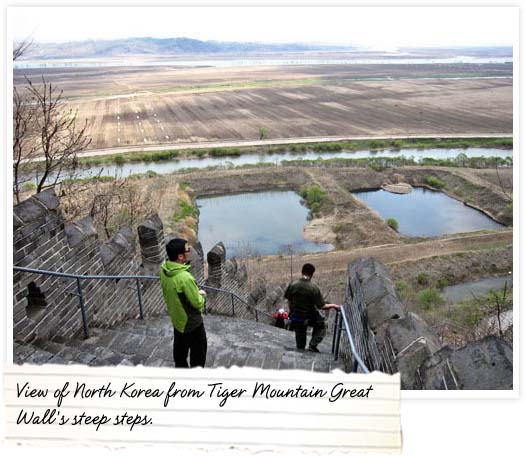
In ancient times, the Chinese people used the Great Wall to keep an eye on their enemies. Now, they’re using it to keep an eye on their allies, at least in Dandong anyway. Only the Yalu River separates the northeastern Chinese city in Liaoning province from the North Korean mainland, and Dandong capitalizes on a few sites that fuel people’s fascination with its reclusive, headline-grabbing rogue neighbor. According to official figures, Dandong gets 10 million visitors a year – not bad for a third-tier city that is not a familiar destination for many foreigners. 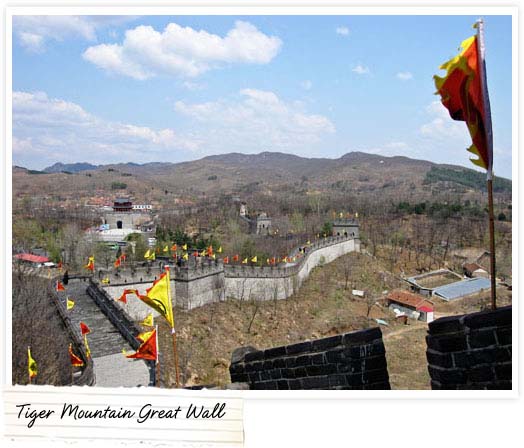 Most tourists flock to a section of the Great Wall that runs parallel to the North Korean border. The Tiger Mountain Great Wall, a 700-meter section of the 7,300-kilometer ancient architectural marvel, is only 20 minutes by car from downtown Dandong. From the wall (admission 40 RMB or P268), visitors can see a cluster of aging bungalows, people working in the fields, and a few farm animals on the other side of the river. Telescopes may be rented by tourists who want a closer look at the country that rules through an iron fist, and continues to provoke international sanctions because of their nuclear and missile tests. No first-time visitor leaves Tiger Mountain wall without setting foot on Yibukua – meaning, “one step across" – an extremely narrow part of the Yalu River. Only chicken wire fences off North Korean territory, so it’s tempting to make the leap across the water. But this is one of the sections of the border where Korean guards are stationed, so old hands caution tourists from approaching the fence even if they think no one is watching. The relatively uncrowded Tiger Mountain wall has a surreal atmosphere, unlike anything I’ve encountered in other sections of the Great Wall. (I’ve been to four others around Beijing, where I live.) Tiger Mountain seems to draw personalities as peculiar as their desire to “spy" on the North. There was the duo of middle-aged men who blasted disco music at one of the towers, encouraging people to dance to stay healthy; the married police officer on his day off who asked my travel companion for a date; and the young mother with her preschool daughter who was at a loss on how to descend the steep wall steps. She finally decided to walk backward to catch the girl if the child fell: a terrible, risky idea to any onlooker with sense. Ringside seat to history “Now I understand why they crossed," said my companion Du Ping, the granddaughter of a Chinese veteran of the Korean War (1950-53), during a boat ride along the Yalu River. She was talking about the two US journalists detained by the North Koreans in March 2009 and sentenced to 12 years in prison for illegal entry and “hostilities against the Korean nation." The women were captured in Yanji, another Chinese border city further north, while making a documentary about the trafficking of North Korean women to China. Having come this close to North Korea, Du Ping said she could imagine them thinking, “Maybe we can just have a quick look and then turn back." The journalists were released in August 2009, during a visit to the North Korean capital of Pyongyang by former US President Bill Clinton. In some parts of Dandong – like Huangjincao, a North Korean village on the Chinese mainland – the border fence is little more than a year old. Residents say the Chinese government erected the barrier around the time disarmament talks about the North’s nuclear program bogged down in late 2008. China was one of the chief negotiators in the talks along with the US, Russia, Japan and South Korea.
 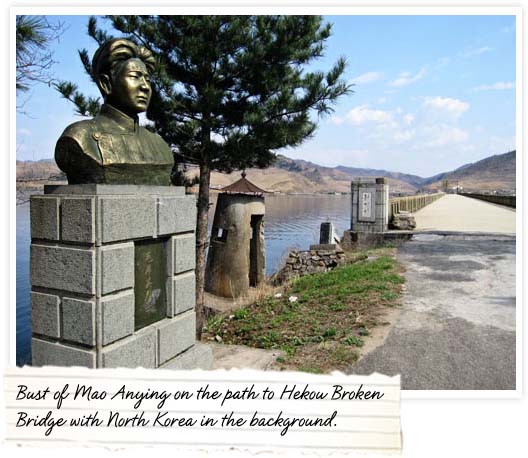 Fifty years ago, the Sino-Korean relationship was all about bridges. It was the Korean War and Peng Dehuai, considered one of modern China’s greatest military commanders, led his troops to the North on what is now called the Hekou Broken Bridge, located 60 kilometers from downtown Dandong. Among the men in General Peng’s volunteer army was 28-year-old Mao Anying, the eldest son of Mao Zedong, former chairman of the Communist Party of China and leader of the country’s communist revolution. On November 25, 1950, less than five weeks after the soldiers crossed the border, the young Mao was killed in a US bombing raid. Mao Zedong did not learn of his son’s death until three months later, said former BBC China correspondent Philip Short in his Mao Zedong biography, Mao: A Life. Peng sent Mao a telegram the same day the young man died, “proposing that he be buried on the battlefield, like all Chinese soldiers in Korea," Short wrote. Mao’s secretary received the telegram and “telephoned (Premier) Zhou Enlai, who contacted other leaders. They authorized the burial, but decided that, with the war at a critical juncture, Mao should not be told." A bust of Anying and China’s other Korean War heroes line the path leading to Hekou Broken Bridge (admission 10 RMB or PhP67), one of the two bridges that used to connect China and North Korea. Hekou bridge was destroyed when the US military strafed it to prevent food and military supplies from reaching the Chinese troops during the war. Made in North Korea How do ordinary North Koreans feel about all the scrutiny and the fascination of foreigners with them? Annoyance, envy, fear, amusement – or resignation? These questions went around and around my head the whole time I was in Dandong.
 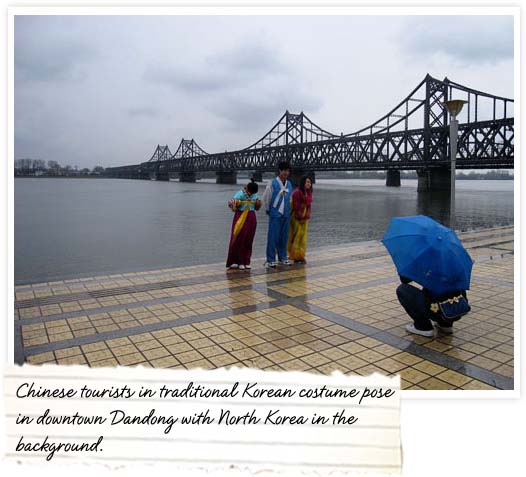 Even Dandong’s souvenir vendors feed on this phenomenon, plying goods “made in North Korea." Their stalls are piled high with cigarettes, compact mirrors, animal figurines, chopsticks and North Korean coins and banknotes. One female vendor said she obtains her goods through barter. In exchange for the items, the North Koreans ask for meat and “daily necessities," she said, adding that some of her suppliers had become friends through the years. Getting there Air China has daily one-and-a-half-hour flights from Beijing to Dandong. If you’re not in a rush, an overnight train ride from Beijing is a good way to get a glimpse of China’s northeastern countryside, formerly known as Manchuria. The train’s hard sleeper section (around 250 RMB or PhP 1674 for six people in two three-level bunks) provides basic necessities for a good night’s rest: a pillow, clean sheets and a duvet. Soft sleepers are double the price for a room of not more than four and a mattress. A taxi from downtown Dandong to Tiger Mountain Great Wall costs 40 RMB. You can also catch a bus from the city’s train station for 2 RMB (PhP13.40).
  On your way to Tiger Mountain wall’s exit, you’ll come across a family-run eatery, Nongjia Tese Xiaochi. Stop by for a meal if you want to taste real village cooking. It specializes in benji or “stupid chicken" – stewed chicken with mushrooms – and Yalujiang Heyu, fish from the Yalu River prepared any way you like. The chicken dish takes about an hour to make because family members first have to catch your chicken inside a coop, then sacrifice it in the name of sustenance. The chicken and fish cost 20 RMB (PhP134) for every half a kilo. The eatery owners, a Manchu family, accept lodgers into their modest home. For 15 RMB a night, a guest gets a spot on their kang, a sleeping platform made of fired clay with a cavity that channels the exhaust from a wood stove to ward off the cold in winter. Behind the house is a makeshift squat toilet, the biggest attraction of which is a view of the Great Wall while you answer the call of nature. – YA, GMANews.TV The author is a Filipino-Chinese journalist based in Beijing. She is fascinated with places steeped in history and culture, and is curious about those with a history of conflict.

