There is much to love about Paris, and love it in all seasons. You will climb the Eiffel Tower, visit the Louvre, gawk at the cathedral of the Notre Dame – these and more of the grandiosity that you see nowhere else but in Paris.
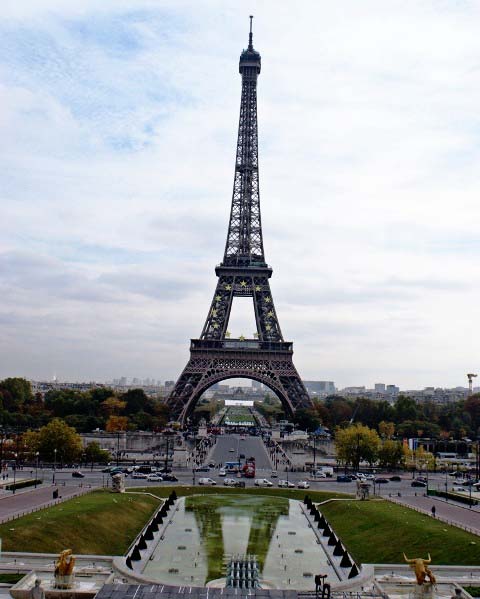
The symbol of Paris. No trip to Paris is complete without a visit to the Eiffel Tower. Christina Banluta
But there is also something to find in the small streets of this city made up of twenty
arrondissements, or districts, partitioned in the twirling shape of a snail, starting in the heart of the city by the River Seine. My world was on the Left Bank, further to the south of the 14th
arrondissement, a neighborhood of a familial atmosphere that does not frequently see the likes of tourists; it had everything that I needed to keep the lifestyle of a married Parisian couple as sane as possible. You can weave your own story of Paris by taking the small streets. You can lose yourself in them and discover that you are setting the pace of your own beat and tempo, a rhythm that will carry many surprises. When I trace my steps on any crisp day in spring, I usually start from the rue Daguerre. Here you can have most things of what constitute France: cafes, bakeries, a butcher, a cheese shop, vegetable and fruit stores, chocolate and ice cream shops, boutiques, florists, small supermarkets, and your typical
bar des amis at the corner. It comes to life mostly on Sunday morning, a frenzy of going about your chores in style. I’d have a drink in a café and read Le Monde leisurely after the usual marketing. I’d hang around for as long as I want ‘til brunch, feeling a bit pleased that I know a little bit more about the world from reading a French newspaper.
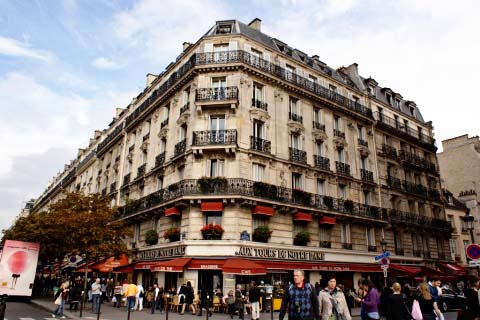
Leisurely days. Mornings can be spent enjoying a cup of coffee while reading the daily paper in a cafe such as this one near the Notre Dame cathedral. Christina Banluta
Otherwise my street expedition is rather simple: my goal on ordinary days is to bask under the sun in the Jardin du Luxembourg. From my apartment I take the shortcut through the Montparnasse cemetery, memorizing names on the tombs other than those of famous people. This place is so lovely when flower buds from the chestnut trees fall like snow. I prefer to snake my way through the back entrance of the
jardin by taking the rue Vavin, which has an array of chic boutiques catering to the bourgeois. I am drawn here by the
papeterie or stationery store, where I can touch all textures of papers, and a shop selling the authentic
savons from Marseille. Before I enter the gates of the park, I treat myself to a cone of
amaretto gelato if the queue isn’t too long. In Jardin du Luxembourg, I do what all Parisians do: I grab two iron-wrought chairs by the flowerbeds, preferably with a view of a statue. I sit in one chair and put my legs up on the other, and then I begin to choose which among the books I’ve brought with me I want to read according to my mood. Leaving the park at the end of the day is just as gratifying; I will take my usual stroll to a small corner of the Latin Quarter, which in the late 1960s was the hotbed of rebellion and has morphed into an enclave of the bourgeois bohemians, or
‘les bobos’ for short. I exit through the northern side of the park, into a street whose name always escapes me but which I know by heart, because it is an empty cobblestone that hears only your thoughts. I can’t help poking my nose at the glass windows of galleries that display things from India and other exotic countries, so far away for me then.
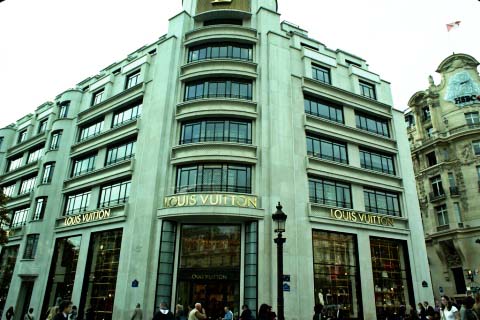
Designer indulgence. Haute couture in the heart of the city. Christina Banluta
And here I see my favorite church in Paris – the St. Sulpice, no thanks to Dan Brown for making it famous in his best-selling book and attracting the tourist crowd when it used to be solemn. There, I could spend time mesmerized by the mural of Delacroix. The fountain outside stands lonely and elegant, and from there I could watch the full moon rise through one of the twin towers of the square church. In the summer there is usually a bazaar selling potteries and ceramics. I end my day browsing through the English bookstore on the rue Princesse nearby, or window-shopping through the maze of trendy shops of independent designers. In my pre-married days, I stayed in the Right Bank, in the north opposite of the 18th
arrondissement, in the neighborhood of the artists in Montmartre – from where, on the steps of the cake-like Sacre Coeur church, you can see all of Paris. To avoid the madness of the tourist rush, I sit on the quiet steps of the rue Gabrielle, a short walk to where Picasso used to live, daydreaming. When I stroll down to the center, I am sometimes torn between pursuing Les Halles or the Opera Garnier. The former was the very first neighborhood I lived in Paris in the early ‘90s, right there by the rue Montorgueil that Monet had painted in the past century when Parisians gathered around here for the hustle and bustle of commerce. The energy of those days still pretty much linger in the place. The Opera Garnier is more in tune with solitude. The actual opera nowadays takes place in the Bastille, while the Garnier stands as homage to the French culture for which the government spent millions to renovate and to wash out the black soot from the stone building. I would buy a ticket for a tour with the singular intention of just sitting there staring at the dome, on which Marc Chagall painted his floating figures as if he were a child playing with colors on a vast sky.
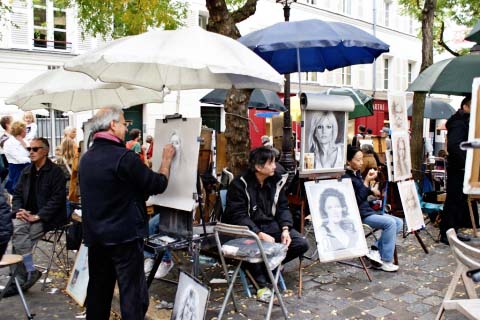
Etched in memory. One of the most popular souvenirs from Paris is your very own portrait done by one of the artists at Montmartre. Christina Banluta
In this district, ‘health bars’ serving fruit juice and vegetable sandwiches or pastas are beginning to sprout. I would grab a takeout before heading down to the Pont des Arts, cutting across the
parvis of the Louvre where the sight of the glass pyramid, which, despite the protests it had received, is one of the most brilliant architectural pieces ever. It sits there serenely, mounted in a landscape of intimidating stone-hedge buildings once occupied by the monarchs. I like to find my spot on the wooden pedestrian bridge facing the Louvre along the river bank, where people from all over the world sit with me – enjoying a picnic, singing, drinking, painting, sketching, kissing. By sunset, the Eiffel Tower looms at a safe distance, rather inconspicuously, but yes, breathtaking when its image strikes on the waters of the Seine, the cathedral behind me. This is where love blooms, like a spell. I have known couples whose fates were made on this bridge; I think that on the Pont des Arts you are confined to a narrow stretch across the river and yet being there at the center does not allow you to escape the splendor, making you feel you are a part of it, and tomorrow does not exist. Take this as a rough guide to a city that everyone dreams of seeing for the beauty it represents, and for the picture of grandeur. Look at it in other ways too: find your own magic when you walk through the unknown streets. See the Eiffel Tower from another angle, the Louvre from the outside, the Notre Dame as a backdrop. And I promise, you will love Paris wherever you go …
- YA, GMANews.TV After seven years in Paris, Criselda Yabes returned to Manila in 2006 to resume her writing career. Her latest book, Sarena's story: The loss of a kingdom, has just been published by the UP Press. 

 GMA Brandtalk
 Tracking
 Archives


