

 GMA Brandtalk
 Tracking
 Archives

ADVERTISEMENT
Filtered By: Lifestyle
Lifestyle
How I survived the Pondicherry tsunami scare
April 12, 2012. Pondicherry, India. What would you do if you were told that a tsunami was about to hit your seaside guest house —with you and all of your guests still in it? 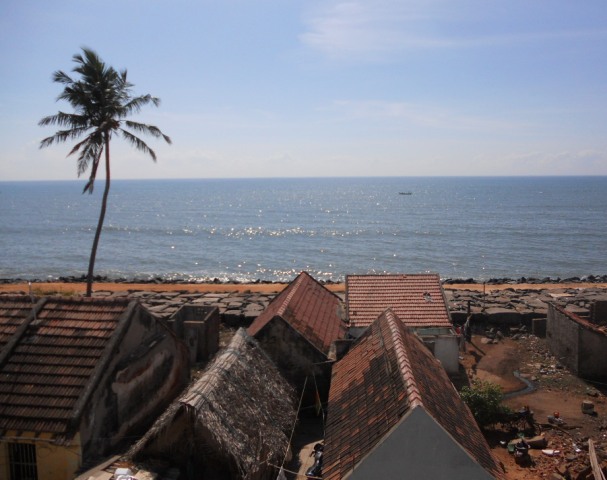
Photo: Eileen Paat
This was exactly the predicament we found ourselves in that Thursday at our little abode here in Pondicherry, a quaint former French colonial town on the eastern coast of India.
In less than two hours, according to the Indian Tsunami Center, my little piece of paradise that is the seashore in front of Mother’s House was going to be ripped apart by a 6-meter-tall tsunami—and there was nowhere to go.
But I’m getting way ahead of myself. This is how it happened:
2:35 pm The US Geological Survey reported than an underwater quake of 8.7 magnitude occurred some 33 km off the coast of Sumatra, Indonesia—or about 500km from the nearest big city of Bandah Aceh, Indonesia.
2:40 pm India’s coastal cities report slight, brief tremors of up to two minutes long. Most of these initial reports came from social networking sites like Facebook, Twitter, and SMS. Later, tremors were also reported from as far away as Bangkok and Singapore.
2:42 pm A tsunami warning is issued to 28 nations by the Pacific Tsunami Warning Center.
3:20+ pm I had just arrived at Mother’s House, one of several guest houses in the area rented out to visitors and devotees to Pondicherry City’s famous Sri Aurobindo Ashram. Both the guesthouse and the Ashram are located no more than 50 meters away from the coast.
Coming in from a long hot walk from the town, I thought it would be good to finally hit my bed for a quick nap. But suddenly, I heard a frantic clash from outside. I looked out of my window on the second floor to see a man walking down the road, banging on what looked like a tin pot lid.
I didn’t make much of him, surmising he was probably just announcing an upcoming street parade. But no sooner had I thought this when I heard a similar commotion coming from just around the street corner.
I then saw the guest house’s German manager, Regina, talking to the Indian couple occupying the house in front of ours. How neighborly, I thought. But she looked a bit agitated, which was quite out of the ordinary for her.
I stepped out of my room, and came across one of the Indian maids who regularly cleans the guest house. In a harried tone, she told me in broken English to close my balcony door and all my windows. I was a bit bewildered, but decided to obey her anyway.
Pondering her unusual request, I walked down the stairs to talk to the manager. “Regina, what’s going on?” I asked. “Why do we need to close the windows and doors?”
And she just calmly said, “Because a tsunami is coming. In 30 minutes.”
3:30 pm After Regina’s heart-stopping announcement, I managed to tell her that we needed to move everyone to the top floor of our four-storey guest house —an idea which she had already considered.
Since Pondicherry has weathered several strong earthquakes and typhoons, it was comforting to know that she knew how to act when faced with a potential disaster.
I followed Regina to the guest house’s basement library, where I volunteered to keep tabs on the outside world through the facility’s laptop. But the computer was far outpaced by everyone else as they secured everything against the threat of rising seawater.
And with nothing but the Bay of Bengal standing between Pondicherry and the quake epicenter, it was a very real threat indeed.
3:35 pm I climbed back up to my room to get my most prized possession: a bag of groceries! If it took the waters a day or two to recede, at least I would have something to eat.
On the way up, I ran into Columbe, my French neighbor and trip buddy. Trying to contain the panic in my voice, I told her to close her windows and doors, and to prepare for the tsunami. At the time, we had no idea how big the wave could be and how fast it would arrive.
I told Columbe that I couldn’t get online. It was a good thing she had her iPad with her. This was our lifesaver during those grueling moments and one of the fastest and most accurate sources of info we had!
3:45 pm After securing my room, Columbe and I met at the ground-floor dining area. She had already turned on her iPad to search for news. The first info that we got was that the quake off Sumatra hit 8.7 on the Richter scale. My heart fell, as I realized that the 2004 earthquake was of almost the same magnitude. And, worse, Reuters had quoted the Indian Tsunami Warning Center as having said that the eastern shore could be hit by a wave as high as six meters!
3:50 pm Online news alerts warned that a tsunami was likely to hit Chennai City —just three hours’ drive away from us— at 4:57pm. Our hearts sank… But at least we had time to prepare. We gathered up all our valuables, especially our passports and money, and stored them in our manager’s safe.
Columbe’s brother had been calling her frantically, urging her to leave for town and to find higher ground. But I told her that there wasn’t much higher ground anywhere to speak of in town. Besides, I thought to myself, 30 minutes couldn’t get us far inland anyway.
As for Pondicherry, the tallest building I knew of along the coast was a derelict lighthouse dating back to the 1700’s.
I decided on staying in the guest house because I was confident it could withstand the flood. Regina told us that, during the 2004 tsunami, Mother’s House and a large portion of Pondicherry were spared; it was her personal belief that the place had its own spiritual protector.
4:00 pm Online news said that the Indian tsunami center predicted a 0.2-meter wave hitting Chennai and Pondicherry’s coastline. That’s a pretty small wave! The news made us heave sighs of relief.
By then, the other occupants of the guest house had arrived: an older Swedish woman with orange hair, and a distinguished-looking elderly Indian gentleman wearing a dhoti. We were all advised to bring our belongings up to the higher floors.
All this time, Columbe and I kept our eyes glued to the online news. We read that Thailand’s Phuket Airport was closed to air traffic.
I remember Phuket very well; it was the most heavily-devastated island by the 2004 tsunami. I was actually part of a delegation that helped turn in some 1,500 bodies—still unidentified more than a year after the disaster—to the Thai national government.
4:10 pm Finally, we got the announcement that we were longing to hear: “There is no likelihood of a tsunami in the Indian Ocean,” reported the National Disaster Management Authority (NDMA) of India. The US Geological Survey also added that there was no tsunami threat for Indonesia as well.
We were saved.
On our way to dinner that evening, we eyed the long-tailed fishermen’s boats docked at shore and the line of Pondicherry policemen keeping an eye out for all-too-curious residents. But other than that, everything seemed back to normal—even though the kids, now free to play outside, were still waiting for something exciting to happen.
We celebrated our salvation with a sumptuous dinner of vegetable and prawn biryani. 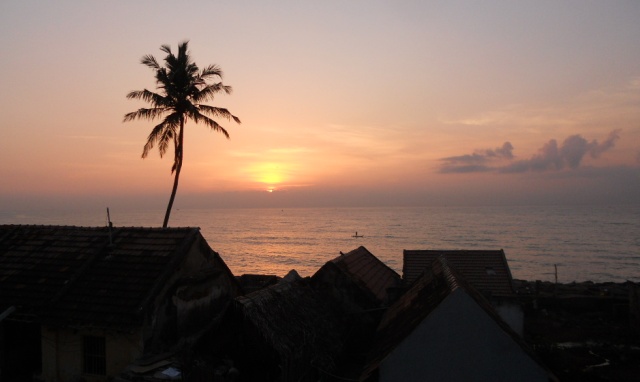
Photo: Eileen Paat
— TJD/KG, GMA News

