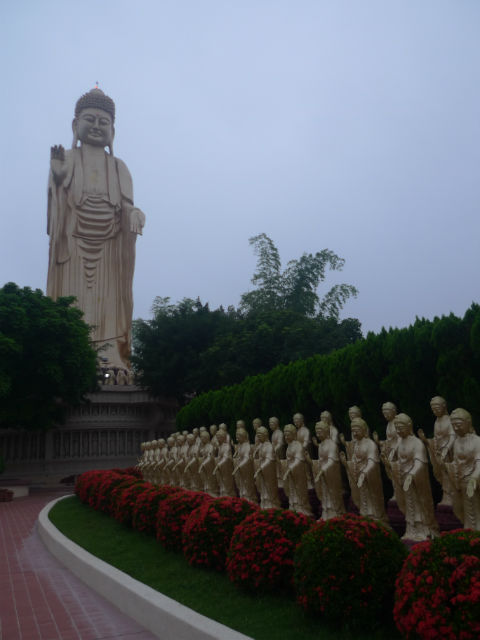
A giant Buddha stands watch over Great Buddha Land, one of the temple's gardens and meditation areas.
Taiwan has been gaining popularity as a destination because of its culinary haunts and tourist attractions. But it offers a different kind of R&R as well. Everyone knows about Taiwan’s night markets and burgeoning food scene, but what many are now discovering is that the country has a spiritual side that draws more and more people every year. The Fo Guang Shan monastery is in what was once a bamboo forest on a mountain in Dashu, Kaohsiung province. The monastery was established in 1967 by the Venerable Master Hsing Yun, with four goals: to propagate Buddhism through culture, to foster talent through education, to benefit society through charitable programs, and to purify the mind for Buddhist practice. I am not a Buddhist, but I have to admit that spending three days as a guest of the monastery left a profound impression on how these peace-loving people view the world. It’s certainly different from the type of Buddhism that I was used to. At Fo Guang Shan, everyone, especially the monks, who are addressed as Shi Fu, seemed to have an aura of calmness, like nothing could faze them, like they could want for nothing else in the world. There are direct flights from Manila to Kaohsiung. You can also get to the province in about two hours via fast train from Taipei. The first thing all guests realize is that Fo Guang Shan defies all expectations of what a Buddhist monastery looks like. It is insanely modern, with technology merging seamlessly with centuries-old traditions. All the buildings are built like Buddhist temples, grand and majestic, but not all of them are houses of worship. Some contain hostels, TV stations (the monastery has its own TV station and produces its own Buddhist-themed shows), and dining halls. Our accommodations, for example, had all the comforts of a small hotel, and was housed in a grand Chinese-style structure that also held the main dining hall where silent meals were served. The monastery also housed separate schools for boys and girls, a non-sectarian orphanage, and several restaurants, all called Water Drop, each one with a different vegetarian menu.
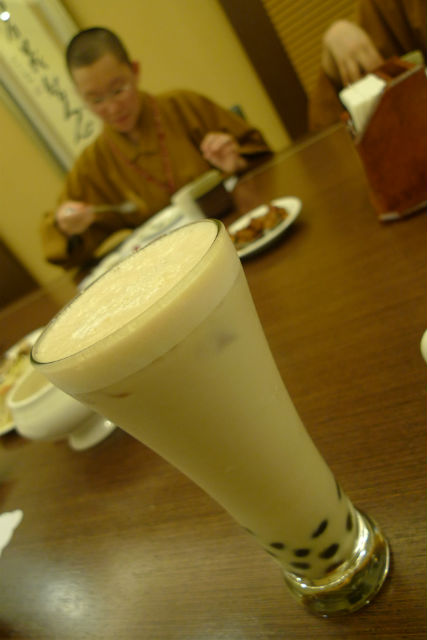
The Water Drop restaurant serves a variety of yummy vegetarian treats, including their version of milk tea.
All the restaurants in Fo Guang Shan and their satellite monasteries around the world are called Water Drop, from the Buddhist saying, “One drop of kindness will be paid back in ripples.” They serve vegetarian cuisine, but prepared in different ways, from traditional Chinese cooking to more Western fare. The food is delicious and of exceptional quality, the kind of vegetarian cuisine that will make meat lovers forget that they aren’t eating flesh. This ties into Fo Guang Shan’s philosophy of making Buddhism accessible, of appealing to the senses of the modern human in order to help them understand the Middle Way. As Buddhism is about being gentle to all living things, Fo Guang Shan has also made it a mission to protect the environment. You can see this philosophy being carried out daily, such as in the practice of offering plastic roses encased in tiny-heart-shaped containers instead of fresh flowers to Kuan Yin. After all, it is the intention that counts, and this way, not only do the flowers always look good, they can be reused the next day. The monastery is next to the Buddha Memorial Center. Opened in 2011, the Buddha Memorial Center is a shrine/tourist attraction that houses the world’s largest bronze statue of Buddha in a sitting position, and a relic—supposedly one of Buddha’s teeth—in the main shrine. The eight pagodas leading to the shrine house exhibits that are meant to take the visitor through the history of Buddhism. It’s not as boring as it sounds, because most of the exhibits are interactive.
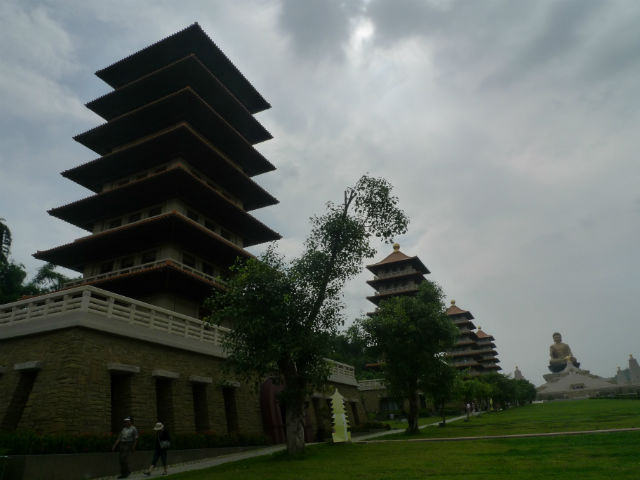
At the Buddha Memorial Center, eight pagodas lead to the main shrine, on top of which rests the world's biggest bronze statue of Buddha in a sitting position.
But to enter the Center, one must first go through the main hall, a large commercial area filled with restaurants and souvenir shops. Aside from the requisite Water Drop restaurant, there is also a Starbucks and a 7-11, both serving only vegetarian food. One can buy different treats such as mochi balls and tiny cakes, as well as jewelry, bags, and tea. The reason these establishments were put at the entrance of the shrine and not at the exit, as most museums and tourist attractions do, is because the Venerable Master Hsing Yun anticipated that many of the visitors would be devout Buddhist families who would bring everyone from babies to grandparents to what is both a vacation spot and a religious place. Visitors with young and elderly companions will want to make sure that their charges are comfortable first before they can explore the rest of the complex. It is easy to see why so many people are drawn to Venerable Master Hsing Yun’s brand of humanistic Buddhism. Watch the monks, acolytes, and even guests on meditation retreat and you will see a basic kindness, a dedication to doing what is right and humane, and a true following of the tenets of Buddhism. I know a lot of Buddhists and yet this was the first time that I had seen people who were genuinely true to its teachings. It was very inspiring.
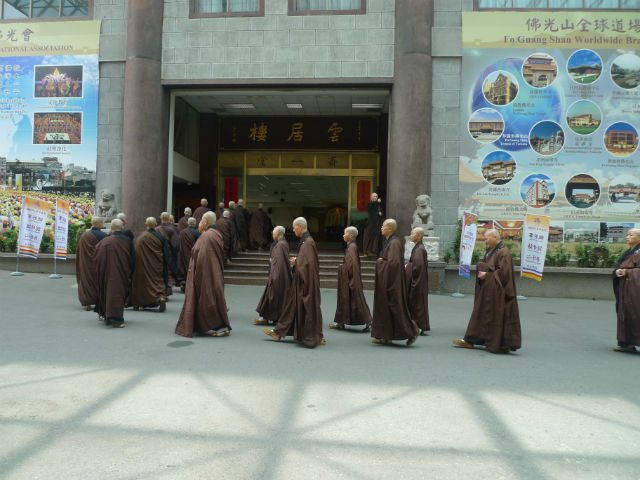
Monks walking single file into the main dining area, where meals are taken in silence.
Fo Guang Shan Philippines has branches in Manila and Cebu. Mabuhay Temple in Manila is a tall, glass and steel building across Century Park. The temple offers classes on different topics, from meditation to Mandarin, and does not require you to be Buddhist to attend. There’s also a Water Drop tea house that has excellent food and pretty good Wifi, a quiet place to while away an afternoon.
— BM, GMA News 

 GMA Brandtalk
 Tracking
 Archives


