

 GMA Brandtalk
 Tracking
 Archives

A day in Tripoli, the bride of the Mediterranean Sea
Libya, North Africa
My husband Alex and I count ourselves lucky to have been able to visit Tripoli, the capital of Libya, three months before the Arab Spring in 2011. Certainly the beautiful and peaceful Tripoli that we witnessed was a far cry from the chaotic city that was shown on TV towards the end of the Gaddafi Regime. Oftentimes we look at the photos that we took then, and reminisce about the serene oasis that was Tripoli, fondly called “the bride of the sea” by the locals because of its calm waters and balmy weather.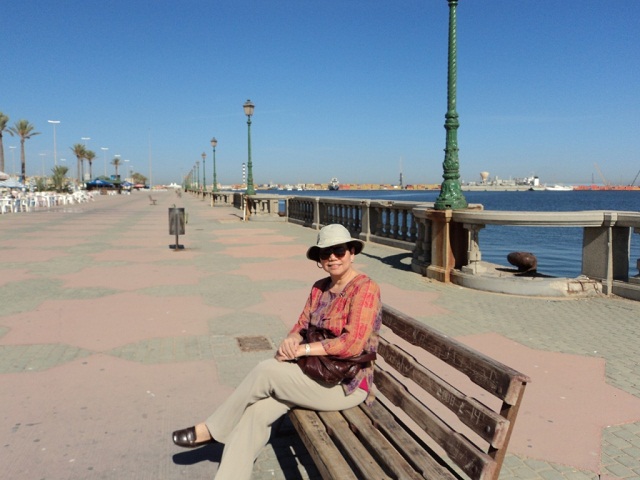
Good friend Al suggested that we start our city adventure along the boulevard, near the harbor. So one morning Alex and I, together with Al’s private staff Gina who was to be our guide, were dropped off at the esplanade by the sea, lined by tall, green lampposts reminiscent of Old Europe. It was a wide and long concrete walk beside turquoise waters, and from time to time seagulls cried out and swooped low. Various freighters slowly wound their way to and from the port nearby, a sign of active trade in the city. There were long benches too, that allowed promenaders to sit awhile. The breeze from the ocean was brisk and warm as we slowly traversed the pathway, shielded from the sheer drop into the sea by a low wall. In my journal I wrote: “At last, another glimpse of the Mediterranean, this time from North Africa!” Somehow it took some time for the thought to sink in: that we were really in Libya!
Crossing the wide boulevard we reached a grassy knoll with stone ruins, and noted the tall, red walls of what looked like a fortress. We went around and realized that we were at the entrance of Assaray al-Hamra Museum, also called the Red Castle Museum. This was the National Archeological Museum of Tripoli, started by the Italians in 1919, which slowly grew through the years. The clay used was reddish, hence the name.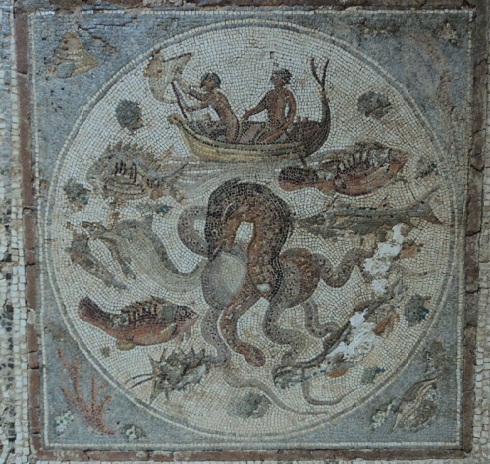 The museum was filled with many exhibits from the prehistoric period to the present, but what impressed us most were the mosaic floors made of tiny tiles depicting gods and goddesses, warriors, and animals. Many of them were well-preserved; some of these, including statues, were said to be taken from the ruins of Sabratha and Leptis Magna, two important excavations a few miles from the city that showed Greco-Roman influences.
There were about five floors of exhibits, and the most interesting of them was the display showing how Muammar Gaddafi brought the country to affluence and importance. Green streamers with Arabic words hung from the ceiling at regular intervals, and the green flag dominated the floor. Huge photographs of Gaddafi were everywhere, with other world leaders. Our only regret was that we didn’t read Arabic, because all the streamers and annotations in the museum were in that language.
We went out into the bright noonday sun, and found haven in a local burger store just across the street called Mo’men. Our beef and chicken sandwich wraps had colorful cardboard cases, which said the food shop's name referred to the Mo’men brothers who opened their first restaurant here in 1988, called “Heliopolis.” There were fries to be had too, and iced sodas.
Walking back to the area near the museum, we found the Ottoman Clock Tower. It was painted white, and because it was tall, it would become one of our landmarks, together with the green-and-white minaret of a nearby mosque, for orientation as we walked around. Just a few steps away was the Old Market, the El-Madina El-Kadima. Ah, the local bazaars, called souqs! My pulse quickened as I saw the labyrinthine paths, each side lined with overflowing silk dresses, veils, cloth material, men’s clothes… Going into one of the shops that sold veils, I touched the gossamer and lacy ones. Some were so soft, silky and so feminine that I suddenly wanted to wear a veil myself!
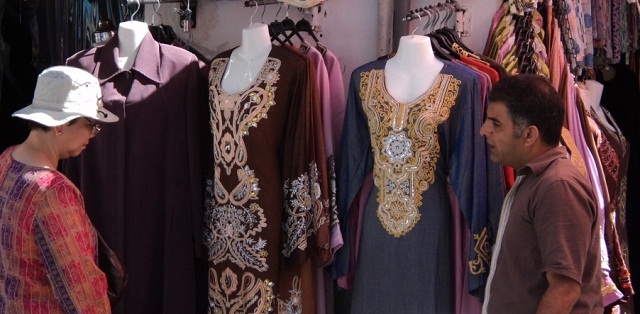
Gina looked for embroidered tablecloths in another shop, and we were shown so many variations in varied hues, some of which even had gold and silver threads running through them. Another shop sold dresses which were very modest, long-sleeved and floor-length, like loose robes. Some had fully-beaded bodices, almost like evening gowns, and in all colors imaginable.
Most of the local women in the souq wore black robes, with different colored veils to cover their heads. Some of these veils not only enclosed the face, but also the noses. Some very conservative ones even had their eyes covered by a fine mesh. A few young ladies though, with Kohl-lined doe eyes, had slim, attractive figures, which even the severest of black robes could not conceal. It could be the cut of the robe, a bit fitting on the hips, perhaps? Or the attractive high heels that they wore, and the Prada bags that they toted, their heads high and imperious, even when covered from head to foot?
Spices too were sold in large open bags, their aromas filling the air. Gina was able to identify a few: cinnamon bark, rosemary, sage, and thyme. Just off the corner were traditional medicine shops; in one, an entire leopard skin was attached onto the low ceiling, the animal’s tail nonchalantly hanging down into the cash register. And as we emerged from a small alcove we were greeted by an explosion of colors from a pottery shop that also sold glazed plates and leather saddles. We needed time to look at the wares slowly, savoring the fine details.

When we turned into another area, we gasped at the sight: rows upon rows of gold jewelry: thick ropes of coiled gold necklaces, filigreed bangles and earrings, some studded with semi-precious stones, some anklets too, and rings. An entire street filled with jewelries, all for one’s picking!
Do we still have the energy for one more souq, Gina smilingly inquired. Alex and I of course said yes, and we went to a more modern mall, the Souq Talat, about 20 minutes by car from the Old Medina. “Talat” means Thursday, just before the day of prayer on Friday. The mall used to open only on Thursday, Gina said, for people to stock up on food supplies during the Islamic weekend (Friday and Saturday).
Indeed the modern mall was air-conditioned, and was a huge concrete building four stories high. We went through the grocery area and gasped at the huge array of pastries in their bakeshops. On one of the shelves, there were small bottles of honey with different nuts immersed in them – almonds, sesame, and watermelon, to name a few identifiable ones. They looked very colorful and strange, and seemed perfect pasalubongs. At the second floor there was a perfumery shop that would mix your desired scent from the many essences that were available. The colorful display of crystal flagons containing the aromatic oils was enough eye candy for passers-by like us.
It had been a long day, and when we were at the third floor looking at the fully-beaded robes in one of the dress shops, severe exhaustion hit us, and we had to sit down on one of the benches to recover. Gina, ever ready and kind, said it was best for us to hail a car to take us home. It was also getting dark. – YA, GMA News

