

 GMA Brandtalk
 Tracking
 Archives

The splendor of St. Peter's Basilica in Rome
One early spring morning while in Rome, my husband Alex and I found ourselves looking for the #40 bus from the Termini, the big transportation hub which was just a 10-minute walk from our small hotel along Via Calatafimi. This public coach was to take us directly to the Vatican City, a place which had been on our wish list for so long.
Safely ensconced in the bus, we felt like locals even if it was just our third day in the Eternal City, as we noted how it quickly filled up, mostly with men and women who seemed preoccupied with the workday ahead. Such a contrast, indeed, with the few tourists who looked hither and yon, chattering among themselves. From time to time carefree laughter burst out from these small groups, who like us, were excited to discover the Vatican.
We went down at a fermata (bus stop) along Via della Conciliazione, a long avenue built by Mussolini during the 1930s to connect the Vatican to Rome. As we alighted I immediately beheld the sight at the end of the long road: the Basilica of St. Peter, with its familiar dome and pillars. Indeed, I had to blink several times and breathe deeply as I looked and looked. This basilica of the Vatican, often seen on television, magazines and books, was finally before us, ready to be explored. Alex put his arms around my shoulders, and smiled; we had to stand there for a while, just soaking in the view.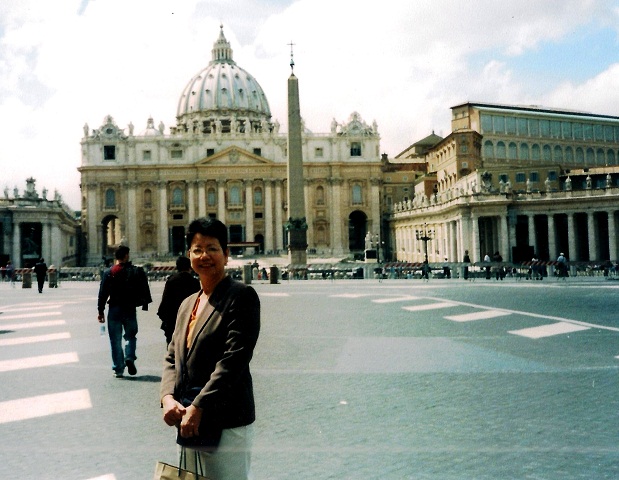
We reached the piazza of St. Peter, and what joy to be standing there before the beautiful basilica, with the rows of colonnades, four columns deep, made by the sculptor Bernini. The columns stood in a semi-circle, forming two long welcoming arms enclosing the piazza, as if embracing all pilgrims that came to visit. One hundred and forty images of the saints stood solemnly on top of the façade of the basilica and the colonnades. The four thousand-year-old Egyptian obelisk at the center of the plaza, made of red granite and supported by bronze lions, stood more than 40 meters, and was flanked by two fountains. Criss-crossing lines on the ground seemed to indicate that the obelisk could be used as a sundial.
Since it was a Tuesday, seats were already readied for the papal public audience the next day, a Wednesday. The immensity of the place gave us pause, and just standing among the colonnades and looking out into the sunlit St. Peter’s square made us feel so small and insignificant. The Swiss guards, young and handsome in their colorful military outfits, stood tall and alert, oblivious to our gawking.
We entered the basilica and a sense of awe enveloped us. Well-lighted with a high ceiling, we were immediately drawn to the light coming from Michelangelo’s huge dome, said to be 120 meters high from the marble floor, and 42.3 meters across. The upper vaults had paintings framed with gold leaf, and the visitor’s eyes were naturally drawn up into the dome. Natural light too, came in from high windows, aided by light bulbs placed strategically near the cornices.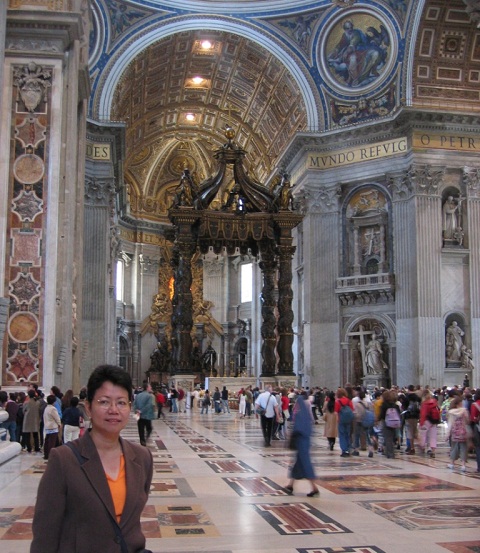 But what drew our attention most was the baldacchino, or the bronzed, heavily ornamented canopy that covered the raised marble altar at the center, reserved for the Pope’s use. It was the only dark-colored monument in the otherwise all-white basilica interior. Below this altar was supposedly the tomb of St. Peter. The baldacchino was supported by four 66-foot high, spiral pillars at each corner, resting on marble plinths. This was another Bernini creation in 1633.
Going around we found numerous marble statues in sunken niches on high ledges, and so many paintings on the ceiling, until we started to have painful cricks on our necks for gazing up too long.
We reached the famous Pietà of Michelangelo at the right side of the entrance. This was a marble masterpiece of our Lady cradling the dead body of Her Son after the crucifixion. What struck me most was not only the deep, quiet grief on her face, but also how lovely and young she looked. For someone who had a 33-year old son she didn’t look a day over 20. Our guidebook told us that Michaelangelo took the liberty of portraying the Virgin Mother as a young girl to remind us of her beauty and purity. The soft folds of her robe, and even the fall of the loin cloth of Jesus, looked so natural one could almost forget they were made of marble. The muscle definition, too, was incredibly life-like. The whole sculpture was now covered in a thick glass case, after a vandal hammered off parts of it, in 1972.
There was an elevator that led to the walkway inside and around the dome; one could then ascend some 400 steps more by foot to reach the outside ledge of the dome, and be rewarded with a panoramic view of the piazza of St. Peter, and the near environs. Indeed, this reminded me of Dan Brown’s "Angels & Demons," when the pope, in the novel’s dramatic end, stood on this ledge at the dark of night; around him were swirling rain, lightning, and thunder.
A good friend in Manila advised us to get souvenirs from a shop called Canova, one of the countless stores along Via de Conciliazione. We found one that sold religious articles: rosaries, prayer books, missals, and large wooden and plaster images, including chalices and priestly garbs. But it was not the only shop in the area. More lined the long street, and we discovered less expensive but equally exquisite rosaries and small crucifixes at the Libreria Editrice Belardetti where we met Evelyn, a Filipina shopkeeper from San Pedro, Laguna. She came in twice a week, she said, and the work was not that difficult. There were days though, that she was kept on her feet for almost twelve hours, especially during the summer season, when droves of tourists poured in. No, she had not been home for some time, and she missed her two daughters, whom she left with her mother in the Philippines. Her husband was working as a mechanic in the Middle East.
The same Instituto Cervantes de Manila friend advised us to look for Pizza Rustica, a restaurant she used to frequent when she stayed in Rome for several years. We chose a Pizza Margherita, surprised it was rectangular, and ate standing up. I noted too, that the locals ate their pizzas like a sandwich: the large slices were folded unto itself, the toppings in between the slices of the flatbread.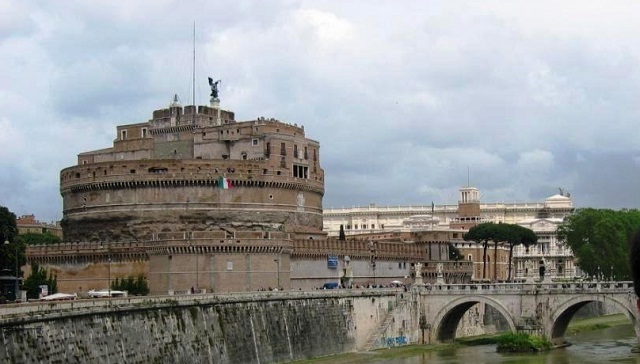
Continuing on our way, we reached a point where we finally saw the Tiber River up close, and one of the bridges that spanned it, the Ponte Sant’Angelo. Many statues of angels, all masterpieces of Bernini, dotted the bridge, and their robes flew about them with such grace. They were made of marble, but looked diaphanous.
Just across this bridge was a massive, round fortress-like building with a flag unfurled on top, and a statue of an angel with a raised sword. We discovered that this was the Castel Sant’Angelo, which started as a mausoleum built by the emperor Hadrian for himself and his family. It was said to have a secret, underground passageway to the Pope’s residence, in case of emergencies. The view from the bridge itself was enough to make us slow down, and simply enjoy the rest of the day strolling along the banks of the Tiber River, breathing in the cold spring air of Rome. – YA, GMA News

