

 GMA Brandtalk
 Tracking
 Archives

Exploring Angkor’s elephant terraces and jungle temples
My husband Alex and I were in Siem Reap, Cambodia – in the area of Angkor Thom, with our kind tuktuk driver Po Lit. We were traveling along the quiet countryside, when Po suddenly stopped and pointed to a grassy area not far off. At first we could only see a raised stone platform, with tall columns guarding the gray walls. We got out of the vehicle and slowly walked towards some structures that looked like ruins. The long columns turned out to be elephant trunks, and the pachyderms were standing in a row, as if guarding the stone staircase leading to the upper terrace.
We were at the Terraces of Elephants, a previous Royal Grandstand of King Jayavarman VII, who built the complex at the end of the 12th century. The place was used as a ceremonial area, where the king stood on a platform to receive visitors and his victorious returning army. In the courtyard below, elephants were trained. Spectacles were performed here too, with musicians and dancers. Made of wood for the most part, much of the grandstand did not withstand the ravages of time. But what remained was breathtaking: the stone walls, about 300 meters long and 2.5 meters high, were filled with bas-relief carvings.
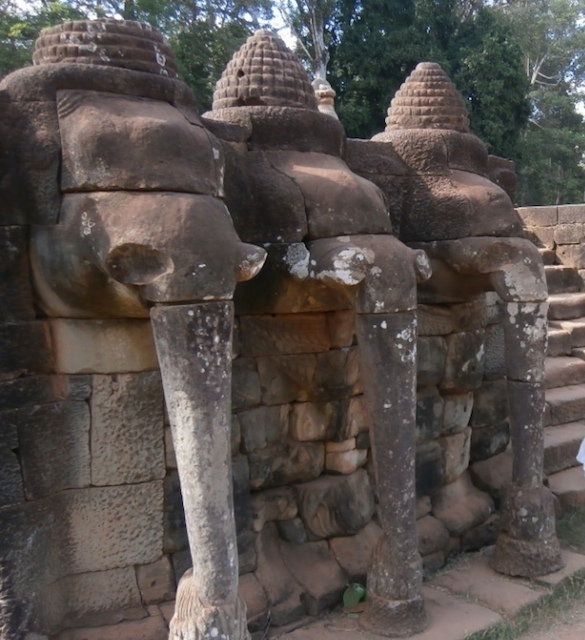
There were sculptures of elephant parades with their mahouts (trainers), elephants with lotus flowers on their trunks, and horses with warriors holding spears. In one section there was a succession of fierce-looking garudas (mythological man-lion-eagle creatures). Their eyes were huge and threatening, their teeth sharp and menacing, their clawed arms raised and holding arrows.
At the upper levels were lions on their haunches looking straight into the horizon, as if guarding against an invasion. Another part held life-size Khmer warriors and dancers, exquisitely carved in the massive wall. Nagas – those large, many-headed hooded snakes not unlike the cobra – which were symbols of royalty, were rendered in stone too.
As we stood on the ramparts of the stone terraces, it was not difficult to imagine how busy the courtyard below could have been. The grassy plain might have been filled with Jayavarman VII’s subjects going about preparing for religious feasts or ceremonial parades; the mahouts training the elephants for combat or for hunting in the nearby dense forest. But that was during the late 12th, or early 13th century. Most parts of the pavilion were already in ruins, and many massive cut stones were lying about. And yet even with the terrace alone, there was an energy in the air, and one could still feel the pomp and splendor of the bygone era.
Po Lit smiled as we recounted our reactions to the beautiful Terraces of the Elephants. He said something as intriguing was coming up, but he kept us guessing.
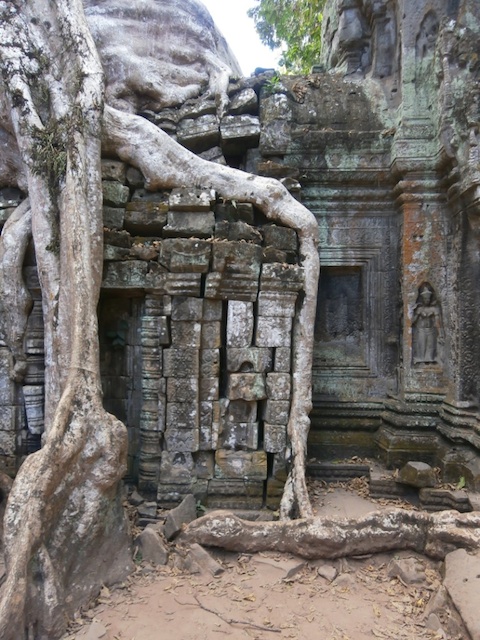 A short ride away was a carved entrance, obviously to a temple. We were almost at the edge of the jungle, with many huge ancient trees towering over us so we were in the shadows, and the temperature suddenly turned cool. A few paces after the carved entrance, Alex and I could not help but gasp. A temple gallery was almost engulfed by the roots of an enormous banyan tree. The roots looked like gnarled feet encircling the roof and doors of the ancient stone building, and it was difficult to separate tree from temple. We simply stood there and let awe take over.
We were at the Ta Phrom Temple complex, the iconic “jungle temple” of Angkor Thom. This temple was also built by Jayavarman VII, mainly for his family’s use. Also in similar Bayon style (stone faces carved on temple walls), scholars said that most of them looked like the king’s mother and elder brother. The temple complex was left abandoned after the 17th century, and it seemed as if the jungle simply took over. When it was discovered during the early 21st century, conservators saw the beauty of the fusion of nature and man, and the jungle’s attempt to subdue man’s dominion over nature. They left the temple as they found it, and did not clear the area of the trees. Through the years, both the silk and banyan trees grew large, their roots digging deep into the soil regardless of temple roofs and doors, so that parts of the trees were incorporated into the stone structures, as if they grew together.
As we went around, the atmosphere became eerie, what with the huge banyan trees, their large, brown vines dripping from their branches, seeking sustenance from the soil below. The banyan trees reminded me of stories I heard as a child in Iloilo, of tamawos (fairies) living in these lunok (as we called them in Hiligaynon) trees. The unearthly creatures lured humans, especially those whom they fell in love with, into the trees where they were enticed to partake of tamawo food. Once they ate the fairy food, the humans could never again return to their world. Surrounded by these ancient trees, one’s imagination ran wild, and I had to walk fast and keep up with Alex.
There were man-made wooden platforms that visitors could climb to reach the middle of the tall trees. Dangerous areas were roped off for safety reasons, and some people were clearing the grounds as we went around. Buddhist carvings of meditating images adorned some walls, especially at the entrance of galleries.
Most people might remember Ta Prohm as the setting for Angelina Jolie’s Tomb Raiders (Lara Croft) movie. Indeed there was a strange atmosphere all throughout the temple site. When we were about to leave, I saw a small tendril of tree root slowly coiling its way on top of a temple roof. How long would it take before this temple got devoured? Nobody knew, but slowly and surely, roof and root shall be one. – YA, GMA News
Alice M. Sun-Cua is an award-winning poet and travel writer. Her latest book of travel essays, 'Autumn in Madrid,' was launched last June and is available in local bookstores.

