

 GMA Brandtalk
 Tracking
 Archives

ADVERTISEMENT
Filtered By: Lifestyle
Lifestyle
At the River Spree and Die Mauer (The Wall) in Berlin
My husband Alex and I were in Berlin one sunny spring morning, and we woke up to a large family bedroom at the Bax Pax, a newly-built hotel along #28, Ziegelstrasse in Mitte, a district in former East Berlin. Construction was still ongoing in some floors, and I found the smell of fresh paint and concrete invigorating, as they were portents of things new, and exciting.
Indeed when we looked out the window, we saw the Fernsehturm, the needle-like TV tower painted red and white, with its round, silver globe at the center. It was said to be the tallest structure in Berlin, at 368 meters.
That morning we decided to follow the River Spree as it meandered across the German capital city. Starting from Friedrichstrasse just off our hotel, passing by sober, grim-looking buildings which were remnants of the old regime, we crossed a bridge and reached the island formed by a bifurcation of the river.
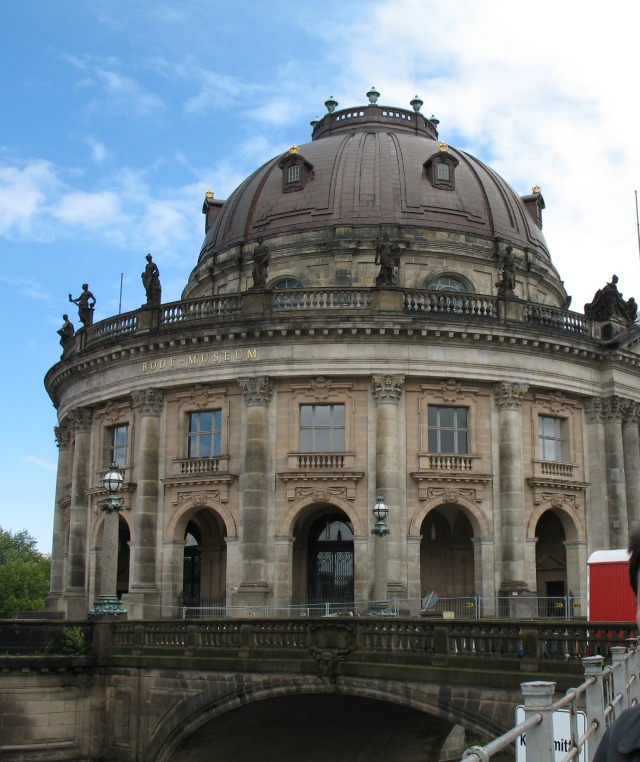 There were five museums in this Museum Island, and the most eye-catching was the Bode Museum, named after its last curator, William Bode. The building itself was constructed during 1904. It looked like a church, with its massive dome and fortified doors, and wrap-around porticos with many statues on top.
That morning we decided to follow the River Spree as it meandered across the German capital city. Starting from Friedrichstrasse just off our hotel, passing by sober, grim-looking buildings which were remnants of the old regime, we crossed a bridge and reached the island formed by a bifurcation of the river.
The Bode Museum by the River Spree
Walking further we reached one of Berlin’s most famous landmarks: the Berliner Dom, or Cathedral (“Supreme Parish and Collegiate Church”). We couldn’t help but stand in awe, beside a gushing fountain, and slowly take in its beautiful façade: at the center, a large dome; and on each side, towers with smaller domes. There were baroque decorations but clean long lines as well. Our guide book described it as “neo-renaissance.” The cathedral started as a Roman Catholic Church in 1454, but later became a Protestant church.
We had the chance to attend an ecumenical Mass that Sunday at the cathedral, with the homily given by a female Protestant archbishop, and received a brown, thick wafer as communion from a priest who concelebrated with her. The interior was lavishly decorated with paintings, tall marble columns, and swathes of drapes, with icons of Calvin, Zwigli and Luther, and stained-glass windows depicting bible stories. There was a huge pipe organ, and the Sunday Service/Mass had a full chamber orchestra and live soloists. That Sunday too, our very own Madrigal Singers were scheduled to sing during the evening service.
We had the chance to attend an ecumenical Mass that Sunday at the cathedral, with the homily given by a female Protestant archbishop, and received a brown, thick wafer as communion from a priest who concelebrated with her. The interior was lavishly decorated with paintings, tall marble columns, and swathes of drapes, with icons of Calvin, Zwigli and Luther, and stained-glass windows depicting bible stories. There was a huge pipe organ, and the Sunday Service/Mass had a full chamber orchestra and live soloists. That Sunday too, our very own Madrigal Singers were scheduled to sing during the evening service.
Further on the Spree had river posts, opening up as river boats passed through. We saw too, a few remains of the old Berlin Wall, not taken down even after its collapse in 1989, leading to the German reunification. They were reminders of how difficult life was, when Berlin was divided into East and West, and how East Berliners tried to escape toward the West side.
Some of the deep trenches, too, were preserved, and a few of the barbed wires. A plaque explained how ingenious some of the plans were to escape: ramming a border wall with a Trabant (a small Soviet-made car that became the symbol of the times), digging through underground sewers with bare hands, flying hot air balloons, jumping from third floor window apartments, and even throwing babies over into the West side so the infants could have better lives. The border guards of course, were merciless: they had orders to shoot anyone who attempted to defect into the West side. For indeed, the wall was erected by the Soviet-backed East Berlin government to “protect” the citizens from the “evils of Western fascism and imperialism.” They first used barbed wires, then through the years erected concrete walls with smooth pipes at the top so climbing over was near-impossible.
To complete the isolation, a death strip about 100 meters across was formed between two concrete walls, with guardhouses manning the borders night and day. From 1963 to 1989 then, many died attempting to escape. There was little communication between the two sides, although West Berliners could get passes and were allowed to enter the East side, but not vice versa. Many books and articles were written about the Cold War, which indeed made fascinating reading.

Some of the deep trenches, too, were preserved, and a few of the barbed wires. A plaque explained how ingenious some of the plans were to escape: ramming a border wall with a Trabant (a small Soviet-made car that became the symbol of the times), digging through underground sewers with bare hands, flying hot air balloons, jumping from third floor window apartments, and even throwing babies over into the West side so the infants could have better lives. The border guards of course, were merciless: they had orders to shoot anyone who attempted to defect into the West side. For indeed, the wall was erected by the Soviet-backed East Berlin government to “protect” the citizens from the “evils of Western fascism and imperialism.” They first used barbed wires, then through the years erected concrete walls with smooth pipes at the top so climbing over was near-impossible.
To complete the isolation, a death strip about 100 meters across was formed between two concrete walls, with guardhouses manning the borders night and day. From 1963 to 1989 then, many died attempting to escape. There was little communication between the two sides, although West Berliners could get passes and were allowed to enter the East side, but not vice versa. Many books and articles were written about the Cold War, which indeed made fascinating reading.
At the Berlin Wall's East Side Galleries, the author looks up at "The Brothers' Kiss" painting which shows Russian Premier Leonid Brezhnev and East Berlin leader Erich Honecker kissing each other on the lips.
Finally we reached the East Side Galleries, the longest (1.3 km) stretch of concrete walls painted with iconic and interesting subjects and graffiti. The paintings were made by international artists after the fall of the Berlin wall (this was the former East Side, and the walls were blank). Alex and I felt our hairs stand on end as we saw with our eyes the familiar (because seen in books and magazines) painting of Russian Premier Leonid Brezhnev and East Berlin leader Erich Honecker kissing each other on the lips (“The Brothers’ Kiss”), the “La Buerlinica” (a take from Picasso’s Guernica), and the “Viele kleine leute...” (Many small people..”) by an unknown African artist.
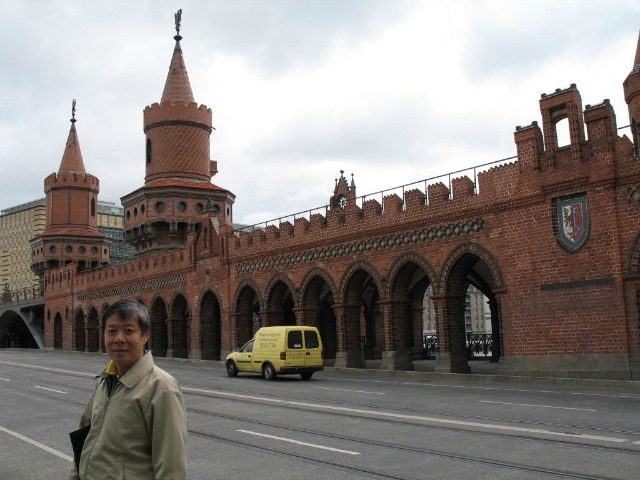
The Oberbaum Bridge
We walked further and reached a medieval looking two-level bridge, with turrets and pointed towers and flags. It was the Oberbaum Bridge.
We found ourselves in the Kreuzberg district after crossing it, a bohemian neighborhood with so many coffee shops. Alex and I succumbed, and entered a shop called Frühstückscafe. We ordered a set menu consisting of crunchy, chewy baguettes, dark nutty bread slices, salami, boiled eggs, strawberry jam, butter, and coffee.
The area too, was home to many diverse ethnic groups, and doner kebap (shawarma to us) kiosks abound. It was jokingly said that with the many Turkish immigrants (most of them now second and third generation ethnic Turks) the national food of Germany has become the doner kebap. We bought some fresh apricots and peaches from a kindly fruit vendor, who was curious enough to ask where we came from.
Slowly we wound our way back to the hotel, passing by neon-colored shops, bars, edgy art galleries with advertisements for rock concerts (the Kunsthaus Tachelese Art House with its graffiti and bold paintings stood out), dress shops, and many ethnic food shops and restaurants that marked the Mitte District. That night, we had the apricots and peaches for a light dinner, and went to bed bone-tired but happy. —KG, GMA News

