

 GMA Brandtalk
 Tracking
 Archives

ADVERTISEMENT
Filtered By: Lifestyle
Lifestyle
The Valley of the Fallen and a palace in Spain
It was a beautiful Sunday morning on a sunny spring day. My husband Alex and I were staying with our good friend Al in his fourth floor flat in Madrid; and it was, we felt, a good time to go out of the city. Why don’t we visit the Valle de los Caídos, I suggested, having read and heard about the place several times in the past. It was only about an hour’s trip by car from where we were, and Al promised a smooth drive. Indeed, the city was still asleep as we went on our way—almost no cars on the road, and so few people about.
The huge white cross was immediately visible as we rounded a bend in the road, and our reactions were of awe. The cross was huge, and glinted bone white under the bright sun. We went down in the parking area, and slowly walked toward the esplanade, a large courtyard surrounded by white colonnades curving in a half circle, with the main door at its center.
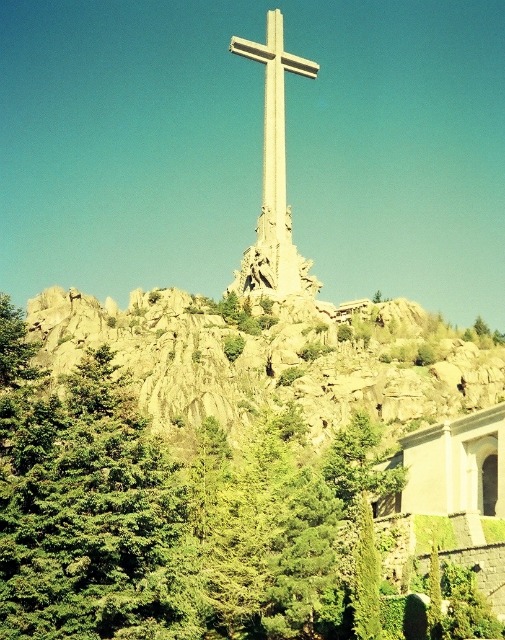 Above the entrance was a Piéta, the mother and Son sculptures looking small amid the massive architecture. At the foot of the big stone cross were sculptures of the four Evangelists, and the cardinal virtues. Both Piéta and the base of the cross were works of Juan de Ávalos. The cross itself rose 152.4 meters from its base, and could be seen as far as 32 kilometers away.
Pine trees grow in the craggy hills of the Valley of the Fallen or Valle de los Caídos.
Below this cross was a huge underground Basilica. Darkness met us upon entering, or perhaps the sun was too bright outside, our eyes needed some time to accommodate to the “tunnel.” It was chilly too, and dank. Perhaps it was the intentions of the architects (Pedro Muguruza and Diego Méndez) to evoke this eerie feeling, as the passageways were poorly lit.
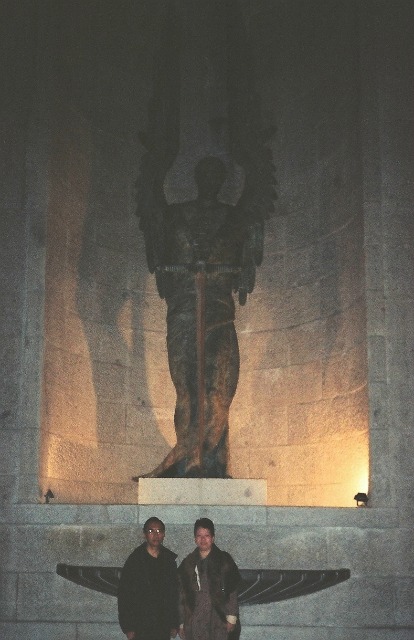
Just after the entrance were two huge metal art deco angels holding swords, backlit by yellow floor lamps. There was actually only one central nave, or aisle, all the way to the altar, the ceilings high and vaulted. Before the altar was a tomb, and we learned that this was the tomb of José Antonio Primo de Rivera, founder of the Falange Movement in Spain, a fascist organization. He was executed by the Republican government at age 33 during the early days of the Civil War (1936). Franco, on the other hand, was buried behind the altar, with the simplest of inscriptions on his tomb: his full name, and a cross. An ironic twist in history: Both share the same death anniversary day, November 20th, 39 years apart.
Just after the entrance were two huge metal art deco angels holding swords, backlit by yellow floor lamps. There was actually only one central nave, or aisle, all the way to the altar, the ceilings high and vaulted. Before the altar was a tomb, and we learned that this was the tomb of José Antonio Primo de Rivera, founder of the Falange Movement in Spain, a fascist organization. He was executed by the Republican government at age 33 during the early days of the Civil War (1936). Franco, on the other hand, was buried behind the altar, with the simplest of inscriptions on his tomb: his full name, and a cross. An ironic twist in history: Both share the same death anniversary day, November 20th, 39 years apart.
Art deco metal angel holding a sword at the entrance of the Basilica at the Valle de los Caídos.
The Valle de los Caídos, or Valley of the Fallen, enclosed about 13 sq. kilometers of woodlands and craggy hills at the foot of the Sierra Guadarrama. The complex included an underground Basilica, a Benedictine Abbey, and the cross, among others; the construction started after the Spanish Civil War, in 1940, and the place was inaugurated in 1959.
It was supposedly a monument for all those that died during the war regardless of political affiliation. Generalissimo Francisco Franco, the Spanish caudillo, envisioned a legacy in his memory, something that might equal the grandeur of time long gone. This site was chosen by him personally, a valley at the foot of the mountains northeast of Madrid, where several tall, craggy hills lent perfect possibilities for a grand memorial. Unlike the two tombs inside the Basilica, the 40,000 men and women who died during the Civil War were buried in the valley, outside.
Large areas of the stony hills had to be carved out, the Basilica underneath. But where did they find enough workers for this gargantuan task? And therein lies the controversy. Franco conscripted war prisoners to dig on the hard ground and haul huge boulders, day and night. These prisoners included political ones, especially those suspected to be communists.
Indeed many Spanish movies show this episode in the country’s history, where even writers and poets also raised pick axes to manually build Franco’s dream. About 20,000 prisoners in a span of 18 years passed through this hard labor “machine,” and several died in these mountains.
Indeed many Spanish movies show this episode in the country’s history, where even writers and poets also raised pick axes to manually build Franco’s dream. About 20,000 prisoners in a span of 18 years passed through this hard labor “machine,” and several died in these mountains.
We went out at the end of the basilica and found ourselves looking at the backside of the cross. Here we discovered a funicular, but inquiries told us it was no longer possible to go up the hill. So we contented ourselves with simply lingering around the gardens, thinking about those who gave their lives for this monument, and how, long after Franco’s death, controversies arose.
These included the transfer of his remains to Madrid, which brought debates to the Spanish Senate and Congress. When Zapatero lost the presidential reelection in 2011, the then-victorious PP (Partido Popular) scrapped the whole idea of refurbishing the façade of the basilica and the transfer of Franco’s remains.

These included the transfer of his remains to Madrid, which brought debates to the Spanish Senate and Congress. When Zapatero lost the presidential reelection in 2011, the then-victorious PP (Partido Popular) scrapped the whole idea of refurbishing the façade of the basilica and the transfer of Franco’s remains.
El Escorial, the palace initially built by King Phillip II in Spain to commemorate the victory of Spain over France in the war in San Quentín in 1557.
Historical palace
Since we were in the area, why don’t we visit El Escorial as well, Al suggested. So we went back into the car and drove over to the palace initially built by King Phillip II to commemorate the victory of Spain over France in the war in San Quentín in 1557.
It was indeed a huge complex completed in 1584 in less than 21 years. It was supposedly built on a gridiron plan, and contained a monastery, royal palace, mausoleum for kings and queens, museum, and school. There were four towers marking each corner, with the basilica and its dome at the center. Known for its austere style, the west façade where we approached it was made up of smooth walls interrupted by similar-sized rectangular windows. The Escorial was also the burial place of many Spanish royalties.
It was indeed a huge complex completed in 1584 in less than 21 years. It was supposedly built on a gridiron plan, and contained a monastery, royal palace, mausoleum for kings and queens, museum, and school. There were four towers marking each corner, with the basilica and its dome at the center. Known for its austere style, the west façade where we approached it was made up of smooth walls interrupted by similar-sized rectangular windows. The Escorial was also the burial place of many Spanish royalties.
There were so many visitors that day, and the queue to enter the palace was very long. So we simply walked leisurely around the grounds, looked at the edifices from the outside, and promised ourselves another visit for a more in-depth discovery of this historical palace. —KG, GMA News

