

 GMA Brandtalk
 Tracking
 Archives

ADVERTISEMENT
Filtered By: Lifestyle
Lifestyle
Mussels, fries, and beer in a medieval city
Bruges, Belgium
I learned about Bruges from the book “The Delicacy and Strength of Lace,” a collection of letters between poets Leslie Marmon Silko and James Wright. In it, James described his travel to Bruges, one of the cities in Flanders, the Dutch-speaking part of Belgium. He was moved by how the place maintained its medieval flavor and overall serenity, and how he discovered tiny, rarely trodden paths where even old men were busy, occupying themselves with lace tatting.
My husband Alex and I arrived in Bruges one late autumn morning. Seeing a belfry from afar, we followed it and found ourselves in the Grote Markt, or the “Big Market,” a huge square with shops and medieval buildings. The belfry was an 83-meter high structure built during the 13th century, and inside were 366 steps to the top that offered a panoramic view of the city. Inside this belfry was a carillon of 48 bells, and a regular carillonneur even gave free concerts on certain days.
At the center of this square were the statues of two local heroes, Jan Breydel and Pieter de Coninck, leaders of the revolt against the French in 1302. What was most interesting was the architecture of the shops and houses that surrounded the Big Market. Most of them had stair-like outlines at the top, which was described as “Spanish Steps” because the silhouette was said to be brought to the country from Spain. Beneath our feet were cobblestones, most of them original ones from medieval times.
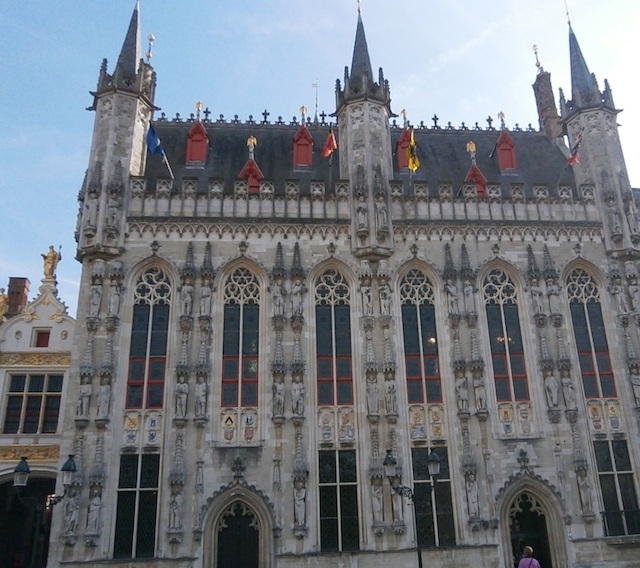
Walking around the other side, we found ourselves in a large open area called the Burg square. Here was the Town Hall, a white, castle-like edifice with colorful flags. It was adorned with gold trimmings, flowers, and leaves, looking more like a fairy-tale palace with turrets than a Town Hall.
Just off to one corner was a brown building with Gothic windows and an embellished façade. Gold statues adorned the spaces between the glass windows. This was the Basilica of the Holy Blood. Inside the church was a relic, a vial of blood said to be that of Jesus Christ, brought to Bruges by a Holy Crusader, Thierry of Alsace, from Jerusalem during the Middle Ages. Every year during its feast day, this relic is brought out in a procession around town. Devotees join the well-attended religious rite, dressed as medieval knights or crusaders. Underground was a Romanesque chapel, a bit gloomy and sad.
Alex suggested lunch, as we were both hungry. Our guidebook led us to one restaurant, Vivaldi, away from the tourist path.
Flanders has always been popular for their moule-frite, or mussels cooked in herbs and white wine with potato fries. The first time we tried this was in Lille, a city in Northern France, also in the Flanders area. The memory of those delicious hot mussels, and its lip-smacking broth, remained with us as one of the highlights of that trip.
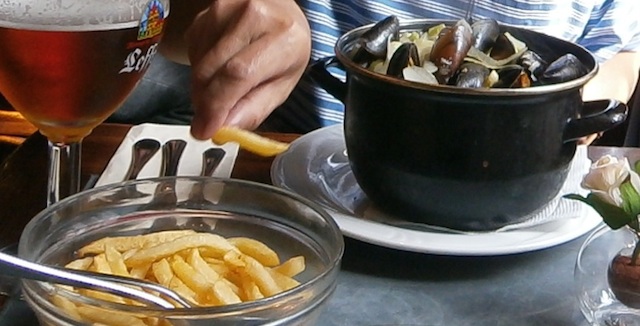
Now almost 20 years later, we agreed to sit down to another moule-frite lunch, this time accompanied by a walnut, peach and lettuce salad, and a 500 ml. cold Leffe beer for Alex. Again, we were not disappointed. The mussels were fresh, plump, and very sweet. Cooked just right to bring out its briny juices, with hints of garlic, onions, parsley, chili, thyme, cloves and white wine, each piece was a gustatory delight. We ate them slowly, from time to time looking out from the latticed window where the soft sunlight shone through. Out in the sunny street, horse-drawn carriages passed by, the click-clack of horse’s hooves making syncopated music on the cobblestones.
Replete with this nostalgic repast, we slowly went back to town, and saw what was once the St. John’s Hospital, a place for indigents during the late Middle Ages. At first glance it looked like a church, with its rose windows and its fully engraved pediment at the entrance. It was now a museum, and the current St. John’s Hospital had become a home for the poor and the aged, just outside the city.
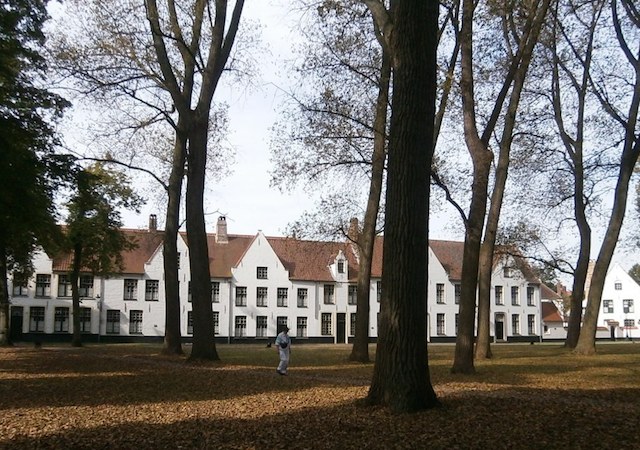
We were just in time to pass through the gates of the Beguinage, a row of white houses in a tranquil part of town. Tall spindly trees surrounded the houses, giving the place an ethereal feel. During the 13th century, a group of women, although not belonging to a religious order, decided to dedicate their lives to God. Thus started the Beguinage in Europe, where they accepted widows and single ladies into their fold. The members of this semi-religious order were given a place to live, which was later enclosed by a gate with specific times of opening and closing for their protection. They were active in charitable work, and in the Beguinage that we visited, they had the St. Elizabeth Church nearby. Each woman lived independently in her own house, but in a way belonged o a larger community.
Going around we felt the rich history of Bruges in the beautiful churches, like the Church of our Lady in Mariastraat, with its marble statue of the Madonna and Child by Michelangelo. Its tall 122-meter spire could be seen even from afar. During the late Middle Ages, Bruges was a rich Flanders city; trading was done through its waterways. Later it was known for its woven wool tapestries, and then, lace. As we reached the river we marveled at the picturesque houses, all looking quaint and medieval. Time seemed to have stood still. Along the smaller canals, the charm of the arched bridges, weeping willows and dappled sunlight took our breaths away.
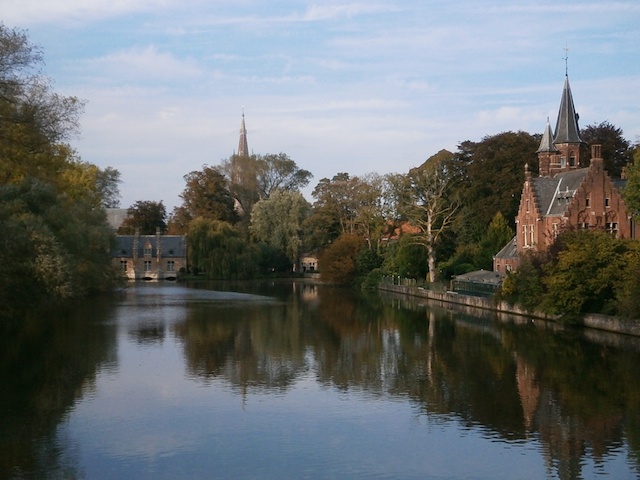
As we reached the bridge before crossing over to the train station, we looked back and gasped. A lake, called Lovers’ Lake, with a church spire and a quaint cottage were gathered before us as if in a postcard, their reflections on the water with the trees completing an unforgettable memento of our visit to medieval Bruges. —YA, GMA News

