

 GMA Brandtalk
 Tracking
 Archives

ADVERTISEMENT
Filtered By: Lifestyle
Lifestyle
By the River Scheldt in Antwerp
My husband Alex and I were in the city of Antwerp in the northern part of Belgium one early fall morning. The very first thing that we noticed after going down the train in the Central Station was the beautiful architecture of the train station itself.

The vaulted ceiling and marble staircase of Antwerp's Central Station
This station, built between 1895 and 1905 and designed by Louis Delacenserie, is 185 meters long and 44 meters high. We went down wide marble stairs to reach the waiting area, a busy but wide place that led out into the street.
It was drizzling when we reached the wide avenue outside. Immediately we noticed that most of the shops were jewelry shops. Antwerp is well-known for its diamonds trade, and indeed, as we peered through the well-lit shop windows, we were amazed to see so many beautiful diamond rings, earrings, bracelets and necklaces—and the gem in different cuts and colors. We could only exclaim with delight, pointing to this piece and that, when suddenly in one of the shops, a disembodied hand appeared and took the piece that we were pointing at. Without our knowledge, a smiling shop clerk was closely watching us inside, and as we seemed so enthused, she thought we were ready to purchase the multi-tiered diamond necklace that so intrigued us.
The wide avenue led to the central business district, and at the end of the road, we looked back and appreciated the Gothic train station in its entirety. Further were high-end shops selling clothes, bags and shoes, and Alex espied an interesting window display in one of the chocolate shops: a bride and groom ensemble, complete with a lacy wedding dress for her with flowers and a tux for him, but the betrothed were both skeletons!
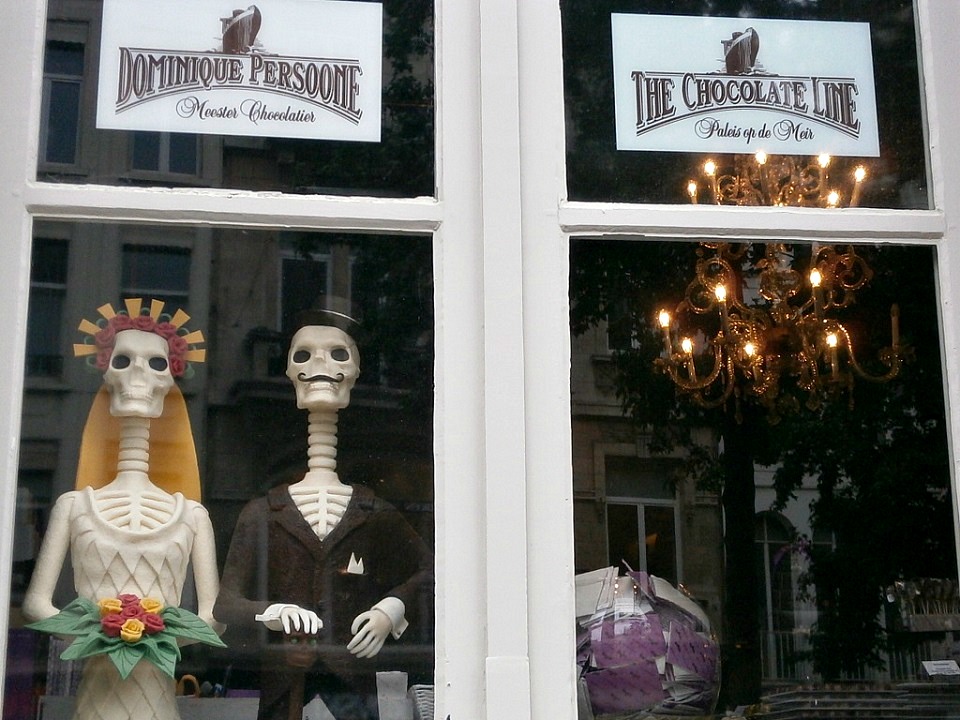
A quirky and fun window display
The original architectural plans though were not all carried out (only one spire was done) because of world wars, religious conflicts, fires, and financial difficulties. In its present form, the slender spire at 123 meters is considered the tallest in the Benelux countries, and could be seen almost anywhere in the city.
We paused at the door of the cathedral and gazed at the intricate carvings in its arches. Inside the cathedral were the precious paintings of Peter Paul Rubens, whose statue we saw at the plaza outside the cathedral. This famous painter, although born in Germany, lived and died in the city.
We walked further on and reached a big open square, and realized we had reached the Grote Markt (Great Main Square). In the center was a fountain with a statue created by Jef Lambeaux in 1887. It represents a mythical Roman soldier, Silvius Brabo. Local lore has it that a cruel giant, Druoon Antigoon, exacted money from those who crossed the river Scheldt. When one of them refused, the giant chopped off the hand of the recalcitrant citizen. Brabo fought the giant and killed it. As a sign of his victory, he lopped off the giant’s hand and threw it into the river. His statue holds the severed hand aloft.
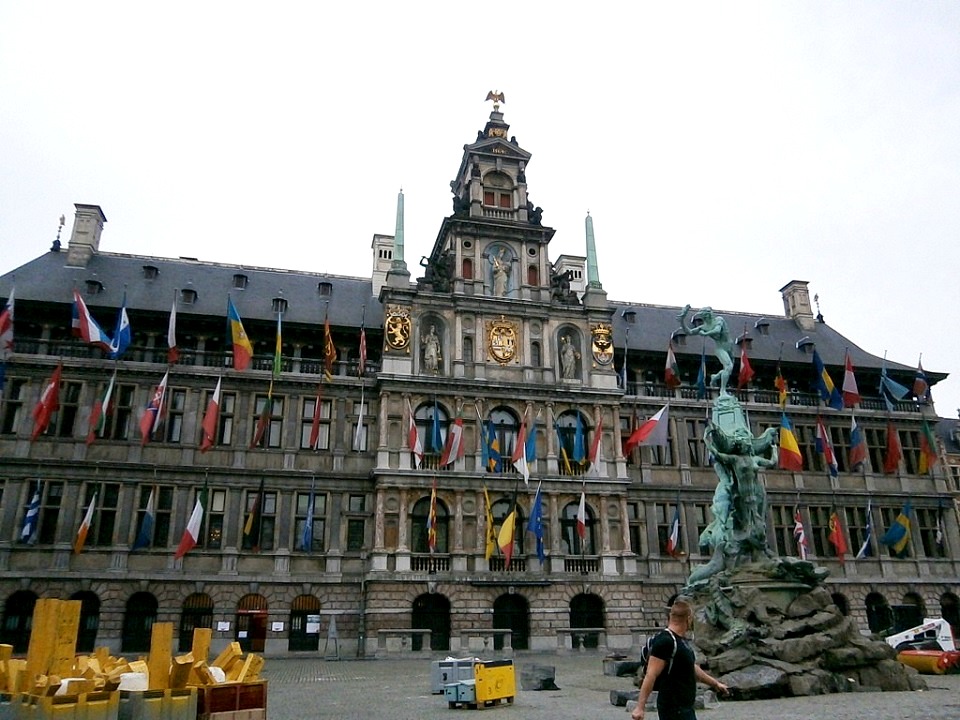
The Town Hall with the Brabo Fountain in the foreground
Beautiful, 16th century tall and narrow buildings surrounded the square, and these were the reconstructed Guildhouses. The original edifices were built when Antwerp was at its height in world trade and its sea ports were important wharves for large vessels during the 16th century. There were gold images at the top of each Guildhouse. The Town Hall building with its ornate façade and numerous windows lined one side of the Main Square, and had many colorful pennants flying in the wind.
Leaving the Main Square, we walked towards the River Scheldt, which now has a busy port.
Along the way we saw an advertisement for “Exploring the Ruihuis.” Ruihuis are underground channels, previously containing the city’s sewage before they were purified and sent back to the river. Now they are well-contained underground, vaulted areas where boat rides were offered, past foundations, bridges and locks. During WWII it was said that the Allies organized parties in the ruinhuis, because it was the best place to hide from German bombs.

Sitting by the River Scheldt
We finally reached an elevated walk where we could see the flowing River Scheldt. The river starts from France, and passes through Belgium (Antwerp and Ghent) and the Netherlands before it empties into the North Sea. Built on the river's banks, Antwerp is the second largest port city in Europe.
By the river there are wooden benches where one could sit and simply gaze at the water, as occasional small cruise boats drifted by.
It was indeed so pleasant to just sit quietly by the quay, the breeze cool and nippy. We took out our homemade sandwiches and thermos of hot coffee, and had a feast by the river Scheldt. — BM, GMA News

