

 GMA Brandtalk
 Tracking
 Archives

ADVERTISEMENT
Filtered By: Lifestyle
Lifestyle
Between the Alzette and Pétrusse Valleys in Luxembourg
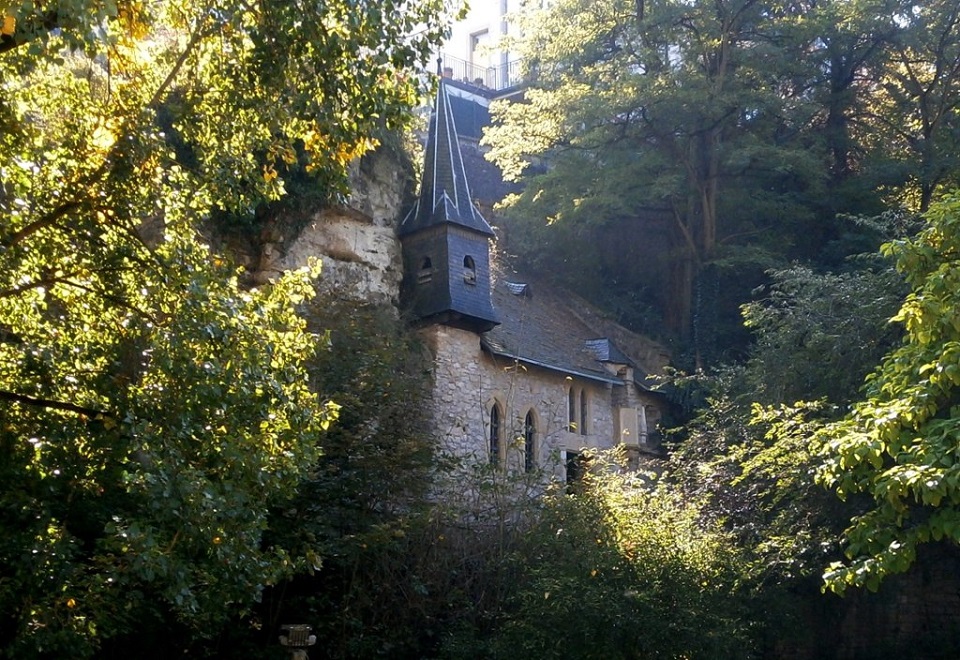
A sunlight-dappled stone house in Luxembourg's Pétrusse Valley
We stayed in Hotel Bristol, a small but efficient hotel along Rue Strasbourg, just off the Avenue du Gare, which was, as the name implied, just a stone’s throw from the central train station. This station was in itself an architectural delight, harking back to the 19th century, with its tall antique clock tower, seen even from afar.
After settling in with a refreshing welcome drink at the hotel’s coffee shop, my husband Alex and I immediately set off to explore the city. The walking map we received from the train station’s Tourist Info Bureau was well-marked by the kind lady on duty, and we set off to orient ourselves.

The Passerelle as seen from a pedestrian lane below it
The Passerelle was completed in 1861 to connect the old town with the train station. It is also called Al Bréck (Old Bridge) in Luxembourgish in comparison to the newer Adolphe Bridge, finished in 1903; and the Grand Duchess Charlotte Bridge, finished in 1965 and connecting the old part of town to Kirchberg, the area where the European Union organizations hold offices.
Walking the Passerelle, we saw the deep gorges and the river that cut through the sandstone cliffs; there were houses and shops beneath us, even cars and regular traffic. In one area we espied a beautiful manicured garden, with wooden benches, inviting visitors to sit awhile.
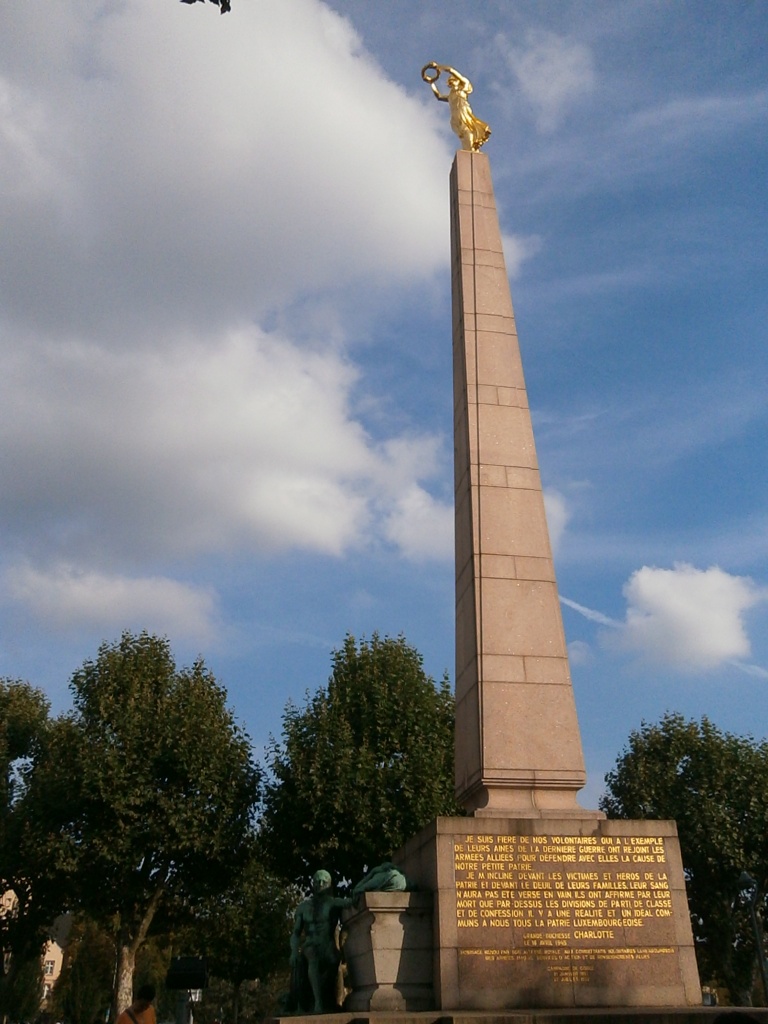
The Gëlle Fra obelisk (the Monument of Remembrance)
Inside the cathedral, we were awed by the immense columns supporting the vaulted ceiling. Majestic and inspiring, these white pillars drew our eyes up, up, up, heavenwards. Outside, we noted that the cathedral architecture fused seamlessly with the 17th century Athenée and National Library buildings beside it, including the old residential houses that quietly stood by.
And what was that structure over at the other side, we wondered. As we drew close we discovered that it was the Monument of Remembrance, a 21-meter-high granite obelisk, on top of which was a gilded bronze statue of a lady in a diaphanous gown holding a laurel on extended hands. This was the famous Luxembourg landmark, Gëlle Fra, or the Golden Lady. It represented Nike, the goddess of victory.
At the obeslisk's base are two bronze soldiers, one on his back, obviously a casualty of the war, and his comrade kneeling beside him in grief. The monument, finished in 1923, was erected to initially remember those who fought during WWI, but later included those who saw action in WWII and the Korean War. Huge wreaths of flowers lay before the monument we were there, and busloads of tourists swarmed the place. A little further away and about 24 meters below were well-designed gardens, where one could sit and look at the arched Adolphe Bridge.

The buskers at the Ville Haute
Not too far away was the Grand Ducal Palace. This is the official residence of the Grand Duke Henri, and where he receives officials and representatives from other countries. A serious-looking young guard, in his green fatigues and black cap, stood at attention in front of the entrance gate.
We followed a route just beyond the Grand Ducal Palace, a seemingly small alley that ran in a downward incline, and found ourselves in the area of the Bock Casements. The Bock was where the city of Luxembourg started. In 963 AD, a count named Seigfried bought this area, including the sheer cliffs, to protect his castle and land from invaders.
Holes were made through the stones where cannons could be fired. Through the world wars, the Bock had been enlarged, leveled, improved, built up, and intricate, maze-like tunnels were dug underneath it. It could contain 35,000 people at a time (a bomb shelter during the wars), and could contain munitions and food.
At the present time, a beautiful church, St. Michael’s, stands on the original site of the castle of Count Siegfried. The Bock Casements have withstood the ravages of time, and can be seen rising broodingly overlooking the Alzette River.

The palace where Grand Duke Henri and his family live.

