

 GMA Brandtalk
 Tracking
 Archives

IN PHOTOS: A Hanoi diary
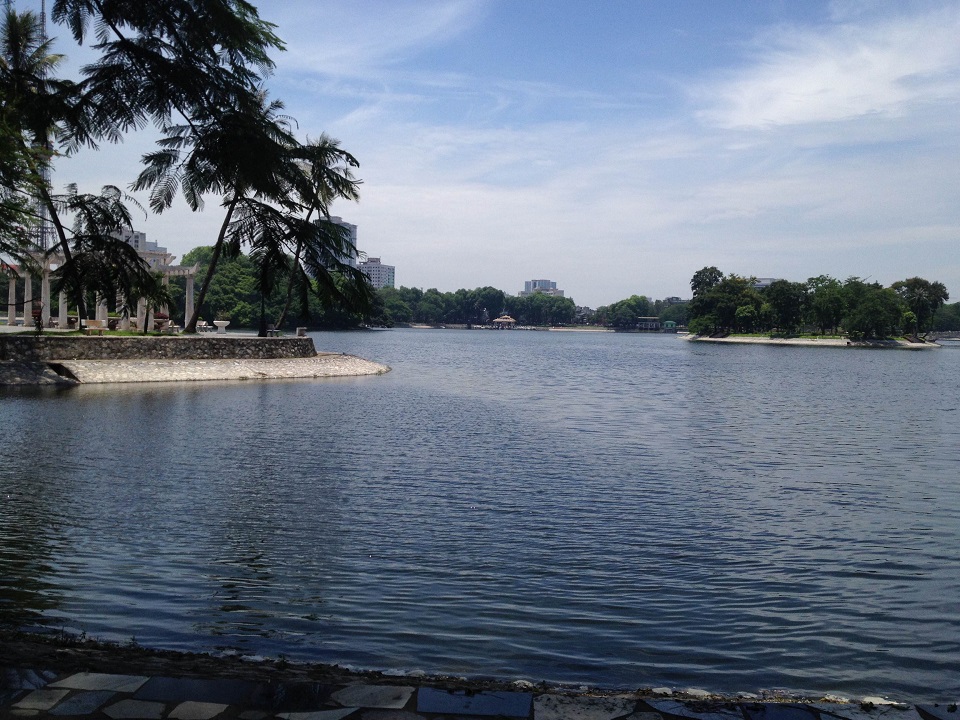
HANOI - It’s 11:36 a.m. as I write this, and while others may think I’m nuts for having walked around the past 30 minutes under the heat of the sun, I believe there’s nothing better I could have done. For here I am on a plastic stool in front of a plastic table covered with white tablecloth, having a light lunch of spring rolls and a cold can of soda, being refreshed by a gentle cool breeze under the shade of big banyan trees by the bank of Thien Quang Lake in the heart of Hanoi.
I could stay here all day, just writing, gazing once in a while at the placid lake before me, for a change letting the day unravel at a slow pace. I read there is more than one lake in the city of Hanoi. I watch as a man cast a fishing rod into the lake, and quietly stand still by the water’s edge. It’s indeed time to be quiet, alone, reset my busy schedule, and just be.
I found Thien Quang Lake by serendipity, by just walking away from the place where I am staying, Hotel Nikko Hanoi, not knowing where to go. Right across the hotel is the National Circus and the Thong Nhat Park beside it, but I wasn’t in the mood to meet clowns, so I just kept walking. I was eager to discover what was at the end of the road when I came upon the lake and followed a man going inside this park.
The place is a welcome break from the chaotic streets right outside, where hordes of motorbikes zip by, their riders beeping as they go along. The driver of the car that picked me up from the airport the other day said almost everyone has a motorbike in Vietnam. When a person turns 18, he or she gets a motorbike. And so in a family of four, for instance, with two parents and two adult children, there will most likely be four motorbikes in that home. Multiply that by the number of homes in Vietnam and there’s the reason there are many motorbikes on the road.
Here inside the park around the perimeter of Thien Quang Lake, though, it’s as if time is on slow motion, there is peace and quiet, until—get this—someone sang a karaoke song from the Gio Moi Restaurant I got my lunch from, and so it was time to move on.
Visiting Ho Chi Minh
I get into a taxi and show the driver a photo of Ho Chi Minh Mausoleum, and we’re off. I discovered that is the best way to communicate with cab drivers here in Hanoi who I cannot communicate with in English: screengrab photos of landmarks and we’re off in a jiffy.
Past quiet streets we go, and before long I get off at the side street beside the mausoleum.
An imposing grey granite edifice in the middle of Ba Dinh Square, the mausoleum is where the late Communist leader Ho Chi Minh’s body is laid to rest, not in the city that bears his name. It was here where he read the Declaration of Independence in 1945, paving the way for the establishment of the Democratic Republic of Vietnam.
I arrive just in time for the changing of the guards, and they march in their white uniforms with legs raised high. I could have gone in but the heat has become unbearable, so I decide to go to my next stop. Two Caucasian tourists, in shorts and without hats or umbrellas, however, continue walking inside the complex, while I, with my umbrella, make a run for the nearest aircon taxi.
The old Hanoi in the Old Quarter
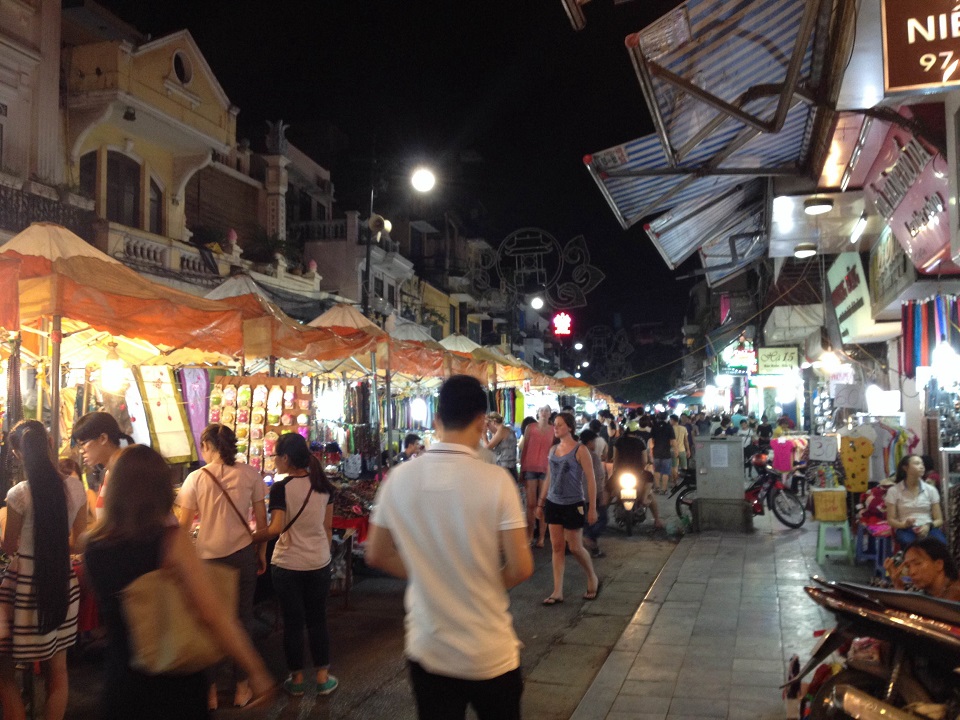
I like the vibe of the Old Quarter. Vendors wearing non la (the traditional conical hat) walk by or ride bicycles selling their stuff—fruits, slippers, vegetables. People eat pho or banh mi or drink coffee on little tables and chairs put up on the sidewalks. In between coffee shops are stores selling reasonably priced clothes.
Just the day before, we went to the Dong Xuan Market, the night market at the Old Quarter, and it was like Divisoria.
Streets were closed and you can take your pick of souvenirs, clothes, Vietnamese lacquerware, and other stuff among the stalls. We found a specialty coffee place, Anan Coffee on Hang Buom Street, where one can buy different types of coffee beans including robusta and weasel, which may be similar to civet coffee. Right across it was where we had Vietnamese coffee—Captain Beans, where a family served us with delight ca phe truyen thong (traditional coffee). I had the Vietnamese black coffee (cafe den) which was strong, dense, and pure but not bitter, while my companions had the Vietnamese milk coffee.
The Vietnamese people
I want to go to the Thang Long Water Puppet Theater but the cab driver does not know how to get there. But he knows the way to the Vietnam Museum of Ethnology, and so off we go in that direction.
Vietnam has 54 ethnic groups belonging to five ethnolinguistic families, and the museum gives visitors a glimpse of their culture. The Viet, also known as Kinh, is the largest of the groups, and account for almost 86 percent of the population of Vietnam. There are also the Muong living in the valleys, the Hmong in the mountains in the north, and the Cham in the plains and coastal areas of southern and central Vietnam, among others. Here at the museum, visitors can see snippets of their daily lives, from their clothes and rituals to replicas of their houses. I am reminded of how big a world we have out there, and how important it is to connect with other cultures.
With the skies suddenly darkening, I make it back to the hotel in time for an early dinner of beef pho—a delicious steaming bowl of rice noodles with herbs and meat. Said to have originated in north Vietnam, it is considered breakfast food, but of course can be had at any time of the day. And this day was just the perfect time to have it as rain poured outside my window.
Sunday, June 14, 2015
With an hour or so left before I have to head to the airport, I want to have another look at Hanoi, this time tracing its French colonial influence, which was there from the French Indochina days up until 1954.
My first stop is St. Joseph’s Cathedral, said to be patterned after Paris’ Notre Dame Cathedral.
I am struck by how small the cathedral area and the courtyard are, and how majestic the Gothic-style church with twin bell towers looks. Built in 1886, it is the oldest church in Hanoi. Only a few people are going inside the church that Sunday morning, and a few tourists outside continue to take photos.
I take a cab next to bring me to Hanoi Opera House which was designed after the Palais Garnier in Paris. It does look beautiful, all yellow and white in neo-Classical design, built by the French colonial administration in the early 1900s. Today, the building is still in use for concerts and ballet performances.
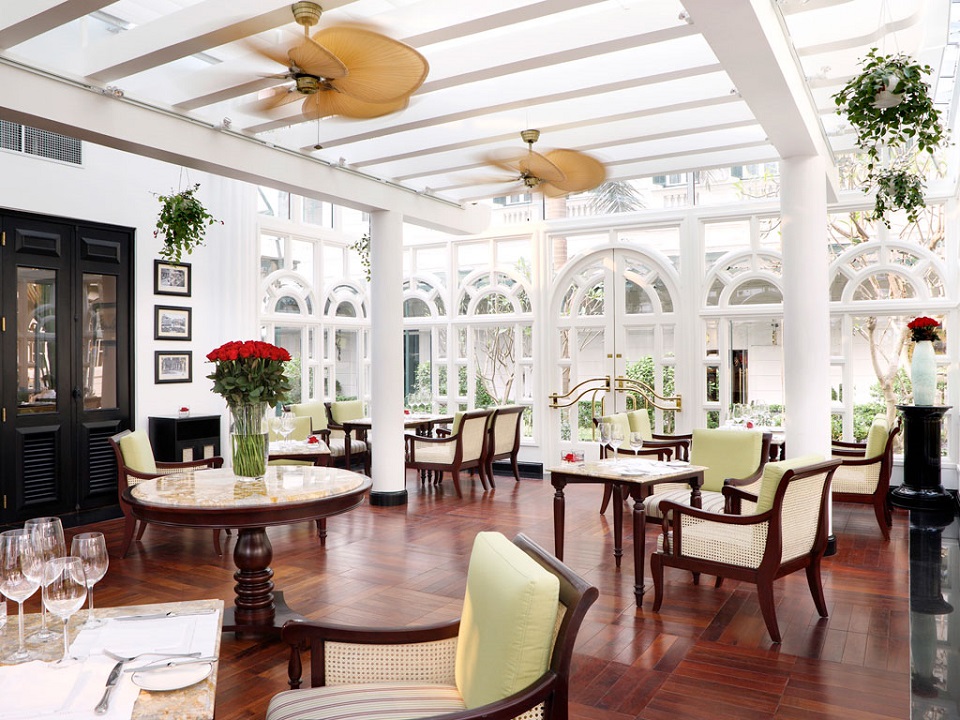
Just a short walk nearby is Hotel Sofitel Legend Metropole Hanoi, whose beautiful architecture shows the French colonial style. I still have a few Vietnamese dong left (and 30 minutes before I need to head back to the hotel for the airport), so I decide to splurge a bit.
I meant to have coffee only but I spot Vietnamese rose bud tea in the menu at L’orangerie, one of the hotel’s restaurants. The friendly waiter assures me it’s really good, and the woman server says it’s wonderful with honey. It is! In fact it is exquisite, and sipping it while looking at the lovely garden through French windows, I have a taste of what Somerset Maugham must have felt while having tea at the Metropole many many years ago.
Ah, if only there was more time. I’m sure there is more to discover in this charming city of Hanoi, where the old and the new blend well and life seems less hurried. “You like it?” the driver asked me as we neared the airport. “Yes,” I said. There’s lots to see, maybe not in terms of shopping malls and skyscrapers, but in art, culture, and the laid-back life. — BM, GMA News

