

 GMA Brandtalk
 Tracking
 Archives

Of stink bombs, freedom, youth, and Hong Kong
When I was 16, I was involved in a benign episode of teen-age terrorism. No harm was done except to young pride, since my terrified classmate Owen managed to elude capture and a certain beating.
I was then a dormer at school in Quezon City as my family was living in China without me. I would visit them during long vacations, and after one of those sojourns on the way home to the Philippines, I made a day-long stopover in Hong Kong, where in my solitary wandering in shop-filled alleyways I had come across what was advertised as “stink bombs,” yellowish chemicals encased in soft plastic capsules that when broken promised to emit the overpowering stench of rotten eggs.
In a prankish, excitable teen-age mind, that was the equivalent of the mother of all farts.
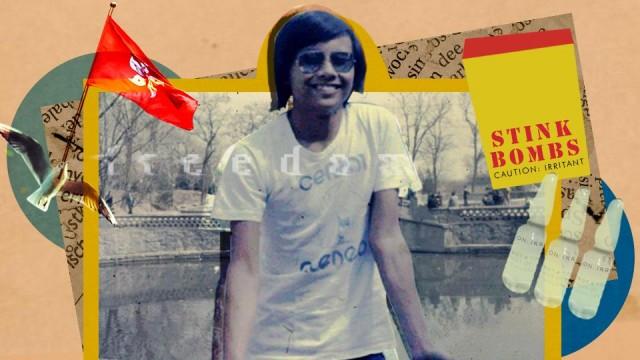
In the 1970s, I never had enough money to buy the brand-name goods available then in Hong Kong. But I could afford a cheap stink bomb. I bought one without any intent to explode it anywhere, but simply to show it off to classmates back in the Philippines who had never seen anything like it before.
Mind you, this was in the mid ‘70s, the height of martial law when even adults had to be home at a certain hour, men could not sport long hair, and scores of people with contrarian minds were in prison.
Having a stink bomb in one’s school bag was already a radical thing to do at our conservative high school in those days. It was my classmate Owen who thought that was not radical enough. It had to be exploded, but not in our classroom.
He brazenly cracked it open in the second-year classroom across the school lawn from ours, assuming those younger students would be willing victims and certainly forgetting that the leader of that class was a hot-headed varsity basketball player who was taller than almost everyone else in the school. The stench of the mother of all farts quickly enveloped their classroom.
Next thing we all knew, Owen was running across the lawn for dear life with hot-headed varsity guy in hot pursuit.
Owen managed to reach the sanctuary of our classroom where the rest of us instinctively formed a cocoon around him without knowing anything about his guilt.
Varsity guy saw that he was outnumbered so he stomped away, but not before he let loose a series of expletives aimed at our hapless classmate the stink bomber.
Strangely, this incident keeps coming to mind whenever I think about Hong Kong, and in recent times, the massive protests that have rocked it.
It’s not really just Owen’s stench attack that I recall but the solo sojourns in Hong Kong as a teen that enabled me to buy that offensive item.
At that point of my martial-law youth, Hong Kong was my first real experience of freedom. My father at the time was a diplomat based in Beijing, then still known as Peking, the capital of China where nearly everyone wore the same loose-fitting, dull-colored garb.
It was pretty much a totalitarian country, more so than today when at least people there can express themselves in fashion and study overseas. The Philippines then was an authoritarian country, where information was tightly controlled and many journalists and oppositionists were in jail.
In between those two repressive societies were the wonders of Hong Kong, an actual democracy and kaleidoscope of stimuli for the senses and the mind. It had, aside from quirky things like stink bombs and aggressive shopkeepers, books and magazines not sold in Manila, and certainly not in Beijing.
And it seemed Hong Kong’s English-language newspapers could say anything! It was then still a colony of Great Britain, its return to China still 20 years away.
Colonization of course is, on one level, a lack of freedom defined. But to a teenager who had just read “Catcher in the Rye” for English class, a big city with newspapers with real news was mind-blowingly liberating.
I was channeling the novel’s troubled protagonist Holden Caulfield who in his escape from the phoniness of his high school teachers and other adults wandered New York City alone, seeking the elusive authenticity of anything.
I had found it in Hong Kong, where I too explored a vibrant city’s narrow streets alone and didn’t have to deal with phony adults, martial-law curfew, and the feeling that the media was feeding me a smorgasbord of lies.
It had color and variety and truth and freedom. It was aspirational, and some ten years later, I was among many in the streets of Manila demanding the same thing.
What would happen in the Philippines in 1986 would inspire people living under dictatorships around the world, leading to triumph in many places but also tragedy in China where the democracy movement was crushed by the government in a bloodbath in 1989.
Now 30 years later, youths in Hong Kong have been in the streets for months demanding democracy for their own future, in the face of a creeping dictatorship imposed by China.
Their numbers, persistence and courage are a beacon for a world that is sliding back to authoritarianism, just as Hong Kong was once a beacon for a martial law generation, and a place where an impressionable teen could wander alone and experience what freedom was like.

