

 GMA Brandtalk
 Tracking
 Archives

ADVERTISEMENT
Filtered By: Money
Money
Suzuki Swift is a decisive contender among hatchbacks
Subcompact hatchback rides aren’t just people movers. Peppy econoboxes – that's the order of the day for small cars.
Interiors must be pleasing – what the market calls for – and the drive, the handling, has to be stable not wobbly. Loaded? It's got to be, apart from disc brakes and bright headlights.
The Suzuki Swift arrived last year on the premise of its predecessor, the second generation 2005-2011 model as a stepping stone. The 2nd Gen Swift practically met the attributes mentioned above, but glaringly fell short in some aspects of what people want in a small car.
Stationary or in motion the Swift is catchy.
The design veered not much from the 2nd Gen precursor, with the somewhat flat roof retained, as well as the almost upright c- and d-pillars, bulbous front end and fax waterfall rear reminiscent of European sport hatchbacks.
The headlights and taillights look like odd slices of pizza and the multi-spoke, 16-inch rims reflect a big upgrade in appeal from the five-spoke, 15-inch rims of the 2nd Gen. Still, a head-turner in supermarket parking or on the highway.

Far from chintzy
A black interior replaces the dark gray inside the 2nd Gen. Plastic that mimics leatherette, a smattering of faux aluminum trim and contrasting dark gray moquette seats adorn passenger bay that look far from being chintzy.
A black interior replaces the dark gray inside the 2nd Gen. Plastic that mimics leatherette, a smattering of faux aluminum trim and contrasting dark gray moquette seats adorn passenger bay that look far from being chintzy.
Controls, spread in a large dashboard, are intuitive in layout with interior fonts and indicator icons, espousing audio and aircon toggling – although the centrally-located blower dial below the head unit were as big as its thermostat and blower direction counterparts.
The audio component holds something rare for small cars – iPod compatibility, not auxiliary input cable that winds an external MP3 player but a USB port for toggling between external MP3 player menu via the head unit controls.
Speaking of sound, the audio system has a “Loud” balance between treble and bass. It faithfully captures even the tinkle of a triangle in Charles Gounod’s “Funeral March of a Marionette.”
In looks and ergonomics, the Swift’s cabin rivals its larger sibling, the Kizashi executive sedan. That raises the question: Should a buyer go for the P789,000 Swift hatchback or its the P1.348 million Kizashi.
On thing though: the loading bay. The rear bench doesn’t fold flush with the cargo area floor as the seatbelt buckles get wedged in. Still, better than the disjointed rear bench in the 2nd Gen that completely obstructs access of long and odd-shaped cargo.
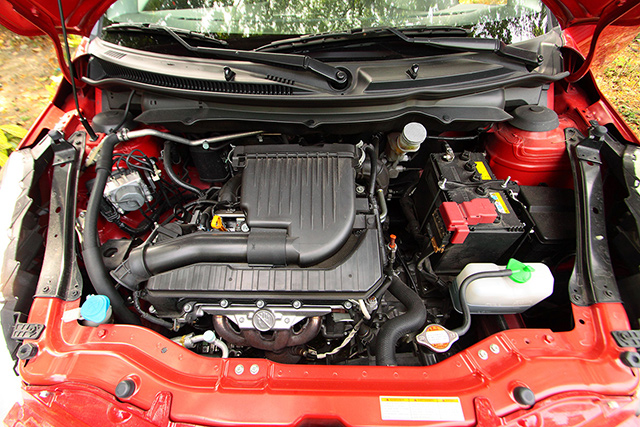
Also, the current model has a narrow powerband. It takes ages for the rev counter to get into the lower fringes of the torque curve at 2,500 rpm onwards, forcing the driver to pin the throttle to the floor. Wide, uneven steps or progression in each of the four forward gears do not help the situation.
Smooth corners
Result? A slushbox that’s lively but almost always out of the powerband. Advice to current and future owners: bolt an aftermarket forced induction kit for the 1.4-liter straight four. The process of delivering compressed air to the intake manifold via a gas compressor – a turbo or supercharger, which takes force-feeds exhaust gases from the engine to the intake manifold – is more efficient than relying on natural breeze.
On the bright side, handling, steering and braking are better if not as good as the 2nd Gen Swift. There’s little lean on bends – as the Swift is a hatchback means most of its mass is closer to the middle area, considering the car does not have a proper trunk, which allows for tighter lateral movement, particularly during turns that force the rear to swing wide such as change of camber turns and switchbacks.
The front rollers comply well with input from the steering wheel you give, making corner navigation – entry, apex and exit – smooth even if not that silky. Steering feels light, saving driver's wrists and arms from unnecessary work outs.
Here's the bite: the disc brakes on all wheels provide the needed grip, and the anti-lock braking system or ABS wakes up with a vengeance with a hard stab on the pedal. This means the system that prevents the wheels from stopping completely or locking up is roused in one big push, pulsating the brake pedal and actively helping shed speed.
The the halogen headlights lit up to a brightness that could rival cars with high intensity discharge or HID lamps.
In the end, the Suzuki Swift is a definite contender in the subcompact hatch segment. If Suzuki Philippines would only do something about the narrow powerband, the rear bench’s foldability and the uneven steps between gears… — VS, GMA News

