

 GMA Brandtalk
 Tracking
 Archives

ADVERTISEMENT
Filtered By: Money
Money
SONA 2015: PPP numbers give PNoy edge over past Presidents
+
Make this your preferred source to get more updates from this publisher on Google.
Former President Corazon Aquino took on a comprehensive land reform program as the centerpiece of her administration. Her son, President Benigno Aquino III, put the public-private partnership (PPP) initiative at the core of his economic agenda.
Since taking the helm of the Philippine government in 2010, the younger Aquino's administration has awarded and signed 10 PPP projects worth P189.00 billion out of the 53 projects in the pipeline. Such numbers make the current administration the most successful in closing public-private partnership deals.
Before Aquino, the administration of former President and now incumbent Manila Mayor Joseph Estrada signed the most number of projects: three.
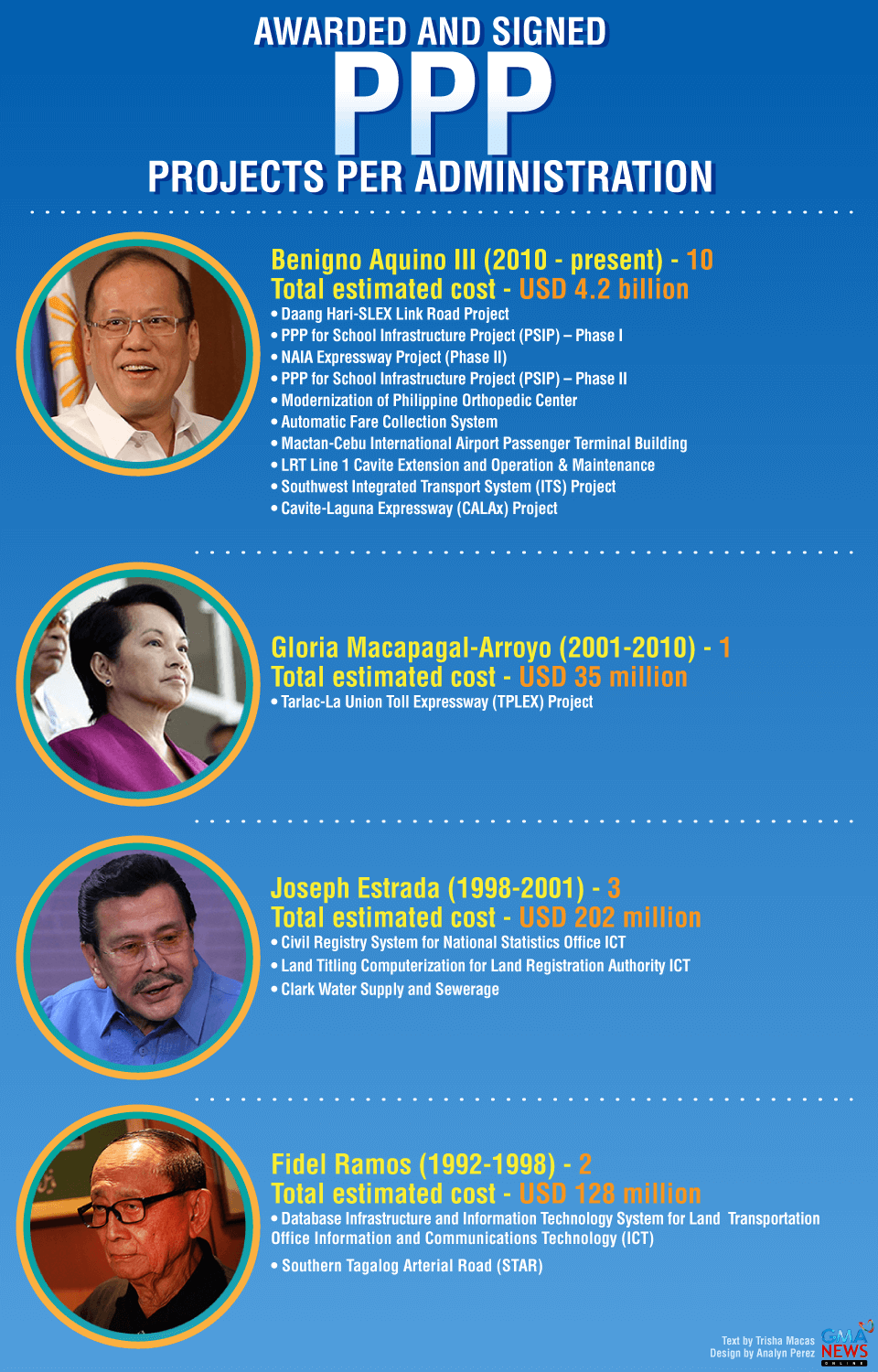
In 2011, Malacañang said the PPP Program is expected to improve Philippine competitiveness in the global arena.
Four years later, The Economist Intelligence Unit named the Philippines as the most improved country in the Asia-Pacific region for PPP readiness.
The country has "recorded the most-improved regulatory and institutional frameworks," it said, crediting the "significant regulatory reform in recent years, new biddings and selection procedures, and better dispute resolution mechanisms."
Despite criticisms about the procurement timelines, the PPP Center said that the Philippine timeframe for developing and rolling out PPP projects is from 18 to 22 months, which is almost the same in PPP-mature countries like Canada and Australia.
In the case of the Philippines, however, projects were pushed back because the private sector requested for more time to conduct due diligence and make sure that their bids are responsive to the needs of the project.
Ghosts from the past
Both Aquinos were seemingly haunted by the past in choosing what to highlight in their respective administrations.
Mrs. Aquino came from a landed gentry that owned hectares and hectares of sugar land, particularly the 6,744-hectare Hacienda Luisita, which was nearly the size of both Manila (3,955 has.) and Makati (2,738 has.) combined or 6,693 has.
Such heritage naturally instilled doubts in the minds of her critics regarding her intentions in making agrarian reform a priority of her administration.
The Comprehensive Agrarian Reform Program (CARP) was an initiative that aims to grant landless farmers and farm workers ownership to agriculture lands estimated at 7.8 million hectares. Mrs. Aquino signed CARP into law on June 10, 1988 and was scheduled for completion in 1998.
On the year of its deadline, Congress enacted a law, Republic Act No. 8532, appropriating additional funds for the program and extending the automatic appropriation of ill-gotten wealth recovered by the Presidential Commission on Good Governance (PCGG) for CARP until 2008.
The Comprehensive Agrarian Reform Program Extension with Reforms (CARPER) extended yet again the deadline for distributing agriculture lands to farmers by five more years. It was signed into law on August 7, 2009.
Last March, lawmakers agreed to pass the proposed law that extends CARP no later than June.
House Majority Floor Leader Neptali Gonzales II said there are already talks between Malacañang and members of the House from the Visayas on some provisions of the pending CARP bills.
Aquino III, on the other hand, was haunted by the ills of his predecessors. Aside from the PPP initiative, he waged a war on corruption as another priority of under administration's "Daang Matuwid" or straight and narrow path.
The PPP Center noted that the PPP initiative embodies the principles of Daang Matuwid in terms of transparency and good governance.
"Thus, the challenge of staying true to these principles were met by institutionalizing certain processes and practices that allowed the general public to scrutinize the bidding process for these PPP projects," the PPP Center said in a noted to GMA News Online.
Updates on PPP projects are posted on the PPP Center website and its social media accounts, and reports are transmitted to Congress and the National Economic and Development Authority-Investment Coordination Committee (NEDA-ICC).
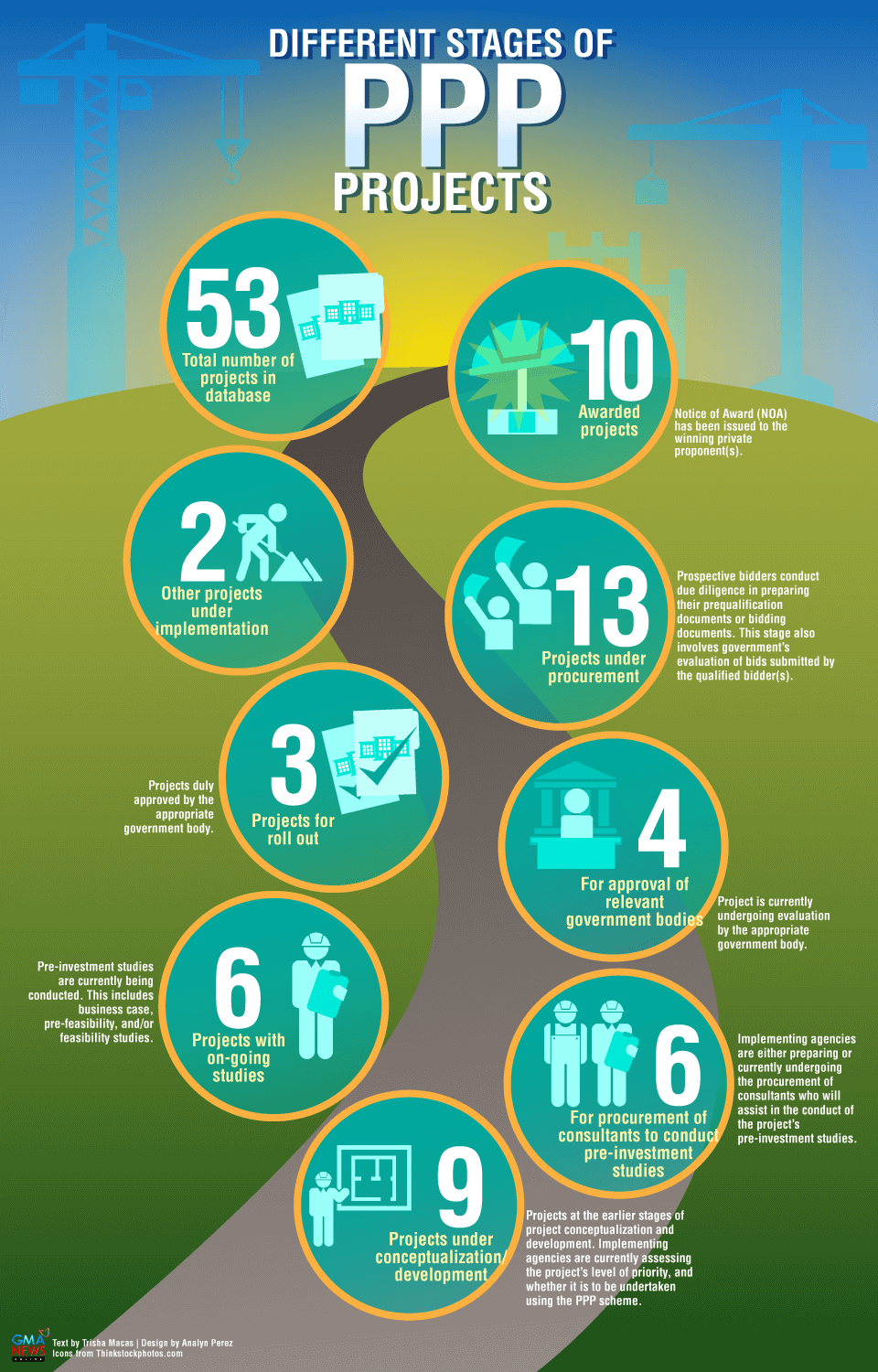
PPP Program
The PPP Program was launched in 2010 with several projects from National Government Agencies (NGAs) initially eyed for implementation, but not all were ready to partner with the private sector.
Most of the feasibility studies of the projects were outdated, which prompted the PPP Center to put up the Project Development and Monitoring Facility (PDMF) with international PPP transaction advisors to update the feasibility studies of the projects and make sure they are viable and bankable.
The advisors also help implementing agencies to properly structure PPP projects, draft contracts, and manage the bidding process.
To address project risks, the government has also set up a Contingent Liability Fund – already included in the 2015 General Appropriations Act – with an initial appropriation of P30 billion.
The PPP Center is pushing for the enactment of the PPP Act or Amendments to the Revised Build-Operate-and-Transfer (BOT) Law envisioned to sustain the gains of the current PPP Program and further enhance the legal and policy environment for private sector participation.
The PPP Act is already with the appropriations panel. – VS, GMA News

