

 GMA Brandtalk
 Tracking
 Archives

Why businesses in the Philippines must be emergency-ready

Due to its position within the area of the so-called Pacific Ring of Fire and a typhoon belt (a fact worsened by climate change), the Philippines is buffeted by weather disturbances and earthquakes year in and year out. In fact, PAGASA confirms that on average, 20 tropical cyclones (TCs) enter the Philippine Area of Responsibility (PAR) each year – more than anywhere else in the world. Additionally, certain areas in the Philippines are still recovering from the effects of 2013’s super typhoon Yolanda (known internationally as Haiyan), which resulted in billions of dollars’ worth of damage.
Risk-informed business development
Attended by over 200 major players in the government, business, and humanitarian sectors, the recently concluded National Summit on Strengthening MSME Disaster Resilience highlighted the need for micro, small, and medium enterprises (MSMEs) in the Philippines to prepare for disaster scenarios. This echoes the findings of numerous studies that businesses which cease to operate after experiencing a major disaster may either die within two years or never resume operations.
As a business owner in such a hazard-prone country, it is imperative to pre-plan for natural disasters and calamities, as they are virtually impossible to anticipate. Fortunately, with the right security measures and solutions in place, you can utilize emergency resources in the event of such incidents.
What it means to be “emergency-ready”
But what exactly does an “emergency-ready” business look like? Among other things, it must:
- Be prepared to face every single emergency scenario, with detailed instructions on what employees have to do;
- Be equipped with a list of emergency contacts that all employees have access to;
- Establish numerous escape routes;
- Have ample insurance coverage;
- Establish evacuation zones where employees should meet in case of a natural calamity forcing them to leave the premises;
- Have employees who are clear on the importance of their own safety over the company’s material resources; and
- Invest in an uninterruptible power supply (UPS) that will prevent power surges, spikes, or outages from permanently damaging electronic equipment.

A reliable IT solution
As more and more vital industries are becoming reliant on IT solutions to enhance their operations, a contingency plan must be put into place in the event of a sudden power interruption.
The impact of power failure on commercial buildings and small to medium data centers and computer rooms, particularly for businesses in the telecommunications field, is obvious. The manufacturing, healthcare, and transportation industries of today are also increasingly dependent on IT.
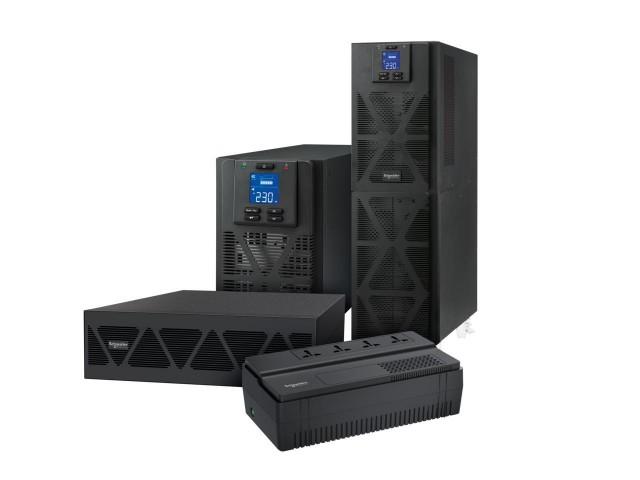
A good example of a commercially available option is the APC by Schneider Electric Easy UPS 3 Series, which is designed to be easy to install, connect, use, and service. This 10-200 kVA 3 phase UPS was made specifically for small and medium businesses, data centers, and other mission critical applications, delivering up to 96 percent efficiency in double conversion mode and up to 99 percent efficiency in energy-saving ECO mode.
The Easy UPS 3S safeguards critical business equipment with its strong overload protection and wide operating temperature range. Combine that with its compact form and lightweight footprint, and you can rest assured that your precious equipment will not be damaged when a natural disaster causes a sudden power spike or outage.
Guaranteeing security in a connected world
APC by Schneider Electric is the leading brand worldwide for integrated physical infrastructure and software. Through products that provide reliable power and availability solutions for IT and communications technologies, APC enables its growing community of partners, individuals, and businesses to work together in anticipating the unexpected, safeguarding critical information and data, and ensuring that businesses can easily get back up on their feet, no matter what.
For more information, visit https://www.apc.com/ph/en/ or contact your local APC representative. #SchneiderElectricPH
*Cover photo from Schneider Electric

