

 GMA Brandtalk
 Tracking
 Archives

Metro Manila condo oversupply eases to 31 months
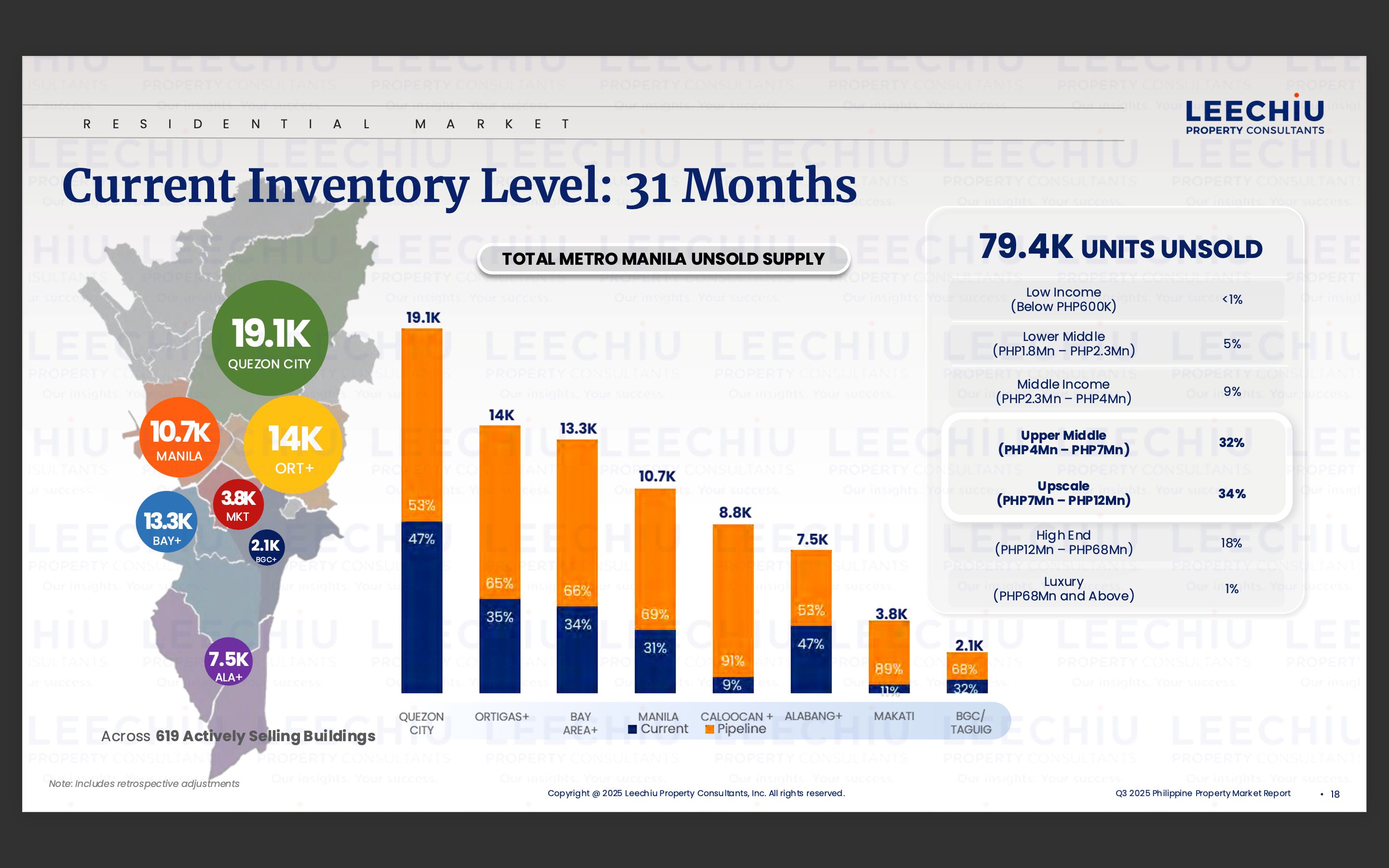
The oversupply of condominium units in Metro Manila is now estimated to take 31 months to sell, lower than that seen in the second quarter due to stronger demand and fewer launches, data released by Leechiu Property Consultants (LPC) on Monday showed.
According to the latest LPC report, there were 79,400 units of available supply across 619 actively selling buildings in Metro Manila in the third quarter, with demand up 16% quarter-on-quarter to 7,713 units, while new launches increased by 0.3% to 1,766.
“Metro Manila condominium market is gaining traction, with demand rising, modest number of new launches, and inventory dropping to 31 months — on the right track to more manageable levels,” LPC said.
This compares with 81,400 units of available supply in the second quarter, which would have taken an estimated 38 months or over three years to be sold, higher than the average of 12 months maximum reported by LPC.
“The market is gaining traction with encouraging signs of recovery — take-up has reached a seven-quarter high, and inventory levels are trending toward lower months supply,” LPC director for Research, Consultancy, and Valuation said in a mobile message.
Out of the 7,713 units sold during the quarter, 2,855 were in the upscale market valued between P7 million to P12 million.
This was followed by 2,316 units in the upper middle income market valued at P4 million to P7 million, 1,942 units in the high-end market valued at P12 million to P68 million, and 394 units in the middle income market valued at P2.3 million to P4 million. The remaining units were in the luxury market, valued at P68 million and above.
For the 79,400 units of inventory available, which includes current units and those in the pipeline, the biggest share is in the upscale market with 34%, followed by upper middle with 32%, high end with 18%, middle income with 9%, lower middle with 5%, luxury with 1%, and the low income with less than 1%.
“But while the market is moving in the right direction, the reality is that most of the available inventory remains out of reach for the average Filipino household,” Golez said.
“Addressing this affordability gap is essential if we want to invite broader participation and ensure inclusive growth in the residential sector,” he added.
Majority of the available units are located in Quezon City with 19,100; followed by Ortigas with 14,000; the Bay Area with 13,300; Manila with 10,700; Caloocan with 8,800; Alabang with 7,500; Makati with 3,800; and Bonifacio Global City and Taguig with 2,100. —AOL, GMA Integrated News

