BANGKOK, Thailand — The profitability of leading tile maker Mariwasa Siam Ceramics Inc. is being undermined by inferior products from China and rising fuel prices. Mariwasa Siam president Surasak Kraiwitchaicharoen told reporters over dinner Sunday at the Dusit Thani Hotel in this city that his company wants the Philippine government to do something about cheaper, inferior tiles from China. These tiles imported from China are being sold in the Philippines even without having been certified by the Bureau of Philippine Standards (BPS), according to the Mariwasa executive. The proliferation of tiles from China impacted on Mariwasa’s market share by as much as 50 percent in the last 18 years, lamented its Thai president. Kraiwitchaicharoen said in 1993, Mariwasa controlled 60 percent of the Philippine market, but now, its market share is just about 30 percent. The Santo Tomas, Batangas-based tile manufacturer said the BPS must “make sure that imported tiles carry the PS [Philippine Standard] mark." Cheap tiles ‘a waste of money’
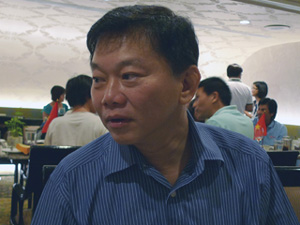
Mariwasa Siam president Surasak Kraiwitchaicharoen said consumers who buy cheaper, inferior tiles will be wasting money in the long run. Vic Sollorano
Mariwasa knows that as things stand now, it does not have the authority or the power to stop cheaper, inferior tiles from flooding the Philippine market. What it currently does, said Kraiwitchaicharoen, is make the Philippine government aware of the situation and the perils of using inferior tiles. The Mariwasa president, who took the helm of the company almost 10 years ago, explained there are safety issues that need to be addressed, noting that substandard tiles tend to shard easily, absorb more water, and get stained easily. For consumers, Kraiwitchaicharoen said, buying cheaper, inferior tiles will be — in the long run — “just a waste of money."
Turning to alternative energy Because Mariwasa’s profitability is compromised, its prospects for expansion in the Philippines are also compromised. To stave off the impact of imported tiles on its bottomline, its outgoing president said the company is now making sure its costs are tamed, its operating costs are low, and its product quality remain high. Part of Mariwasa’s approach to cost-savings in terms of energy is by going for alternative energy, Kraiwitchaicharoen said. The company is preparing for a transition to using rice husks as feedstock for producing steam to power its operations. Energy cost accounts for 40 percent of its production cost, with oil prices in the world market staying above $100 per barrel, Mariwasa finds transitioning its whole operations with the use of rice husks to be more efficient. Last May the company started the transition process with a P400-million project that will be on-stream sometime next year, making the company less dependent on crude oil-based petroleum products
— MRT/RSJ, GMA News 

 GMA Brandtalk
 Tracking
 Archives


