

 GMA Brandtalk
 Tracking
 Archives

ADVERTISEMENT
Filtered By: Money
Money
The cost of sending your child to college in top PHL universities and the world

The world rankings for universities were released by the education firm Quacquarelli Symonds (QS) this June, in which four Philippine universities out of the 300 top universities in Asia made the cut.
These are:
70. University of the Philippines
114. Ateneo de Manila University
143. University of Santo Tomas
181. De La Salle University
The state university slipped seven notches in the rankings, while Ateneo de Manila climbs one spot up from 2014. UST and DLSU suffered slides, with UST falling by two places and DLSU by 30.
The top four schools in the world are:
Massachusetts Institute of Technology in Cambridge, MassachusettsUniversity of Cambridge in the UKImperial College LondonHarvard University in Cambridge, Massachusetts
So how much does it take to send your child to college in the top four Philippine universities compared with the top four in the world?
The cost of going to the top PHL schools
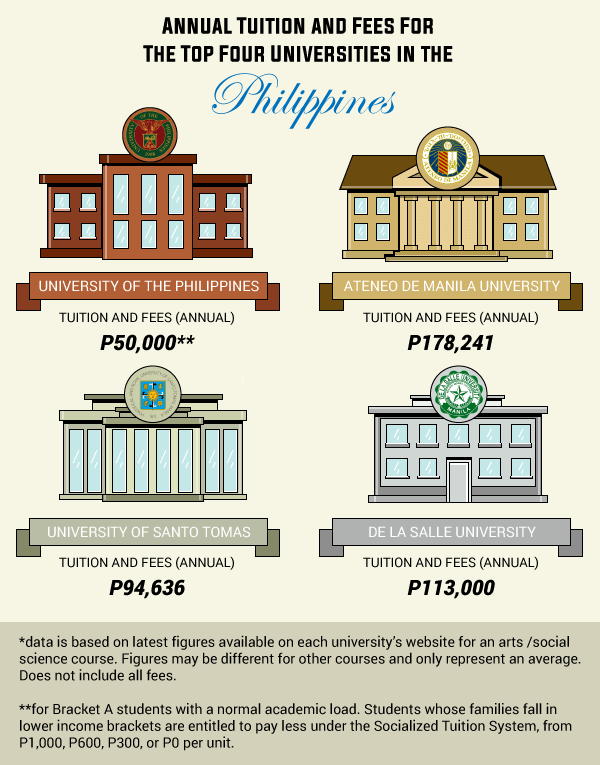
As you can see, the top university in the Philippines can also be the cheapest, especially if your family earns less than P1 million a year. The idea is to ensure that a top-class education is not out of the reach to financially challenged families or those in the lower income bracket.
The private institutions listed above can be pricier than a state education when you factors in all the fees involved.
However, there are several scholarships that translate into financial relief and lessen the cost of your child’s education.
While a lot of people were burned by the collapse of education plan providers like PET and CAP, companies like Sun Life and Philam Life have pre-need plans for that help you save for your child’s education well ahead of time.
The cost of going to the top schools in the US and UK
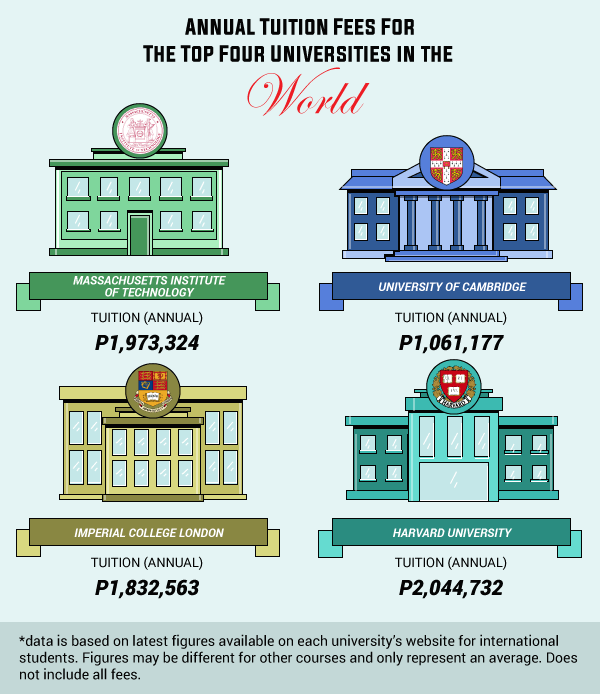
At first glance, the cost of education at these prestigious institutions might give you a heart attack, and those tuition fees exclude these additional expenses:

Fees are estimates based on data provided by the universities.
These expenses vary depending on your child’s lifestyle and the location of the college. If your child lives in an on-campus dorm, he may not even have to worry about transportation costs since he or she can bike or walk and only pay for transport when he leaves the campus.
You can also lower costs by signing up for different meal plans, or having your child cook some of his or her own meals. But even with such concessions, it looks like studying in the US or the UK is beyond the reach of many Filipino families.
However, if you are bent on providing your child with an education at some of the most exclusive (and expensive) institutions of the world, don't let these “sticker prices” deter you. The rule of thumb is that the more expensive a university, the more money it has to help financially challenged by deserving students, especially in the US.

Your child could go to Harvard almost for free
At MIT, students whose families earn less than P3.4 million a year can attend practically for free through a combination of scholarships. For Harvard, families making less than P3 million a year do not have to pay anything for their child’s undergraduate education, with almost all expenses covered. International students also have the chance to supplement their finances by taking on-campus jobs to a maximum of 20 hours a week.
So even if the total cost of one year at Harvard or MIT is almost P3 million, you could pay almost nothing at all. MIT and Harvard are two of only six US universities that are “need-blind” towards international students – meaning your financial situation is not considered when they are deciding to admit your child or not, and they pledge to meet all your financial needs through a combination of scholarships, subsidies, and student employment.
The other top two universities in the world offer some financial relief as well, though it can be much more competitive.
At the University of Cambridge, “overseas students” (non-UK or EU students) who are embarking on a research program and have high academic achievements can win one of 80 scholarships that pays for all tuition and fees for the duration of the course (three years). Imperial College London lists a number of external funding opportunities along with their admission material.
Of course, the hard part, even harder than paying for college, is getting in. In 2014, MIT accepted only 7.9 percent of applicants. Harvard accepted even less, 5.9 percent. The University of Cambridge accepted 20.8 percent of applicants in 2013 and Imperial College London, 15.2 percent.
In comparison, Ateneo de Manila accepts 10 to 15 percent and UP around 18 percent of total applicants.
Making the right decision – It's not just about cost
When making the decision on which colleges your child should apply to, make sure you know the true costs involved, and the available scholarships. With financial aid and student employment, four years at Harvard may be well within your budget! Figuring out your child's earning capacity due to a good education may be the key to knowing the return on your investment may be much greater.
So don’t let the sticker price be the only factor in your child’s education. You and your child have to decide together if it’s worth it to study in the Philippines or if going abroad for a college education is the better option. Once you’ve made a decision, doing research on the costs involved allows you to financially plan for your child’s education.
=============================================================================
This article first appeared in slightly different form on iMoney.

