The economy is growing, but where are the jobs? The government has trumpeted a robust 6.6 percent economic expansion last year, exceeding most expectations. But analysts warn that job growth is lagging, threatening recent economic gains. "Without interventions creating a strong domestic industry translating to jobs, the country could have two to three more years of good economic growth, then we may be in for a lower growth trajectory," University of Asia and the Pacific senior economist Victor Abola said in an interview with GMA News Online. According to the Socioeconomic Report 2010-2012 of the National Economic and Development Authority (NEDA), employment generation in the first two years of the current administration averaged 997,000 per year.
But Abola said that the figure is not in net terms or after the number of those who left or lost their jobs is subtracted from the total employment created.
In net terms, Abola said employment only averaged at "less than half a million per year since the start of the Aquino administration—way below the 1.5 million to 2 million annual net job creation needed to sustain growth."
Most of the jobs created were in the services sector and not in the much needed industrial sector, he added.
IBON Foundation, a non-profit research institution, has echoed the concern, describing the gains so far made by the government as "jobless growth."
"The last decade has seen the fastest growth in the post-Marcos era, yet has also seen record joblessness and increasing numbers of poor Filipinos aside from severe inequality," IBON said in a statement.
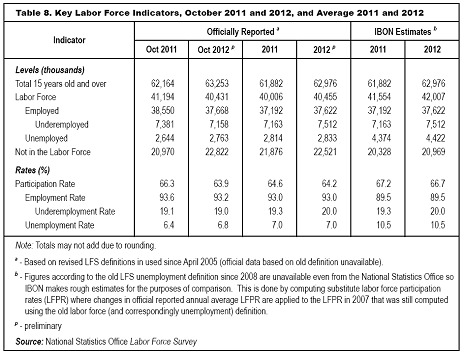
Citing its own estimates, IBON said the lack of proper job creation has resulted in the number of unemployed Filipinos reaching 4.4 million and the number of underemployed 7.5 million in 2012.
The underemployed are those who want additional working hours, an additional job, or a new job with longer working hours.
The unemployment rate remained at 10.5 percent with the underemployment rate at 20.0 percent, IBON claimed.
Its estimates are higher than the the National Statistics Office jobs data that showed a 6.8 percent jobless rate in October 2012 from 6.4 percent a year earlier.
There are 2.76 million jobless and 7.16 million underemployed Filipinos last October, with the unemployment rate averaging at 7 percent in 2011 and 2012, latest government data showed.
 A problematic revision
The difference in the jobless data stems from the NSO’s revised data collection method since 2005. It changed the definition of employed to those who will work in the next two weeks and those included in unemployed numbers are required to have been actively seeking jobs in the past six months.
In a separate interview, IBON research head Sonny Africa said the revision is problematic because "you can’t compare this to decades’ worth of data" and that consistency in methodology is a must in creating policy against unemployment.
"You can't measure the effectiveness of policies if you can't compare data," he argued.
To Abola, the revisions were necessary to comply with International Labour Organisation standards. "You just can't index (employment) to the old definition. We need to comply," he said.
Nevertheless, both IBON and government data should be a cause for concern.
The government’s 6.8 percent unemployment rate compares unfavorably with Malaysia’s 3.0 percent, Singapore’s 1.7 percent and Thailand’s 0.60 percent jobless rate in 2012, latest data compiled by the Bangko Sentral ng Pilipinas showed.
The higher unemployment rate was recorded despite the Philippines posting the highest growth among its Southeast Asian peers.
Policy reforms
NEDA has repeatedly noted the importance of monitoring industry growth to ensure economic expansion is sustained and more employment opportunities are created.
"It is our immediate task to put in place policies and implement programs that will sustain our economy’s growth over the medium term. We shall continue planting the seeds of a structural transformation in our economy to make it more investment and industry-led," Socioeconomic Planning Secretary Arsenio Balisacan said last week, echoing the government's position on the matter.
The Philippine Development Plan: 2011-2016 aims to achieve rapid and sustained socioeconomic development that generate employment and reduce poverty.
Historical data shows that the share of industry to GDP peaked at 40 percent in the 1980s, plummeting to a little over 20 percent in early 2010 to the third quarter of 2012 and recovered to 35 percent in the last quarter.
The recovery created employment in sub-sectors mining and quarrying—increasing by 10.8 percent in the last quarter—and construction and utilities also rising by 5.3 percent and 7.5 percent, respectively, the National Income Accounts showed.
But analysts said jobs and higher wages on the back of a well-developed Filipino industry could be achieved faster if more active and responsible state interventions are employed.
Africa said the government needs to have a "well-defined" foreign investment regime that compels companies to reinvest in the country and to transfer technology to homegrown industries. "The current foreign investment regime has resulted in having no emerging Philippine counterpart," he said.
While agreeing that an "industry that is fostered by a more domestic resource base is what is needed," Abola said, "that's not a matter of compulsion."
According to the UA&P economist, the foreign exchange policy "has to be managed" in a way that the peso is "not stronger" than its regional counterparts.
"Instead of investing in domestic industry, a lot of investors will find it cheaper and more efficient to just put plants here and outsource materials elsewhere. Worse, some might even find it cheaper to construct plants elsewhere," he said.
In a separate interview, NEDA Deputy Director General Emmanuel Esguerra said the government is now looking at rationalizing fiscal incentives and studying the effects of a strong peso in industrial development.
The 6.6 percent growth last year should be cheered, but Esguerra noted more work needs to be done. "We still have to address a number of things, and we’re working on it," he said. — HS/VS, GMA News


 GMA Brandtalk
 Tracking
 Archives


