

 GMA Brandtalk
 Tracking
 Archives

ADVERTISEMENT
Filtered By: Money
Money
Resilient mango weathers storms, costs and prices
Beset by harsh weather conditions, high cost of production and low market prices, mango has remained a resilient fruit crop and the third in terms of export volume and value next to banana and pineapple.
Production has been up and down in the last four years, largely because of rains and storms that pummel the Philippines year in, year out.
“Mango production dropped by 2.57% in 2012,” said Jennifer Remoquillo, national coordinator of the Department of Agriculture's High Value Crops Development Program. “The early rain showers during the flowering stage in the first half of the year and Habagat in the second half of the year in Ilocos Region and Cagayan Valley and Bulacan province constrained the development of fruits,” she said.
Production was down to 767,851 metric tons (MT) in 2012, from 788,074 MT in 2011, government data showed. In 2010, output reached 825,676 MT from 771,441 MT in 2009 from 884,011 MT in 2008, and from 1,023,907 MT in 2007, the same data also showed.
In the first 10 months of 2012, fresh and processed mango exports reached $58 million from $96.20 million in 2011.
In the first 10 months of 2012, fresh and processed mango exports reached $58 million from $96.20 million in 2011.
Virginia dela Fuente, Philippine Mango Industry Foundation Inc. (PMIFI) president, enumerated the three main challenges weighing on the industry: sudden weather changes, high costs of inputs, low selling price.
While mango is the only fruit whose flowering stage can be artificially induced, farmers cannot spray the leaves when it rains because the chemical will simply washed off the leaves.
And weather is a phenomenon that is outside the reach of human control, said Evelyn A. Grace, Samahan ng Magmamangga ng Zambales Inc. president and contractor of 20 mango trees.
“Ang pinakamagandang panahon ng pagtatanim ng mangga sa Luzon ay dry season... Ang pag-ba-bago-bago ng panahon ay nakakaapekto ng malubha sa produksyon ng mangga. 'Di namin malabanan ang pag-ba-bago ng panahon," she said.
Luzon is the primary producer of carabao mangoes, which accounts for 64 percent of production, while Mindanao accounts for 23 percent.
“Once na sunud-sunod ang pag-ulan, hindi na kami makakapagspray ng fungicides dahil matatanggal lang ng ulan ang ini-spray. Malakas pa naman ang fungus kapag tag-ulan. Kaya kapag masama na ang panahon, hindi na itinutuloy...” Grace explained.
Beyond rain
For a mango farmer Jimmy Nacua, Northern Mindanao Mango Industry Development Council president and owner of 1,000 mango trees, the lack of capital is the top challenge faced by farmers.
“Hindi makakuha ng financing ang farmers dahil... masyadong mataas ang interest rate sa mga rural banks... umaabot sa 20 percent,” he said.
Stakeholders also claim the industry is beset by high costs of inputs, labor and transportation.
"Napakalaki ng gastos namin sa inputs pa lang. Kelangan namin ng flower inducers, fertilizers, insecticides, mango paper bags, fungicides at kung anu-ano pa," said Grace.
Nacua raised the same concerns, adding that inputs range from P3,000 per liter to P5,000 per liter.
A chunk of the expenses is eaten by labor and transportation.
"May labor pa sa pag-spray, pag-fertilize, pag-harvest na kung saan kailangan din ng baskets. Bagging pa lang malaki na ang gastos, tatlong tao ang kailangan sa isang puno tapos P300 per day yun. Sa transportation naman, ang isang delivery truck mula Zambales hanggang Manila ay mga P10,000,” Grace noted.
In Mindanao, Nacua said hiring workers is a problem because there is a shortage of workforce in the agricultural sector in the region. “May shortage sa tao dito lalo na kapag maganda ang production, tapos all year round pa ang mangoes dito. Kami-kami lang din ang nagte-train sa isa’t isa sa pag-aani, pag-pa-package ng mangga,” he added.
As there are no processing plants in Mindanao, mango farmers must pay for shipping to Cebu— their main market, Nacua explained. “Sa barko pa lang, talong-talo na kami. Ang market namin ay sa Cebu para sa process grade na mga mangga. Kulang sa processing plants ang Mindanao,” Nacua added.
“Pumapangit ang mangga sa pag-ta-transport nito dahil 'di marunong ang mga handlers... kaya nalulugi ang mga retailers dahil mahal ang pag-transport, tapos mababa na-i-bebenta ang mga produkto. Mga 20 percent ang lugi dahil sa pasa at shrinkage,” Dela Fuente noted.
Bruised and blemished fruits are for the domestic market, and those in the worst of conditions are for processing. Those with smooth skin are for export, she said.
“Madami ang nag-pu-putol na ng mango trees dahil na-di-discourage ang farmers sa bentahan ng mangga at kaya nag-shi-shift sila sa ibang crops,” Dela Fuente added.
An industry map
Earlier this year, the Agriculture Department set a four-year roadmap to increase mango production to 955,823 MT in 2013 and 5 percent a year to reach 1.1 million MT by 2016.
"Ang industry ang nag-set ng target. Support facilities lang tayo," DA Assistant Secretary Dante Delima said.
The Agriculture official noted the government is constantly conducting training workshops for farmers, research and development for farming inputs and equipments, and weather forecasting.
"We have a series of consultations with the mango farmers. On research and development, pinag-aaralan namin ang mga dapat gawin sa mga insektong nakasasama sa production ng mangga,” he said.
“We are monitoring and constantly coordinating with PAGASA [Philippine Atmospheric, Geophysical and Astronomical Administration] para matulungan mag-forecast kung tamang panahon ba magtanim hindi lang ng mangga pati ng iba pang crops, Delima noted.
“Kailangan ma-empower ang micro-climatic forecasting sa bawat lalawigan. Sa ngayon, sa 100 na probinsya pa lang na-e-establish ito," he added.
The Agriculture Department's crop development program is giving priority to strengthening the accreditation of nurseries and plant material certification to produce quality materials, said Remoquillo. This includes regulatory services like certification system, pest risk analysis, pesticide residue analysis, and food safety, she added.
On high interest rates on loans, Delima said there are already models being studied but it would need legislative process. "Ang pag-po-provide ng kapital ay isa sa inaasikaso ng DA pero di pwedeng dole out.
“In the works na ang pagpapababa ng interes, may mga model na. Kaya lang kailangan nito ng legislation dahil ito ay banking policy. Hindi pwedeng memo lang ng DA," he added.
'Mango tourism'
'Mango tourism'
The Philippine Mango Industry Foundation is directly buying fertilizers, insecticides, herbicides, fungicides to lessen the costs of mango farmers. "Kasi kapag sa importers, dumadaan pa sa middleman tapos may taxes pa kaya mas mahal,” said Dela Fuente.
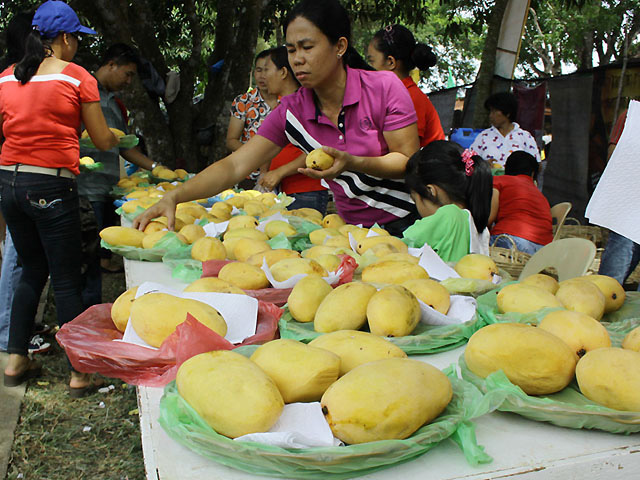
To help sales, the industry group, through its provincial associations, is also helping farmers market their products staging “mango tourism.”
“Mababa kasi 'yung locally sold mangoes, that’s why we’ve been developing mango tourism festivals to promote mangoes and so farmers can sell mangoes directly to consumers. Sa ganun, nababawasan ang lugi nila,” Dela Fuente noted.
To increase quality of exportable mango, Delima said government is helping the industry put up post-harvest facilities to avoid shrinkage and bruising.
The value of fresh mango exports has somewhat declined despite an increase in quantity while dried mango exports continue to grow both in quantity and value, according to Bureau of Agricultural Statistics data.
"Hindi maganda ang export ng mangoes dahil hindi pumapasa sa export grade ang mangga. Kaya kailangang ayusin ang post harvest facilities," Delima noted. — VS, GMA News

