

 GMA Brandtalk
 Tracking
 Archives

ADVERTISEMENT
Filtered By: Money
Money
Inflation quickens in April on higher food, fuel, electricity prices
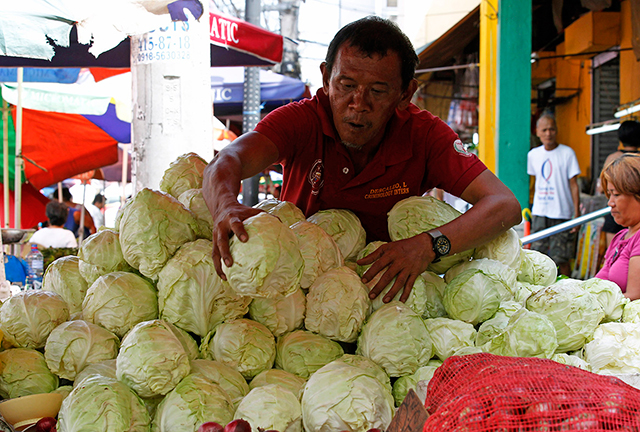
Cabbages are selling for P50 per kg. at a market in Manila on Tuesday. At the same time Philippine inflation last April came in slightly faster than expectations, driven by higher food and utility costs. Photo by Romeo Ranoco, Reuters
Higher prices of food, fuel and electricity drove inflation faster in April, the National Statistics Office (NSO) reported Friday.
On average prices accelerated to 4.1 percent last month from 3.9 percent in March, but much faster compared with 2.6 percent a year earlier, NSO data showed.
The latest inflation rate, which was near the upper end of the 3.6 to 4.5 percent forecast by Bangko Sentral ng Pilipinas for April, brought the year-to-date average to 4.1 percent.
The central bank will remain watchful of any financial stability risks from the still elevated liquidity growth rate, and continue to monitor the impact of the Monetary Board’s last action, Bangko Sentral Governor Amando Tetangco Jr. told reporters in a text message.
Bangko Sentral will also take into consideration global developments that could impact on the Philippine situation, the central bank chief noted.
“We will not hesitate to make pre-emptive adjustments to any of our policy levers in measured pace if the inflation target would be at risk or financial stability pressure heightens,” Tetangco said.
Bangko Sentral targets inflation to settle within 3 to 5 percent in 2014 and 2 to 4 percent in 2015.
The food and non-alcoholic beverages index rose to 6.2 percent from 5.8 percent in March, while housing, water, electricity, gas and other fuels indexes increased to 3 percent from 2.7 percent, according to NSO.
The transport index climbed to 1.3 percent from 1 percent in March.
Higher rice prices
The latest inflation rate is still within expectation, but is on the upper end of the central bank target, Bank of Philippine Islands economist Nicholas Mapa told GMA News Online.
"Food is something we should be watchful, particularly rice prices," he noted.
"With El Niño expected to hit the country in the middle of the year, this might have some impact on prices of commodities," he added.
Economic Planning Secretary Arsenio M. Balisacan said the tight supply situation in rice persisted last month, resulting in higher prices of the commodity.
"Similarly, the relatively higher corn prices may be attributed to lower production of corn, resulting from dry spells in a number of corn-producing regions,” he added.
The continued ascent of crude oil prices in the world market also pushed the prices of domestic petroleum products higher.
“The domestic prices of unleaded gasoline, diesel, kerosene and LPG recorded faster adjustments last month. These are also consistent with the Dubai crude price, which increased by 3.0 percent in April 2014, coming from a 1.2-percent annual contraction in the previous month,” Balisacan, who is also NEDA director-general, said.
Last month, power distributor Manila Electric Co. said customers will see their April bills go up by P0.89 per kilowatt hour (kWh) due to higher generation charge and other billing items.
“This was due to higher power costs from suppliers resulting from the several outages in large power plants, coupled with the increase in demand caused by the summer season,” Balisacan said.
Despite an uptick in inflation, the National Economic and Development Authority (NEDA) expects the movement of prices of basic commodities to be manageable in 2014, and that the government is addressing upside risks to inflation.
Balisacan said the government needs to concentrate in addressing the upside risks to inflation, especially of food, which emanate from weather disturbances such as El Niño, the depreciating peso and the pending petitions for further adjustments in utility rates, transport fares, and wages.
“In the short term, the interventions can focus on improving the management of inventory, including that of imports, and the efficiency of the distribution systems," he said.
"In the medium term, we need to focus on increasing the productivity of agriculture and the food processing industries as well as expanding production capacity,” he added. – VS, GMA News

