

 GMA Brandtalk
 Tracking
 Archives

ADVERTISEMENT
Filtered By: Money
Money
Typhoon Glenda wasn't strong enough to dent GDP – economists
Typhoon Glenda (Rammasun) packed turbulent winds that shut down schools, offices and financial markets and caused massive outages in Luzon, but it wasn't powerful enough to trigger an economic downturn in its aftermath.
The Category-3 cyclone, however, may have added further suffering to the coconut industry, which is now enduring a deadly infestation while still trying to recover from the wrath of killer Typhoon Yolanda, economists interviewed by GMA News Online said.
Economics Professor Alvin Ang of Ateneo de Manila University noted Glenda largely damaged the agriculture sector – particularly the coconut and rice subsectors – and power infrastructure. "Quezon, Batangas, Laguna areas are a coconut producing area. Bicol a rice production area," he said.
In January to March, Philippine coconut oil exports contracted by 54.1 percent to 174,210 metric tons (MT) from 379,470 MT a year earlier after Typhoon Yolanda destroyed vast plantations in the Visayas last November.
Coconut trees in Basilan, Cavite, Laguna, Batangas, Rizal and Quezon provinces – all of which have declared a state of emergency – have also been infested by coconut scale insects, according to the Philippine Coconut Authority.
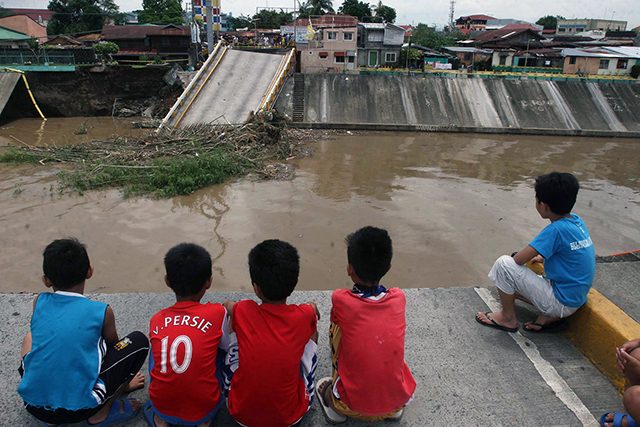
Impact on fisheries
Preliminary estimates by the Department of Agriculture showed the fisheries subsector suffered the most, incurring losses estimated at P810 million.
Preliminary estimates by the Department of Agriculture showed the fisheries subsector suffered the most, incurring losses estimated at P810 million.
"Nasa Southern Luzon ang pinakamalaking lawa natin na Laguna de Bay at ang baybayin ng Manila Bay at Mindoro, na nadaanan ni Glenda," Dennis Arpia, Agriculture Information Service director, said in a separate interview on Thursday.
"But the agriculture sector accounts for just a small percent of GDP, so we won't see much of it in the coming quarters," Ang said.
The economy expanded by 5.7 percent in first quarter from 7.8 percent a year earlier as the Philippines continued to reel from the lingering effects of Typhoon Yolanda that hit the country on November 8, 2013.
Philippine output grew by 6.5 percent in the fourth quarter of 2013 after a series of natural calamities tempered growth, bringing the full-year GDP to 7.2 percent.
While Glenda did destroy crops and infrastructure and some livestock, the extent was more confined and only to the point where it wouldn't impact much on the economy.
There was also the perception that the typhoon did not linger long enough to inflict serious and long-term damage. "Plus, bumilis si Glenda at hindi nagtagal sa Pilipinas," Ang added.
Though there are no relevant numbers yet, Security Bank Corp. economist Patrick Ella said in a separate interview Friday, Glenda barely dented the economy. "It's too early to tell but impact to economy is very limited," he said.
Typhoon Glenda packed winds of up to 185 kph which battered the Bicol and the Southern Tagalog regions Tuesday, and Metro Manila and the provinces of Cavite, Laguna, Batangas, Bataan and Zambales on Wednesday.
In comparison, Typhoon Yolanda was packing 315 kph sustained winds and 378 kph gustiness.
Power interruption is the number one challenge for the industry sector, Ang noted. "Dumaan si Glenda sa industrial centers. Cavite and Laguna are home to most factories," he said.
Power being restored
Power being restored
The industry sector is now recovering since power is being restored in some typhoon-stricken areas, Philippine Chamber of Commerce and Industry president Alfredo Yao said.
"Metro Manila and North Luzon okay na, but impact was really felt in South Luzon because that's where the industrial plants are," he said.
"We are all hoping that power will be fully restored within the day," Yao added.
Early Friday, Manila Electric Co. (Meralco) said some areas under its franchise may face more rotating brownouts of up to five hours due to the low power supply especially due to problems with some plants in the north.
The largest distribution utility said it remains committed to restoring power to most of Metro Manila by 10 p.m. Friday
Price pressures are expected on consumer goods, especially food, stemming from the destruction of crops, Security Bank's Ella said.
"[Glenda] will delay some processes in production," he said. "There might be short-term impact on food prices due to delays, power disruption," he added. – VS/TJD, GMA News

