

 GMA Brandtalk
 Tracking
 Archives

ADVERTISEMENT
Filtered By: Money
Money
How do you solve a problem like port congestion?
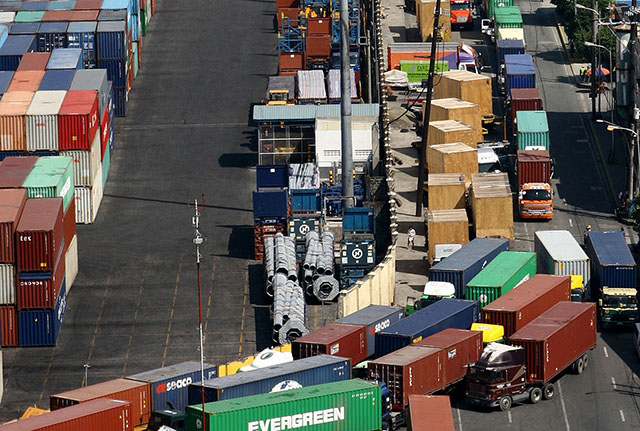
Cargo trucks wait inside the Manila Port Area in this May 2014 photo, while cargo deliveries have been paralyzed supposedly by City Ordinance 8336 which banned trucks from city streets during the day. The Professional Customs Brokers Association of the Philippines also said 12 cargo ships could not dock in the absence of warehouse space at the Manila International Container Port. Danny Pata
Since the cargo congestion plaguing the seaports of Manila erupted early this year, fingers have been pointing at the daytime truck ban the city government implemented last February.
However, the truck ban may simply be the tip of the iceberg that goes deeper that a prohibition on cargo trucks to solve a traffic problem.
For the largest business organization in the Philippines, the problem now hounding the cargo gateways is actually rooted on lack of planning and foresight to accommodate the economic boom in the past ten years.
The Philippine economy has grown at an average rate of 5 to 5.5 percent over the past decade, British banking giant HongKong Shanghai Banking Corporation (HSBC) Limited.
Last year, the Philippine gross domestic product grew by 7.2 percent from 6.8 percent in 2012, reflecting Asia's second fastest growing economy next to China.
The robust economic growth was driven by the manufacturing and services sector, the Philippine Statistics Authority said.
A situation waiting to happen
As businesses thrive amid the growing economy, more cargoes will definitely pass through the seaports, Sergio Ortiz-Luis Jr., Philippine Chamber of Commerce and Industry (PCCI) chairman, told GMA News Online on Thursday.
"Ten years ago, the PCCI warned of a port congestion taking place," he said.
"About five years ago, we asked the Bureau of Customs (BOC) to bid out the empty containers that have been piling up in the Manila ports, but nothing happened," said Ortiz-Luis who is also president of the Philippine Exporters Confederation (PhilExport).
Last August 6, Senators Francis Escudero and Paolo Benigno Aquino IV asked for a Senate probe on the worsening state of the two major ports in Manila.
The Manila International Container Terminal (MICT) and Manila South Harbor currently have a backlog of 73,500 container vans. There is also a backlog of 12,000 twenty-foot equivalent units (TEU) of empty containers – down from the previous 22,000 TEUs.
MICT is operated by International Container Terminal Services Inc., and Manila South Harbor by Asian Terminals Inc.
Blaming Erap's truck ban
The Philippine Ports Authority (PPA) went on to blame the daytime truck ban announced by Manila Mayor Joseph "Erap" Estrada in February. The policy banned cargo trucks from main roads from 5 a.m. to 9 p.m., which the PPA blamed for creating a backlog in deliveries to and from the ports.
It said the truck ban caused a backlog of 135,000 TEUs in three months since 5,000 TEUs arrive daily and only up to 3,500 TEUs were being discharged from south Harbor and MICT.
To resolve the port congestion, PPA said the truck ban should be lifted along selected routes.
The ports of Manila were already congested way before the truck ban, but the situation was still manageable, Alberto Suansing, Confederation of Truckers Association of the Philippines director, told GMA News Online in a separate interview.
"Lumalala na lang noong nag-start ang Manila truck ban, dahil na-restrict ang movement ng cargo out of the port," he said.
The truck prohibition in Manila was a "logistical nightmare" for truckers associations, Suansing said.
"Truck trips to and from the Manila ports before the ban reached 5,500 a day but now it's down to 2,000 a day," he said.
"Hindi puwedeng i-siksik yung 5,500 truck trips in just eight hours," Suansing noted.
Colorum trucks
The prohibition on cargo trucks could have worsened the congestion in Manila ports, but it was also an "eye opener" for everybody to realize what has been happening for quite some time, Ateneo de Manila University Economics professor Alvin Ang told GMA News Online.
"Ang tanong diyan: Noong in-implement ang stringent truck ban lang ba nagkaroon ng port congestion o baka dati pa?" he said.
Another problem that aggravated the pile up of empty containers in the ports was the situation involving colorum cargo trucks, which should be stopped, Ortiz-Luis said.
"Maraming trucks ang walang franchise. Marami sa kanila walang garahe. In reality, there's no shortage of trucks," he said. "In-enforce ang truck ban tapos sinasabayan pa nila ng strike kaya lalong 'di natatanggal ang mga container," he added.
There are about 11,000 franchised trucks compared to 30,000 colorum trucks plying the streets of Metro Manila, Land Transportation Franchising and Regulatory Board (LTFRB) chief of staff Mary Ann Salada said in a text message to GMA News Online, citing figures based on estimates of the agency.
Just last week, the LTFRB and the Metro Manila Development Authority (MMDA) teamed up to crack down on colorum trucks with green license plates.
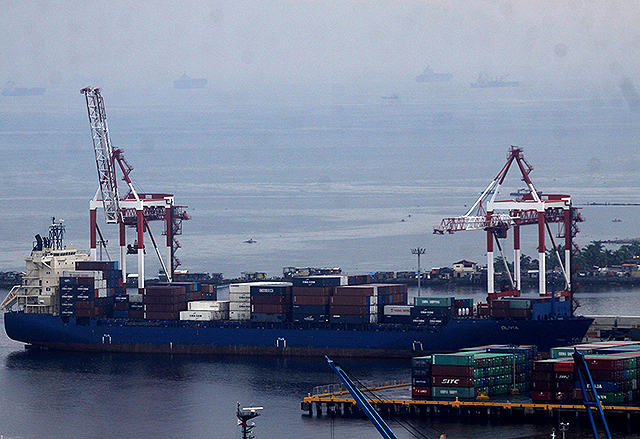
Empty container vans are loaded into cargo vessel Olivia at the Port of Manila on Thursday, August 21. Olivia was chartered by the Philippine Ports Authority to transport some 3,000 containers to the Subic Freeport Zone and decongest Manila's Port Area. Danny Pata
Move empty containers
To resolve the port congestion, government must fast-track the transfer of empty containers to other under-utilized ports, Ortiz-Luis said.
"Napakatagal ng process. Ngayon lang na-recognize. Hindi dapat trucks ang magdala ng mga containers, dapat barges," he noted.
Earlier this month, Trade Secretary Gregory Domingo said government is taking measures to ease congestion but it may take a month to decongest the ports.
The measures include transferring empty container vans to the ports of Subic and Batangas and opening BOC warehouses during weekends.
On Wednesday, Manila port operators spent P14 million to ship 3,000 container vans to Subic.
Decentralizing port operations
Decentralizing the port operations in Manila is also being looked at as a possible solution, but government should give incentives to industries and manufacturing companies transferring to sites near the Ports of Subic or Batangas, Suansing said.
"Decentralizing is good, as far as truckers' associations are concerned. But government needs to convince na maganda ang business environment sa lilipatan nila," he said.
"Kakaunti ang industry operations sa Subic at Batangas to induce delivery of shipments there," he said.
If they stay put in their current locations while shipments come from either Subic or Batangas, it will be more expensive for businesses, Suansing noted. "That would mean higher freight costs because of the distance."
Apart from freight costs, businesses would have to pay more in transport costs to have their goods delivered back to Manila, University of Asia and the Pacific (UA&P) School of Economics dean Peter Lee U said.
"Since Batangas and Subic are far from where they operate, business would have added transport costs, and this would translate to higher costs of goods in the market," he said.
"From a theoretical stand point, if Manila ports are congested, it's only natural to go elsewhere but with added costs," U added.
Economists earlier said that the Philippines may have forgone growth with the delays in the delivery of goods.
If the port congestion is not resolved quickly, it will have a domino effect on prices of goods, business sentiment and economic growth, economists said.
"Nagkapatong-patong na ang problema that's why government should act quickly," Ortiz-Luis said. – VS, GMA News

