

 GMA Brandtalk
 Tracking
 Archives

ADVERTISEMENT
Filtered By: Money
Money
WB downgrades PHL ranking in ease of doing business
(Updated 3:08 p.m.) The Philippines ranked 165 in the latest World Bank-International Finance Corporation's Report on Doing Business for 2016, down eight notches from 157 in 2015.
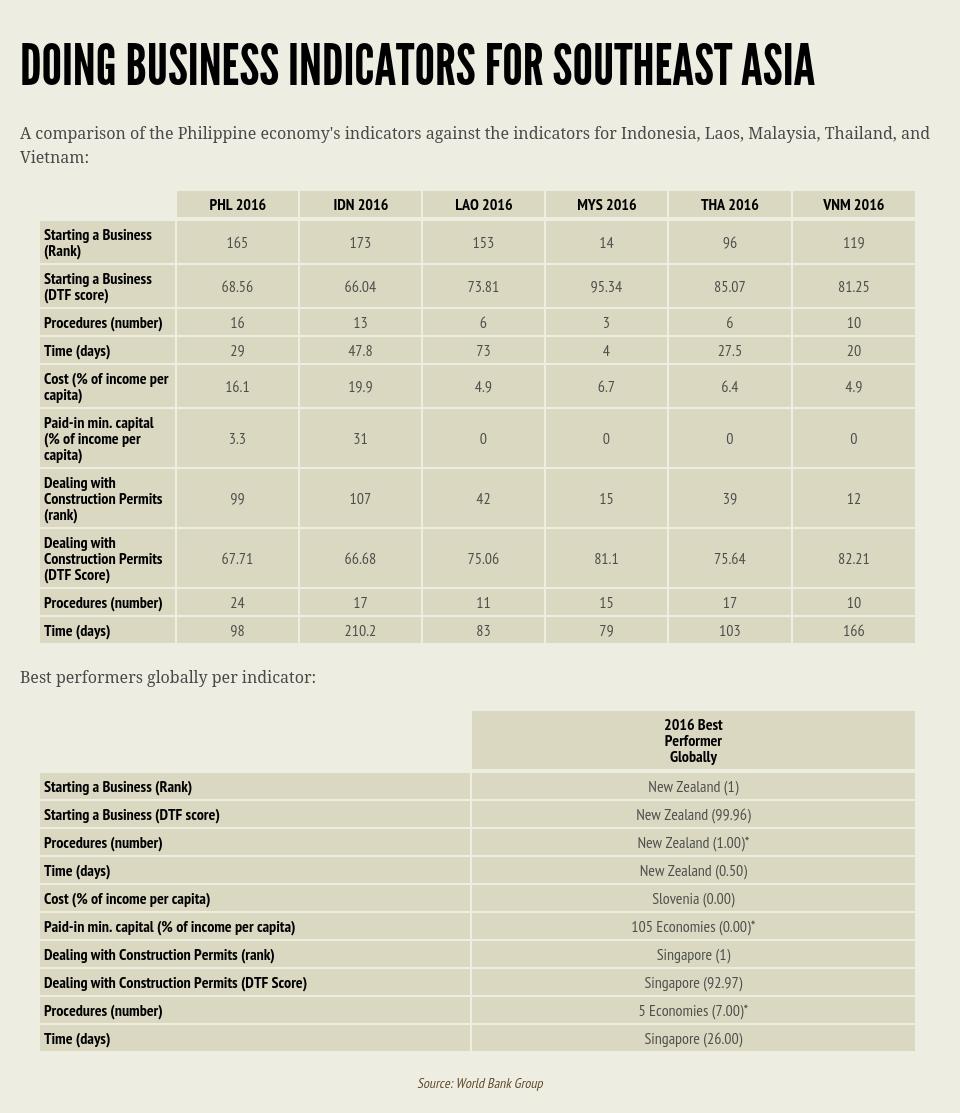
According to the WB Flagship Report-Doing Business 2016, the Philippines stands at 165 in the ranking of 189 economies on ease of starting a business.
“According to data collected by Doing Business, starting a business there (Philippines) requires 16.00 procedures, takes 29.00 days, costs 16.10 percent of income per capita and requires paid-in minimum capital of 3.30 percent of income per capita,” the World Bank said on Wednesday.
The 10 topics included in the ranking in Doing Business 2016 include starting a business, dealing with construction permits, getting electricity, registering property, getting credit, protecting minority investors, paying taxes, trading across borders, enforcing contracts, and resolving insolvency.
Compared to its Asian neighbors, the Philippines is behind Lao at 153, Vietnam at 119, Thailand at 96 and Malaysia at 14.
The best performer globally is New Zealand at No. 1.
The Philippines did not take the report lightly and issued its loudest critique yet of the report.
“The Philippines firmly believes that the Doing Business survey methodology of collecting sample data from only one or two cities makes it inappropriate to present the report as reflective of the state of doing business for an entire economy,” the Department of Finance (DOF) said in an emailed statement.
Doing Business 2016 focused on Quezon City for the survey.
The DOF noted that the Philippines undertook reforms in April to hasten the process of starting a business, reducing the process from 16 steps and 34 days to six steps and eight days.
Streamlining communications
Streamlining communications
Despite the drop in rankings, the World Bank noted the Philippines has made business transactions easier.
“The Philippines made starting a business easier by streamlining communications between the Securities Exchange and Commission (SEC) and the Social Security System (SSS) and thereby expediting the process of issuing an employer registration number,” the report read.
In terms of building a warehouse, the Philippines ranks 99 globally, with the process requiring 24 procedures, takes 98 days, and costs 1.10 percent of the warehouse value.
“The Philippines made dealing with construction permits easier by eliminating the requirement to obtain a health certificate,” it added.
Globally, the Philippines ranks 19 on the ease of getting electricity with a process that requires 4 procedures, takes 42 days, and costs 28.70 percent of income per capita.
Registering property in the country takes 9 procedures, takes 35 days, and costs 4.30 percent of the property value as the country ranks 112 out of 189 economies.
In terms of getting credit, the Philippine economy has a score of 5.00 on the depth of credit information index and a score of 3.00 on the strength of legal rights index. Higher scores indicate more credit information and stronger legal rights for borrowers and lenders.
The Philippines ranks 109 in this aspect.
“Globally, Philippines stands at 155 in the ranking of 189 economies on the strength of minority investor protection index,” the report read.
A higher ranking indicated that an economy’s regulations offer stronger minority investor protections against self-dealing.
The ease of paying taxes in the Philippines is ranked 126, with the firms having an annual average of 36 tax payments, spending 193 hours filing, preparing, and paying taxes amounting to 42.90 percent of profit.
Bright spots
Bright spots
Trading across borders, the country was ranked 95th, noting that the country imposed a new city ordinance restricting traffic in Manila.
In terms of enforcing contracts or resolving a commercial dispute, the Philippines stood at 140 as contract enforcement takes 842 days and costs 31 percent of the value of the claim.
Solving insolvency in the Philippines was ranked 53 globally. According to data collected by Doing Business, resolving insolvency takes 2.70 years on average and costs 32 percent of the debtor’s estate with the most likely outcome being that the company will be sold as piecemeal sale.
E-government initiatives were also launched on April which reduced the number of payroll-related payments from 36 to 13.
The DOF noted the processing of construction permits and registering property were also reduced, noting the same improvements in other indicators such as getting electricity which was lessened to approximately 35 days.
According to the DOF, starting a business and registering property vary across cities since local governments have varying procedures and processing times for the various activities involved.
“Countries, especially developing ones like the Philippines, will have bright spots of promise in some areas and not in others,” Finance Secretary Cesar V. Purisima said.
Purisima cited the economic zones managed by the Philippine Economic Zone Authority which give investors a “drastically different” landscape than other areas.
“With this methodology, the DB survey should be more aptly titled as ‘Doing Business Across Cities’ to provide a better representation of the results of the reports,” Purisima added.
Purisima stressed that the Philippines continues to undertake reforms to ease the conduct of doing business in the country.
“Make no mistake: while we maintain the firm position we have long taken against the flawed methodology, we are committed to the continuous work of reform that catapulted the Philippines up by 53 places in the last five years,” Purisima said.
“We refuse to be held hostage by flippant and unreasonable methodologies others insist upon us. We will persevere in rolling out more reforms to boost our competitiveness across various indicators,” he added. – Jon Viktor Cabuenas/VS, GMA News

