

 GMA Brandtalk
 Tracking
 Archives

December inflation clocks in at 2.6%, the fastest in 2016
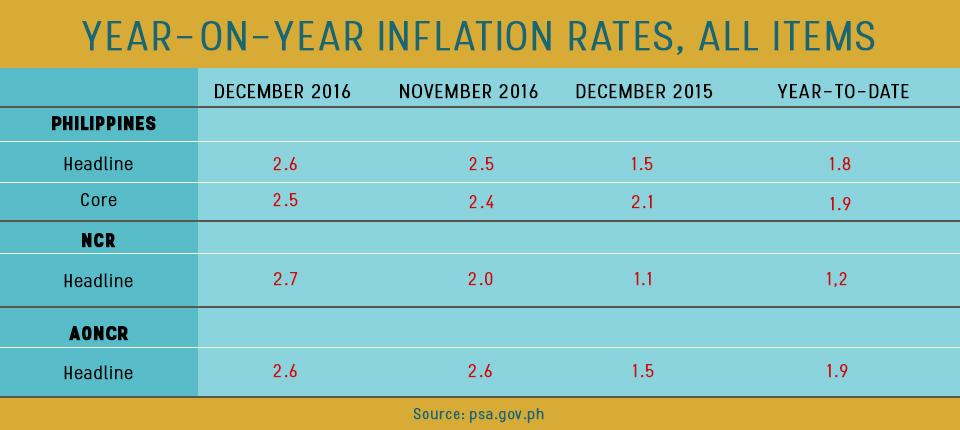
Inflation in December quickened by almost twice as it did a year earlier, the fastest in 2016, on the back of higher prices of food and non-alcoholic beverages, the Philippine Statistics Authority (PSA) reported Thursday.
"The Philippines’ year-on-year headline inflation inched up 2.6 percent in December 2016," the statistics office said.
This compares with 2.5 percent in November and 1.5 percent in December 2015.
An earlier forecast by the Bangko Sentral ng Pilipinas (BSP) placed the inflation rate for December between 2.2 and 3.0 percent.
Prices of consumer goods were lifted higher primarily by the yearly increases in the heavily-weighted food and non-alcoholic beverages index, the PSA said.
National Economic and Development Authority (NEDA) Director-General Ernesto Pernia attributed the increase in consumer prices to the holiday season.
“The uptick in inflation last month was caused by price increases partly due to the holiday season and supply constraints on some food items,” Pernia said in a separate statement.
Food inflation increased to 3.7 percent from 3.5 percent in November, and higher than the 1.8 percent in December 2015. Faster increases in the prices of bread and cereals at 1.6 percent from 1.5 percent, fish at 5.5 percent from 4.7 percent, and meat at 1.8 percent from 1.5 percent were recorded.
Oil prices
"Higher annual rates posted in the indices of transport and recreation and culture also contributed to the uptrend," the statistics office noted.
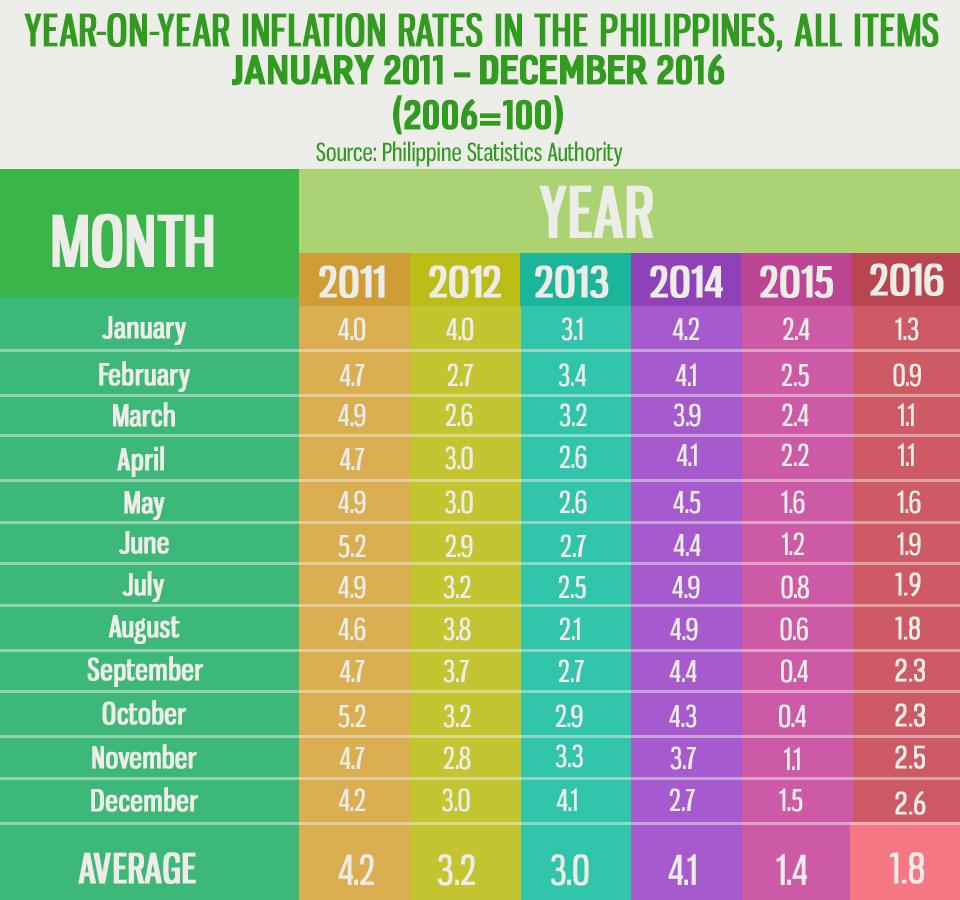
The December inflation brought the full-year rate to 1.8 percent, which reflected the projection of the central bank's policy-setting Monetary Board.
"The inflation prints are expected, and in line with our assessment that inflation would be inching up towards the NG (national government) target," BSP Governor Amando M. Tetangco Jr. said in a text message to reporters.
The government's inflation target is 2.0 to 4.0 percent for 2016.
Non-food inflation was pushed by transport index to 1.9 percent from 0.5 percent in November and recreation and culture to 1.7 percent from 1.6 percent.
“The higher prices in transport commodity reflected the hike in international oil prices, caused by oil-producing countries’ decision to cut oil production by almost 1.8 million barrels per day,” Pernia said.
Core inflation, excluding selected volatile food and energy prices, also soared to 2.5 percent from 2.4 percent in November and 2.1 percent in December 2015. The 2016 full year core inflation averaged at 1.9 percent, still lower than the 2.0 percent recorded in 2015, according to the NEDA.
“This indicates slower price movements across a relatively wide range of commodity items,” the Cabinet official said. — With Ted Cordero/ VS, GMA News

