

 GMA Brandtalk
 Tracking
 Archives

Miss Universe ‘More Fun in the Philippines’
The Department of Tourism (DOT) aims to surpass last year's tourist arrival target with the country's hosting of the 65th Miss Universe beauty pageant.
But while the DOT may indeed beat last year's 5.4 million foreign tourist arrivals, it's still a long way to go before the country beats its ASEAN neighbors.
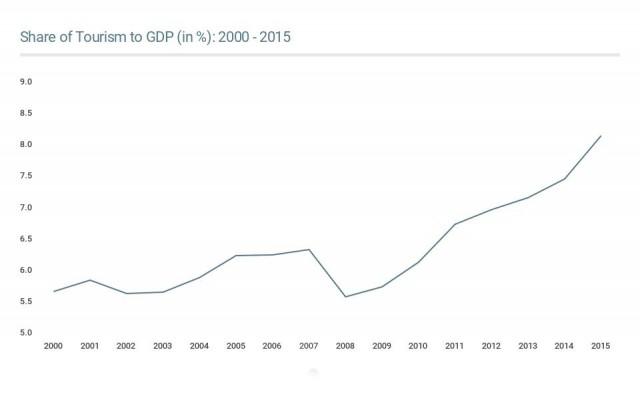
Members of the tourism academe, however, note that—with or without the Miss Universe pageant—Philippine tourism is a major economic driver, contributing 8.2 percent to the gross domestic product in 2015, making it as among the top exports of the country.
Miss Universe candidates have visited at least seven top Philippine tourist destinations as part of the activities for the international beauty pageant. (see map)
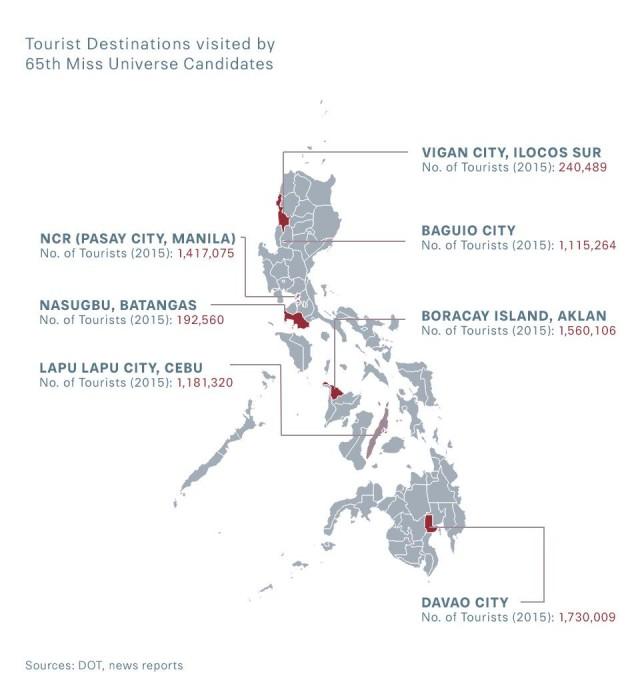
Six of these sites are top tourist destinations based on 2015 DOT data.
Among the tourist attractions the candidates visited are:
- Lapu Lapu City in Cebu, the number one tourist destination among the provinces;
- Davao City, which had more than 1.7 million visitors in 2015;
- Boracay Island, the fifth most visited tourist spot with more than 1.5 million visitors in 2015;
- Metro Manila, the region that ranked as the seventh most visited travel destination with more than 1.4 million visitors in 2015;
- Baguio City, the country’s “summer capital” where more than 1.1 million tourists visited in 2015; and
- Nasugbu in Batangas had nearly 200,000 travelers in 2015. The province of Batangas ranked 11th most visited destination in 2015.
Vigan City in Ilocos Sur was the site of the terno fashion show of Miss Universe candidates. The province was not in the DOT’s list of top destinations in 2015 but Vigan City had the highest tourism arrivals among the cities in Region 1, with 240,000 visitors that year. Vigan City is also the hometown of former Ilocos Sur Governor Luis “Chavit” Singson, one of the partners of the pageant.
Tourism boost?
As early as July 2016, the DOT has hyped the gains the country is expected to reap through hosting the 65th Annual Miss Universe competition. “Once (reigning Miss Universe) Pia (Wurtzbach) announces that the Miss Universe is going to happen here, people abroad will start looking at the map and see where the Philippines is. And, we’re saying, we’d love to have you in the Philippines,” Tourism Secretary Wanda Teo said in a press statement.
Members of the academe say economic gains from hosting the pageant remains to be seen.
Professor Maricel Badilla of the UP Asian Institute of Tourism said several indicators will need to be checked to say that, indeed, there were economic gains.
“As an academician, there are indicators to say that the use of a certain event can create success for a destination. In the absence of empirical research, meaning na magse-survey ako at aaralin ko ang mga comments (sa social media) like kapag nag-host ka ng Olympics, (can we say) siguradong mabu-boost ang tourism arrival mo? In the study of sports events, kadalasan you don’t just look at arrivals. Yung ganung exposure you cannot really measure that just in terms of arrivals,” Badilla said.
Since the pageant is a big international event that will boost awareness of the venue, Miss Universe can be considered a success in that point, Badilla said.
But whether such awareness translates to a boost in local tourism through foreign tourist arrivals is a different matter, she noted. Badilla said the “expected” boost in tourism arrival may come years later as trip planning takes time.
Professor Victoria Villegas, also of UP-AIT, agrees that global exposure, instead of tourist arrivals, is the immediate advantage of hosting the pageant. “Kung ang basis natin ay tourist arrivals hindi pa natin masasabi sa ngayon. One positive thing that Miss U can do for us is media global exposure kasi nga it’s an international event. At the minimum, yung mga participating countries, at least they (each) have a hundred people ang manood ng event or susubaybay sa social media. For us, mae-enhance and help sa exposure sa atin. It will help enhance kasi mayroon na naman tayong recall internationally,” Villegas said.
Tourist arrivals
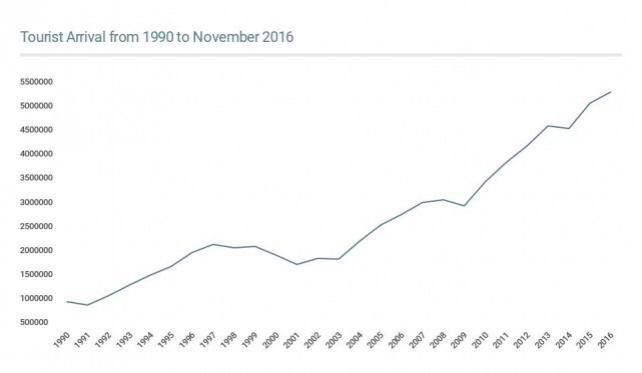
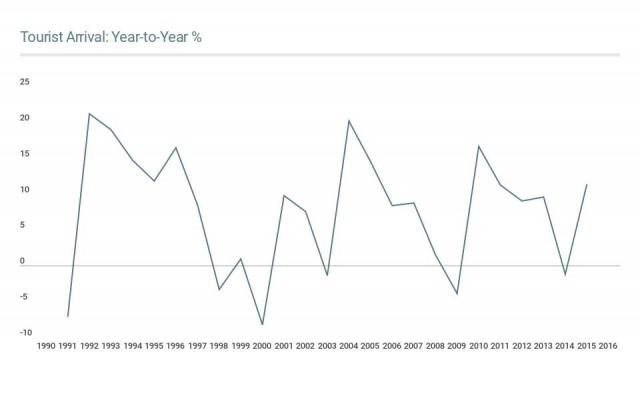
There was an increase in tourist arrivals in 1994, the last time the Philippines hosted Miss Universe. That year saw an 11-percent increase in tourist arrivals, from almost 1.4 million in 1993 to around 1.6 million in 1994.
Still, it should be noted that tourist arrivals had been increasing since two years before that, in 1992. In the last 26 years, tourist arrivals ballooned from around 1 million in 1990 to about 5.4 million in 2016. (see table and graph)
Badilla said the effect of hosting the pageant may be felt a year after it took place, since foreign tourists plan ahead of time—from six months to a year.
DOT data show that tourist arrivals steadily grew from 1992 to 1997. The number of tourists who came to the Philippines slightly decreased in 1998—Badilla attributed this to the Asian financial crisis.
It slightly increased in 1999 only to drop again in 2000 and 2001. It rose in 2002 but fell in 2003.
In the next five years, from 2004 to 2008, tourist arrivals steadily increased. The year 2004 posted the biggest year-on-year increase in tourist arrivals, from 1.9 million in 2003 to almost 2.3 million. Badilla said this can be attributed to the DOT’s WOW Philippines tourism promotion campaign.
In the last eight years, except for the years 2009 and 2014, tourist arrivals followed an increasing trend.
Sixth in ASEAN
Still, the Philippines lags behind five of its neighbors in the Association of Southeast Asian Nations. World Tourism Organization data show that Thailand, Malaysia, Singapore and Indonesia all enjoy eight-digit tourist arrival figures in 2015. Vietnam edged out the Philippines in the fifth spot, with 7.9 million visitors in 2015 compared to our 5.4 million.
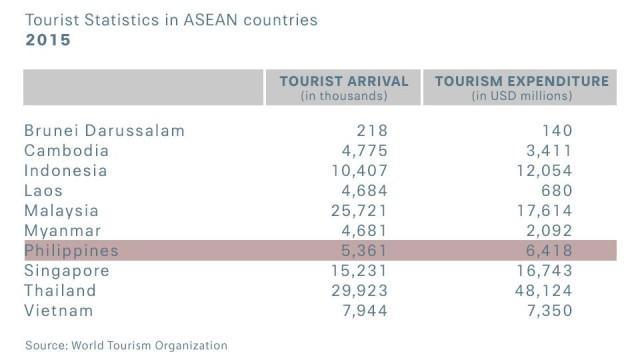
Villegas said the Philippines’ middling ranking in the tourist arrivals game can be attributed to connectivity. “We are an archipelago while the rest have land access,” she said. Villegas also cited the absence of certain tourist-friendly government policies such as tax refunds as well as poor infrastructure.
“Ang bawi naman natin sa totoo lang ay hospitality and warmth and the professional service that we give. But that’s quite difficult to communicate nang malayo yung bisita. Kailangan nandito na sila para maipakita natin yung side na yun,” Villegas said.
Third biggest PHL export
While tourist arrivals is the primary indicator of tourism growth, Badilla said focus should be given to tourism spend. She noted that the Philippines is doing well on inbound tourism expenditure or the expenses of non-resident visitors, including foreigners, within the Philippines.
Philippine Statistics Authority data show that inbound tourism expenditure grew by 10.7 percent in 2015, equivalent to P306.6 billion, from P276.9 billion in 2014. The PSA notes that inbound tourism expenditure took up 8.2 percent of the country’s total exports. Inbound tourism ranked third among the biggest export items in 2015, after miscellaneous services and semiconductors.
“Ang struggle kasi namin sa tourism industry is not many see it as an important economic driver… Arrivals tell how many people came but another better indicator is tourism receipts. How much did they spend? Doon tayo malaki compared to our ASEAN neighbors. We get that long haul kasi, they (foreign tourists) stay longer,” Badilla said.
World Tourism Organization data show that foreign tourists stay the longest in the Philippines among seven ASEAN countries, edging out even such tourism hot spots as Thailand and Indonesia. Foreign tourists stay nearly 10 days in the Philippines, spending about $108 per day.
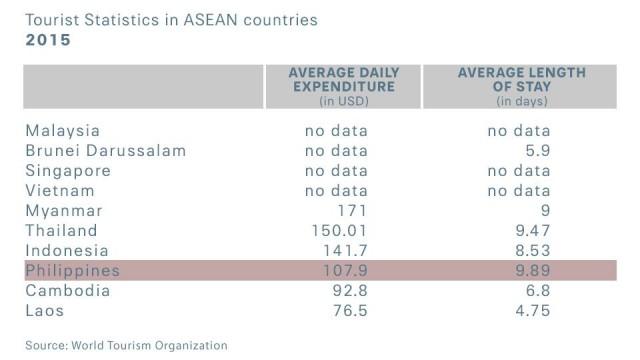
“Tourism is like an export. We are ranked third biggest export. Hindi yan nakikita ng regular layman. You normally look at arrivals. But if you look at the comprehensive impact of tourism, you have to look at length of stay, tourism receipts. Yung total cumulative tourism expenditure, inbound,” Badilla said.
P210-billion earnings
In January to November 2016, total earnings gained from tourism activities totaled to about P210 billion. The DOT noted that this is 3% higher compared to the previous year’s earning of P204 billion. Tourism’s share to the gross domestic product, at 8.21 percent as of 2015, is said to be the highest in 15 years and has been on the rise since 2008.
“It is a growing industry and those destinations that adopt a priority on tourism have actually grown. Malaysia, Thailand they have significantly depended on tourism as a driver for their local economy. Even in the Middle East, they are reverting to tourism as their back-up industry to rely on kapag the supply of oil ran out. Tayo sa Philippines, if we get investments towards tourism-related products, you’d see na yan (tourism) na ang next driver of economy,” Badilla says.
Summits vs. pageants
In the long-term, international summits such as the ASEAN and Asia-Pacific Economic Cooperation bring more tourism-related investments compared to an international beauty pageant such as Miss Universe, Badilla and Villegas said.
With an event like Miss Universe, Badilla said, one would just look into tourist arrivals. But those attending the APEC summit are seeking to invest in the Philippines, she said.
“In terms of investors, high ang return sa mga business summit hosted by the Philippines. Itong Miss U, regular market lang ito, kumbaga mga independent travelers. But if you have investments coming in, feeling ko that’s more effective use of the limited resources in the Philippines. Sa mga summit ang papasok na investment, isang bilyon or magtatayo ng hotel. Kung tourist arrivals lang ang titingnan, hindi siya enough assessment of an event,” Badilla said.
Villegas also said bilateral agreements are usually signed during government-sponsored summits. “In terms of popularity, malaki ang maibibigay ng Miss Universe but yung long term, APEC or ASEAN ang magbibigay ng benefit especially kung ang topic ay tourism development. Itong Miss Universe naging malaking bonus siya in terms of exposure,” she said.
74th in tourism competitiveness
The Philippines slightly improved in ranking in travel and tourism competitiveness among 141 countries. From 86th in 2009, the country moved up 12 notches to 74th in 2015, data from Travel and Tourism Competitiveness Index show.
The 2015 TTCI report noted that the Philippines, along with Saudi Arabia and Qatar, had the biggest increase in tourism expenditure.
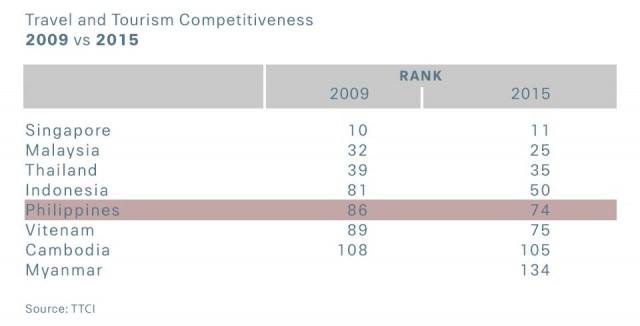
Despite this improvement, the country still lagged behind in certain aspects like infrastructure and security. The Philippines ranked near the lower end of the spectrum in terms of quality of airports and security. It is in the lower half level in terms of quality of roads.
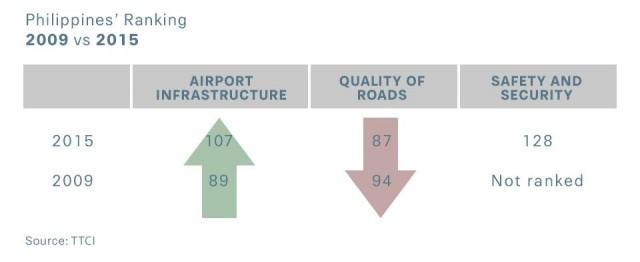
Badilla and Villegas both call for the improvement of airports, the Philippines being an archipelago.
“Acceptable travel time is 40 minutes,” Badilla said. “Ibig sabihin from the airport, you should be in your destination in 40 minutes. E tayo, magba-bus ka pa, magbabangka ka pa. E naka-leave ako for one week, one day or two days doon, ibabiyahe ko? So doon na lang ako sa kaya kong puntahan agad so ipapahinga ko na lang imbes na i-travel ko pa.”
Villegas noted that there a lot of destinations in Visayas and Mindanao that can be best reached through direct flights.
In terms of safety index, Villegas said that despite the travel bans imposed by, for example, Australia, that country remains a top foreign visitor. “Travel agents are really asking, e maraming napapatay diyan sa inyo, how can you assure us na pagdating namin diyan hindi kami mapapatay? May ganun na talagang ni-raise ang ilang travel agents,” Villegas said.
Badilla said the Philippines’ image is tainted with terrorism; Mindanao and the southern Philippines in particular are hard to market. “Sometimes hindi na sinasabing sa Pilipinas or sa Mindanao siya. We just promote the destination per se,” Badilla said.
Price competitiveness
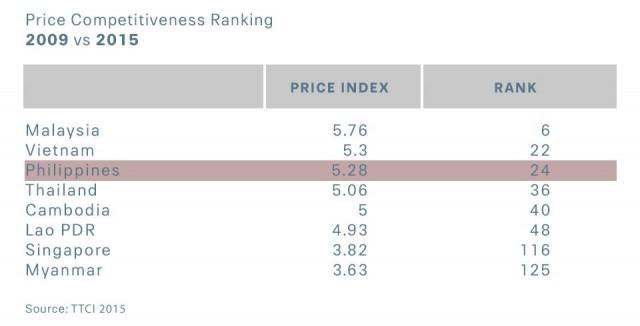
In term of prices of hotels, food and other goods, the Philippines fared 24th among the countries. The country ranked fourth among ASEAN countries in terms of price competitiveness, next to tourist drawers Indonesia, Malaysia and Vietnam. Prices are higher in Thailand, the top ASEAN destination, which ranked 36th.
In the 2009 report, where the Philippines ranked 16th, TTCI noted that lower prices in our country drew tourists. The Philippines subsequently went down eight notches to 24th in the latest survey.
“Mahal ang mga hotel dito," Badilla said. “May law of supply and demand din yan. Since tumatas ang arrivals natin, we don’t have that many rooms. A lot of people look at selling part lang. A lot of pricing, puwedeng mag-iba 'yan. 'Pag fully booked yung hotel na katabi mo, puwede ka magtaas.”
Still 'more fun'
Besides the Miss Universe, the Philippines is also hosting the yearlong meetings and activities of the Asean this year.
This week, the DOT launched its first promotional video, a minute-long clip entitled “Anak”, which was shot in the Enchanted River in Hinatuan, Surigao del Sur. The DOT of the Duterte administration has decided to retain the “It’s More Fun in the Philippines” campaign of its predecessor, although Teo had promised an “upgrade.”
In a press conference during the launch, Teo said the leveled-up campaign seeks to answer the question, “Why is it more fun in the Philippines?” The first campaign video, she said, provided one answer: Filipino hospitality and warmth.
Whether this branding will bring in more tourists to the country, poor facilities and safety issues notwithstanding, remains to be seen. —ALG, GMA News

