

 GMA Brandtalk
 Tracking
 Archives

NCR still main driver of GDP growth despite slowdown in 2017 —PSA

The National Capital Region (NCR) remains the most influential driver of economic growth in the Philippines despite slowing down in 2017, the Philippine Statistics Authority (PSA) said Thursday.
“Rank 10 siya among the regions in terms of growth rate. Even the growth rate of NCR was below the national level average,” Rosalinda Bautista, assistant national statistician, said.
“It’s still positive. We continue to be the main driver because ang NCR accounts for 36.4 percent of the entire economy of the Philippines,” she told reporters after a press conference in Pasig City.
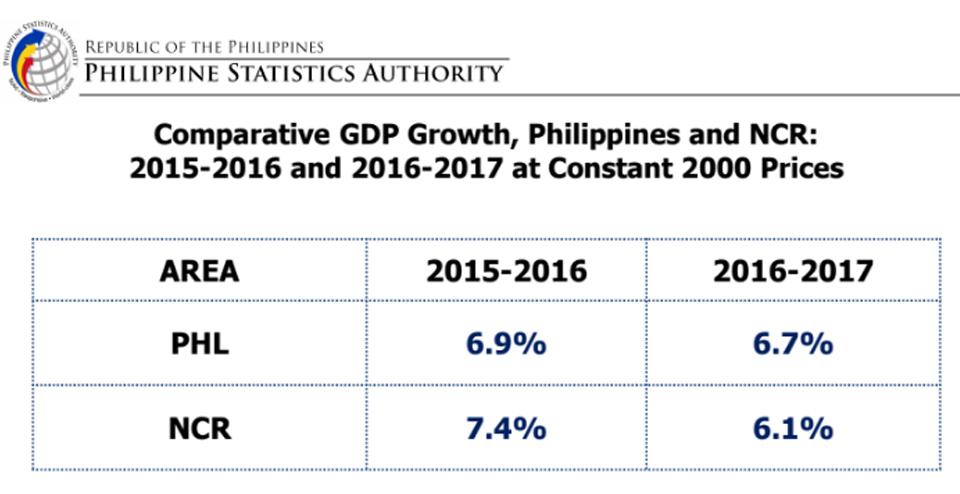
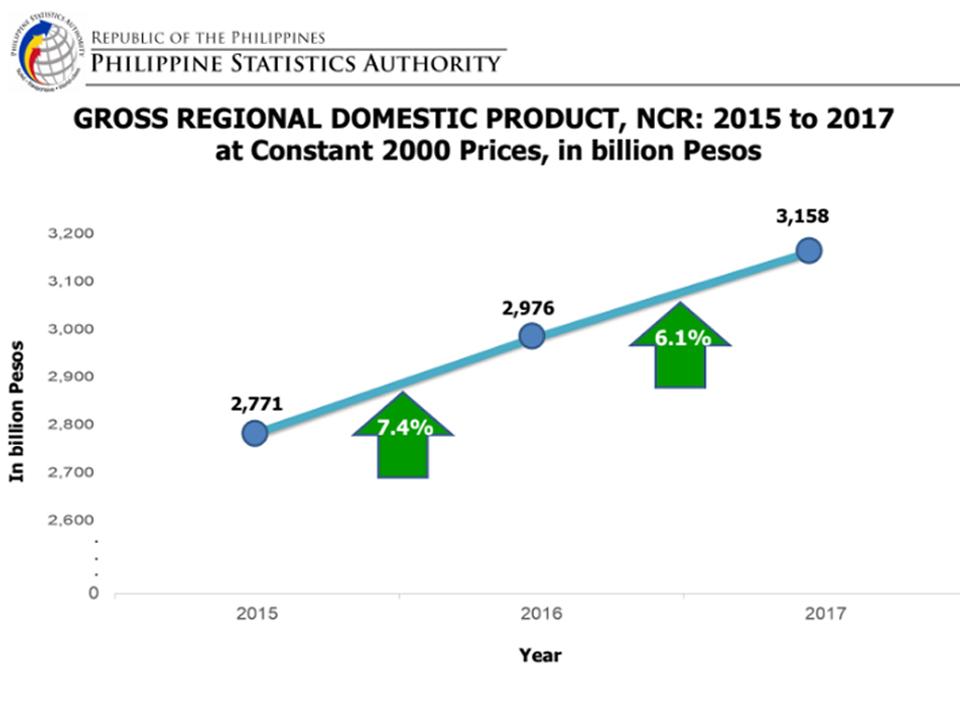
According to the PSA’s presentation on the 2017 economic performance of NCR, the gross regional domestic product (GRDP) in the capital region grew at a slower pace of 6.1 percent, valued at P2.976 billion, in 2017, compared with 7.4 percent, valued at P3.158 billion in 2016.
The national average of GDP growth was 6.7 percent last year.
“Nagslow-down lang po ‘yung paglaki,” Ma. Josefina Faulan, Metropolitan Manila Development Authority (MMDA) Planning Office director III, said during the same briefing
“Lumalaki pa rin, the total value of the services of products tumataas pa rin, but the rate of change, ‘yung pagbabago niya ay hindi lang kasing bilis. Hindi na siya kasing-bilis ng pagbabago,” she said.
PSA-NCR Regional Director Paciano Dizon said the slowdown was partially caused by the drop in spending in private construction.
“This construction data comes from approved business permits, which comprises 80 percent of the data, and only 20 percent comes from the national. One of the reasons is the decline, the weigh down in construction,” said Dizon, noting that manufacturing also slowed down.
While no percentage was given on the impact of traffic on the economy, Bautista said whatever positives it brings in terms of income investment is offset by business owners possibly being turned off from building their base in the NCR.
“Pag matrapik itong lugar na ‘to, ah, ayaw ng investor magtayo ng new industries or establishments, they will not come in the area, and therefore,‘ yun ‘yung makikita natin na pwedeng mapunta,” she said.
“Nandito pa rin sila sa Pilipinas, pero sasabihin nila o sige, doon na lang tayo sa ibang regions na walang ganitong traffic situation,” Bautista noted.
In contrast, the Cordillera Administrative Region (CAR) registered the biggest growth rate in 2017 (12.1 percent), along with Region XI (10.9 percent), and Region III (9.3 percent).
Though the Philippine economy is not dependent on NCR’s output, Bautista said the capital region’s GRDP carries a big impact on the economy as a whole.
“Kung anuman ang mangyari sa economy ng NCR, magkakaroon siya ng malaking impact to the country’s economic development,” she said. —VDS, GMA News

