

 GMA Brandtalk
 Tracking
 Archives

Philippine Stock Exchange to face a challenging 2019
As the market moves to recover from the volatility of 2018, the same risks as the US-China trade war and threats of rising interest rates are expected to soften investor sentiment in 2019.
The market endured volatility this year amid soaring inflation, interest rate hikes—both domestic and overseas— and the escalating trade tensions between the US and China.
“Overall, we think that 2019 will be a challenging year,” PNB Securities president Manuel Lisbona told GMA News Online.
He noted that the benchmark PSEi runs the risk of falling to the psychological support at 6,600 if yield rates and the tariffs conflict continue exert pressure on the market.
“Rising interest rates and trade war tensions are still the biggest concerns. Support looks strong at 7,000 but 6,600 could be hit if rates rise faster than expected,” Lisbona said.
Perhaps, the most pressing issue for the market this year is when US President Donald Trump waged a “trade war” against China. China retaliated and imposed levies on more than 80 percent of US goods.
Early in December, Trump and Chinese President Xi Jinping agreed to a 90-day lag in imposing new tariffs. It was received positively by financial markets.
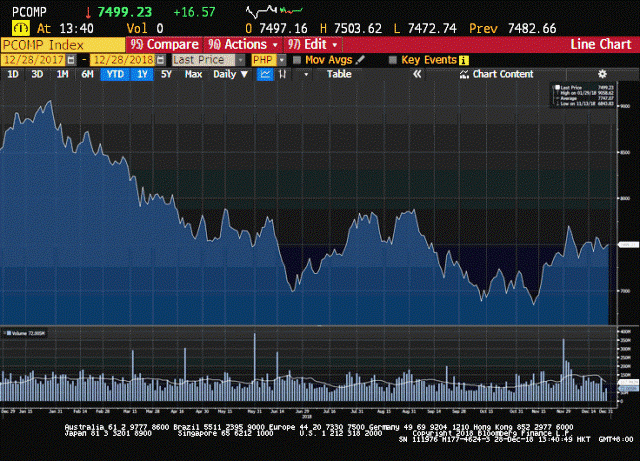
In the Philippines, the benchmark PSEi peaked at an all-time high of 9,058.62 on January 29. From that level, it steadily slipped to hit its lowest for the year at 6,884.38 on October 12—a 24-percent drop from the peak in January.
Since then it has recovered and traded within the 7,000 to 7,500 range in November until late December as inflation started to show signs of easing and trade negotiations between the US and China showed signs of improvement.
Regina Capital Development Corp. head of sales Luis Limlingan holds a more optimistic view of the market.
“We are hoping for 8,800,” Limlingan said, citing an election year, slower inflation, and lower crude prices as factors working in favor of a bullish market.
However, he cautioned against the ill effects of the US-China trade war and spikes in oil prices.
Then there is also the gapping trade deficit that might lead to further depreciation of the peso, and the slowdown in global growth.
“For next year, several factors coming from the US and China may play a big role in the movement of our market,” Timson Securities equities trader Jervin de Celis said.
The rift between the world’s two biggest economies must first be resolved to restore market confidence in risky assets like stocks.
“In this case, the PSEi may finally breach its resistance at 7,500 and revisit 7,800 to 8,000,” De Celis noted.
“If the trade rift worsens and our macroeconomic data do not improve, we may be dragged by the negative sentiment and send our index below 7,000 again.”
The silver lining could be the dovish stance of the US Federal Reserve, holding back on further rate hikes that could prompt fund managers to take new positions in the Philippine market.
“If foreigners come back ... a buying spree may push the PSEi to breach 8,100 and revisit 8,400-8,500 level,” De Celis said.
“PSEi at 9,000 may be too ambitious, but this is still possible if local corporate earnings and our gross domestic product improve next year,” he said.
Window dressing
Analysts expect the PSEi to close 2018 between 7,200 and 7,800 as fund managers go on window dressing to improve their portfolio—buying winning shares and selling losing stocks.
Limlingan cited 7,300 and 7,700 for the benchmark index.
“Optimistic case with no macro external shocks ‘til year end is 7,700 ... If there is, it will be 7,300.”
On top of window dressing, investors tend to start taking positions for 2019 on the premise that election spending would be a strong catalyst for the market.
There is also the negative factor that could stop buyers from taking new position on the last trading day of 2018.
“For the year-end, the PSEi may fall within the range of 7,250 to 7,750,— Philstocks Financial Inc. research associate Piper Chaucer Tan said.
“The market is expected to remain volatile with global factors being the main influencers. The local bourse has been more sensitive to the spillovers from Wall Street. Oftentimes, when US indices go down the PSEi follows,” Tan said.
US stocks closed in positive territory on Thursday, with the Dow adding 1.14 percent, after suffering steep losses for much of the session, according to a report by Reuters. —VDS, GMA News

