

 GMA Brandtalk
 Tracking
 Archives

Balisacan says PH economy remains strong amid governance challenges
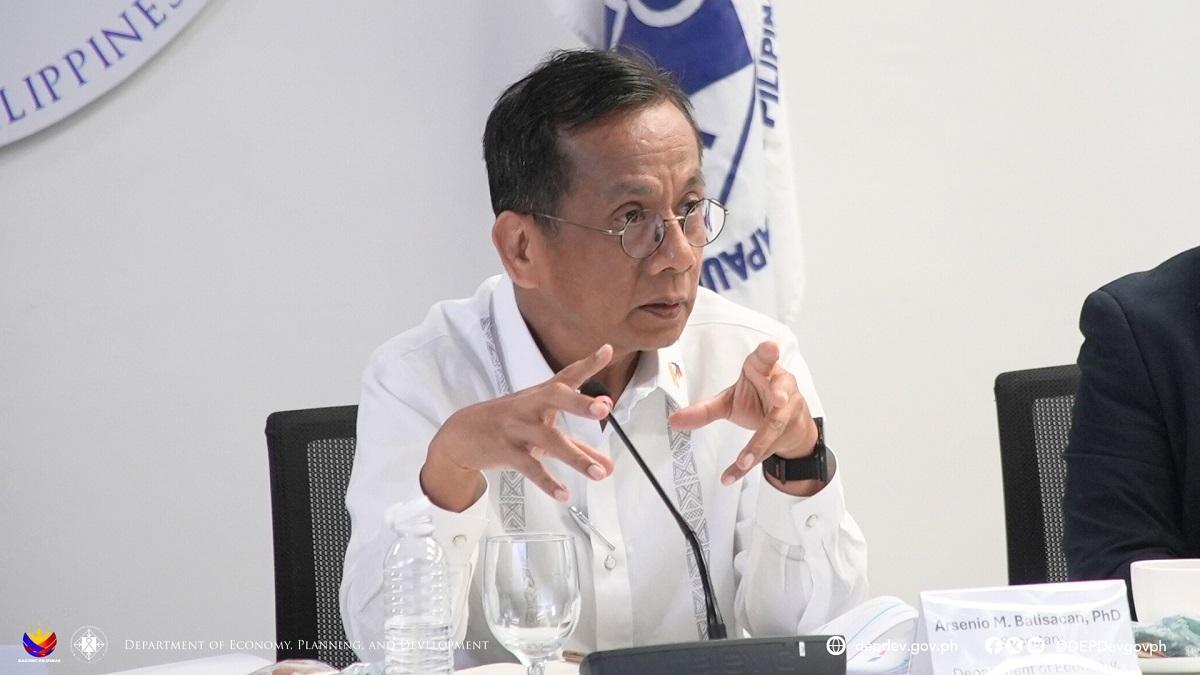
Department of Economy, Planning, and Development (DepDev) Secretary Arsenio Balisacan on Thursday acknowledged governance troubles gripping the administration, but maintained that the Philippine economy remains stable and supported by structural strengths and reforms.
According to Balisacan, the country’s overall economic trajectory “remains firm,” with efforts underway to deepen reforms, and potential growth remains at least 6% annually.
“The Philippine economy remains strong despite recent governance challenges and continuing global uncertainties,” he said in an emailed statement.
“Amid political noise and global headwinds, the economy continued to expand: although growth moderated to 4.0% in the third quarter, full-year growth for 2025 has so far averaged 5.0%. International institutions, on average, project a 5.7% growth rate for 2026,” he added.
This comes amid a shakeup in the Marcos Cabinet, with the departures of Executive Secretary Lucas Bersamin and Budget Secretary Amenah Pangandaman earlier this week.
Senator Maria Imelda Josefa “Imee” Marcos earlier this week accused her brother, President Ferdinand “Bongbong” Marcos Jr. and the First Family of using illegal drugs, claims which Malacañang said were lies.
Philippine economic growth clocked in at 4.0%, the slowest in four years since the 3.8% recorded in the first quarter of 2021 when the country implemented strict lockdown measures due to the COVID-19 pandemic.
“Our sound macroeconomic fundamentals — sustained growth, easing inflation, a healthy labor market, a manageable fiscal deficit and public debt, a broadly stable currency and external position, and a robust banking system — continue to anchor our resilience,” Balisacan said.
Latest government data show that inflation was unchanged month-on-month at 1.7% in October, below the central bank’s 2.0% to 4.0% target range. Jobless Filipinos also declined to 1.96 million in September from 2.03 million in August, while the sovereign debt dropped to P17.455 trillion in September from P17.468 trillion the previous month.
“Supported by structural strengths — including a robust labor force, steady capital investment, productivity gains, and ongoing technological progress — our potential growth remains at least 6% annually. Our medium-term targets reflect this capacity,” Balisacan said.
The inter-agency Development Budget Coordination Committee (DBCC) expects economic growth to range between 5.5% to 6.5% this year, and from 6.0% to 7.0% from 2026 to 2028.
“The government will continue to deploy fiscal, monetary, financial, technological, and social-protection policies, together with key legislative measures, to keep actual growth aligned with this potential,” Balisacan said.
“At the same time, we have been laying down the necessary investments to future-proof the economy amid environmental, technological, and geopolitical disruptions,” he added.
Former Finance Secretary and now Executive Secretary Ralph Recto previously made a similar statement, maintaining that the Philippines remains on solid economic footing and good governance “is more resolute” than ever.—AOL, GMA Integrated News

