

 GMA Brandtalk
 Tracking
 Archives

Philippines closes 2025 with 1.7% inflation rate
The Philippines ended 2025 with a year-to-date average inflation settling well within the government’s target, the Philippine Statistics Authority (PSA) reported on Tuesday.
At a press conference, National Statistician and PSA chief Claire Dennis Mapa said the overall inflation —which measures the rate of increase in the prices of goods and services— clocked in at 1.8% in December 2025
This was faster than the 1.5% rate posted in November 2025.
December’s inflation print brought the 12-month 2025 national average to 1.7%, which stood well within the administration’s comfortable ceiling of 2% to 4%.
The 2025 average inflation was slower than 2024’s average rate of 3.2%.
This was also the slowest annual average inflation rate since 2016 when the overall year-to-date inflation rate stood at 1.3%.
'Resilient'
In a statement, Department of Economy, Planning, and Development (DEPDev) Secretary Arsenio Balisacan said, “Despite global headwinds and domestic challenges, the Philippine economy has remained resilient against inflationary pressures due to the government’s timely and targeted interventions.”
“Building on this momentum, the government will continue to pursue prudent fiscal and monetary coordination and advance structural reforms to sustain the downward inflation trend and support inclusive growth in 2026 and beyond,” said Balisacan.
The PSA reported that the downtrend seen in 2025’s annual average inflation rate was primarily due to the lower increase in the heavily weighted food and non-alcoholic beverages index, with a rate of 1.2% from 4.4% in 2024.
Meanwhile, the uptick in December alone was attributed to the impact of Typhoon Uwan, which disrupted food production as food inflation—which tracks the price movements of food items in a "basket" commonly purchased by households—accelerated to 1.2% from -0.3% in November.
This was due to the faster increase in vegetable inflation to 11.6% from 4% to 11.6 percent on the back of increases in onions at 79% from 48.2%, eggplants at 29.4% from –6.5%, and pumpkins at 20.1% from 8.8%.
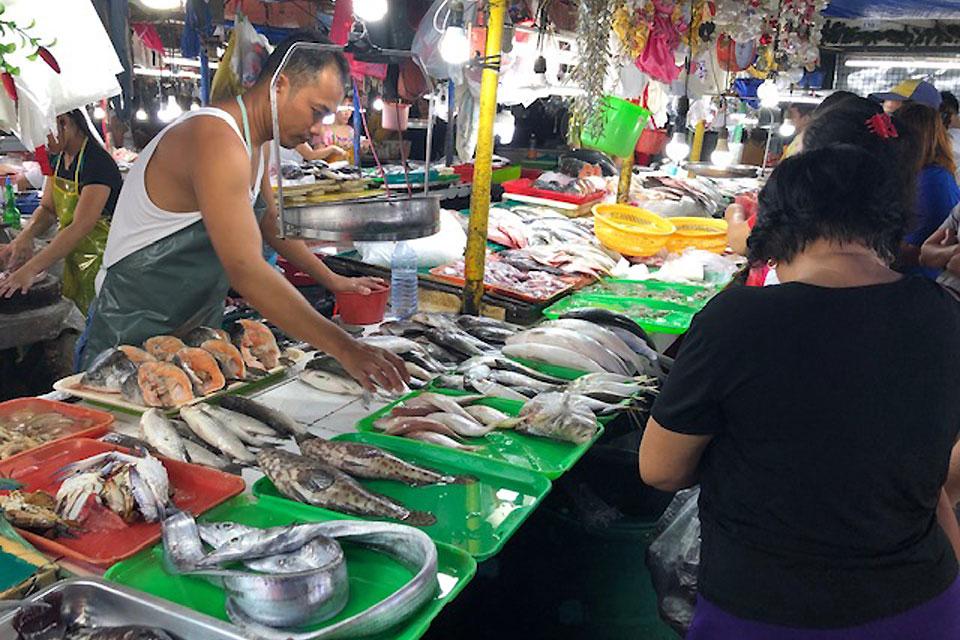
Inflation for fish, likewise, increased to 9% from 8.6% due to limited import arrivals.
The increases in the said food commodities were partly offset by slower inflation in meat products, which declined from 4.2% to 3% amid the decrease in the cases of African swine fever (ASF), which helped pull pork inflation down to 4.8% from 7%.
Moreover, surplus supply drove chicken inflation slower from 1.9% to 0.7%.
Inflation for rice, the country’s food staple, saw a moderated deflation of –12.3% from –15.4%.
Balisacan said the government remains steadfast in implementing policies that temper price pressures and maintain the inflation rate within the 2% to 4% target range for 2026 to 2028.
The country’s chief economist said a key component of the government’s inflation strategy is the P297.1-billion allocation for the agriculture sector in the 2026 national budget, which would prioritize boosting farmer productivity and strengthening food security through measures such as the construction of farm-to-market roads and bridges; development of food hubs, cold storage facilities, and rice mills; and programs to help maintain affordable prices of agricultural products.
Furthermore, in addressing the impact of rising electricity demand and managing energy-related price pressures, the Department of Energy is accelerating the completion of 200 power generation projects, ensuring that committed capacity comes online as scheduled and meets safety and reliability standards.
“These policy initiatives form part of our broader thrust to attain food security, improve human capital, and enhance the quality and efficiency of public service delivery—priorities that enable inclusive, broad-based growth for all Filipinos,” Balisacan added. —AOL/ VAL, GMA Integrated News

