

 GMA Brandtalk
 Tracking
 Archives

Entering the investment world? Learn to be ‘mindful’
D
o you want to have enough money to travel, or treat yourself once in a while? Do you want to buy a house? Do you want to give back to your parents, or pay for your children's education? Do you just want fewer financial worries?
Making wise investments can help you get there. But where should you start, and how do you know if you are in the right mindset to invest?
Investing is putting resources—such as money—in an asset or assets in order to generate more income. Investments can take the form of stocks and bonds, real estate, or mutual funds. You put your money in these assets with the expectation of earning higher returns than from simply putting your money in a savings account.
But the increased chance of higher returns means there is more risk in investing. That is why you have to be aware of what you're getting into. You don't need to be demure, but it pays to be mindful.

Investing against inflation
G
inelle Sequitin is a financial advisor at Sun Life Philippines, one of the country's oldest insurance and financial services companies. She shared some things you have to do before you get into investing:
- You have to be aware of the ins and outs of your money. Is your income enough for your present and future plans? What are you doing with it, and is it growing enough for you? Once you have answers to these questions...
- Have a goal. Making a vision board can help you to get a clear picture of what you want and how you can get from point A to point B. Once you have identified your goals...
- Bring yourself to a supportive environment. Assess whether the ones you are with have the same lifestyle as you or have the same visions and values. Work to put yourself in a new environment if your current one is bad for you. Once you get to a better place...
- Understand that there are risks and learn to balance. Develop a good money EQ (emotional intelligence) by studying up on investing and personal finance, because it will help you recognize the risks and manage your response to the ups and downs of investing.
Sequitin adds that if you want to start investing, you must first master managing, keeping, and saving your money.
- Managing your money. This is learning to allocate your money: what portion goes to your bills, what portion goes to other expenses, what portion goes to your savings, and what portion goes to your investments.
- Keeping your money. This is gaining control of how you handle your money. You pay off your bills and debts, and budget your expenses so that you still have some left over.
- Saving your money. This is setting aside the money you have after payments and expenses and saving it for future use.
If you are doing well so far, you can move on to growing your money.
- Growing your money. This is taking the opportunity to increase your money such as in business—or investments. Investments will take your idle money and make it grow.
- Protecting your money. This is making sure that your money is safe and secure, there in case of emergencies and as a cushion for the future. You learn about diversifying your portfolio, insurance and income protection plans—as well as scams and bad risks out there.
For many people, the only options are to either save their money or to spend it. It's often we hear people say, “I might die tomorrow, so I might as well spend my money,” or “I worked hard for this money, I deserve to use it and do what I want.”
Sequitin said, “Kapag nagtipid ka lang, yung flow ng money mo kuripot din. [Pero] kapag masyado kang patapon, yung flow ng pera mo mabilis ding mawala [If you only saved, your flow of money will also be small. But if you are too wasteful, you will lose your money quickly]. So you have to find the balance of both.”
Sequitin, 28, hopes more young people will look into the third option of investing.
“At the end of the day, the goal of investing is to give you financial freedom. And if you want to be financially free, then you have to invest, to grow your money. Because again, our life and age is getting longer, there will be unexpected expenses because you are alive, and number three, inflation is here. Our purchasing power decreases, and the value of money is getting lower and lower. The cost of living is getting higher and higher,” she said.
F
rancis Diaz is president and co-founder of Luna Securities Inc., one of the newest stock brokerages in the country, with a focus on technology and making investing easy and accessible. He also makes the point that inflation, a major factor often overlooked, also makes investing crucial as it isn't just about rising prices—it also includes lifestyle inflation, the growing cost of maintaining your way of life.
“The reality is, if your money isn’t growing at a rate that beats inflation, you’re losing purchasing power. Simply parking your money in a low-yield savings account won’t cut it. That’s why investing is crucial,” he said.
'The key is to start'
Diaz said starting out in investing can feel intimidating, especially for young people. In many cultures, including the Philippines, investing doesn’t always come naturally.
“There are myths, fears, and hesitations—‘You’ll lose all your money!’ is a common sentiment. But the truth is, no one is ever truly ‘ready’ to invest—just like no one is ever fully ready to drive or swim. The key is to start,” he said.
Two good ways to start are to look for a good professional advisor and to do your own research.
In looking for professional assistance in investing, Diaz said you should always remember to keep it “R.E.A.L”:
- Reputation - Check that the company has a good track record and no history of fraud.
- Experience - Look into how long it has been in the field and learn about its specializations.
- Ask - Know their fees and how they earn from advising you.
- License - See if they are accredited by regulatory bodies such as the Securities and Exchange Commission, the Bangko Sentral ng Pilipinas, and the Insurance Commission.
But even when you have a professional to advise you, doing your own research is key, Diaz said.
“Self-study matters. Because if I'm being honest here, all advisors, all professionals, they have their own biases from their own experience, their own products that they sell, right? They have their biases. It's not wrong. It's just part of human nature to have kasi dito ako kumita [because this is where I profited], right?” he said.
When investors become more informed, they become financially literate and future-focused, and develop critical thinking, risk management skills, and curiosity about economic trends. Self-study will help you understand the fundamentals of investing, and even help you realize what your personal goals are.
Start small, start young
T
he risks that can trip up investors can be external, such as market fluctuations and political upheavals; or internal, such as family, health, and career.
If you want to see if investing is for you, you can start small: get your feet wet first before taking the plunge. What is the smallest amount a person can invest? Sequitin says the amount can be as small as P500 or P1,000.
“Itabi mo na, i-grow mo na [You can set it aside, grow it already]," she said. "You can invest P1,000 already. For example in SunLife, P500 per month you can [already] open mutual funds. Or sa [with] digital, any amount.”
On the other hand, said Luna, the lower the risk, the lower the return.
“For young people, taking on risk is actually an advantage. Because time is on your side," he said. "Your key earning years are still ahead, and you’re in the growth stage of life. This means you can afford to take more risks now compared to when you’re older and have more financial responsibilities. While it’s essential to be mindful of your personal situation, the general advice is clear: start investing early and embrace calculated risk."
Sequitin agrees that young people have an advantage when it comes to starting out in investing.
"You can do that as early as you can. Ang pinaka-kalaban mo sa [Your biggest enemy in] investing is time. So the more you delay your investing, the more time ang nawawala sa iyo [that will be lost to you]," she said.
"It’s not about how much you save, or how much, but it’s about how early you start. It’s really the time, not the amount. 'Yan ang sinasabi natin [That's what we say]. In investing, you’re buying a day that you don’t have to work. So the earlier you start, the more time your money can work for you,” she added.
Sequitin, 28, hopes other young people can get on board with investing.
“It’s really the time, not the amount. Yan ang sinasabi natin [That's what we say]. In investing, you’re buying a day that you don’t have to work. So the earlier you start, the more time your money can work for you.”
‘Invest only what you can afford to lose’
Y
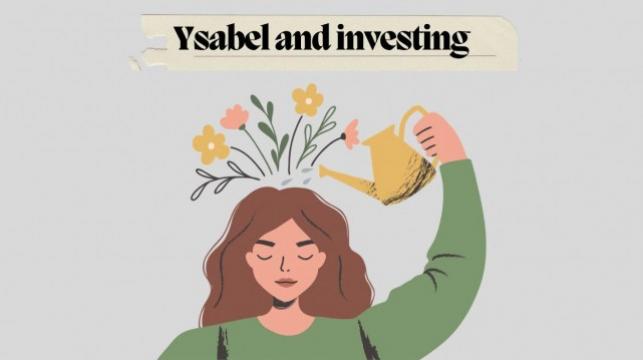
sabel Quintos was 18 when she started investing. Now 25, her ultimate goal remains having security—not just for herself, but for her future children and grandchildren.
“Apart from growing wealth and reaching my financial goals, I aim for my kids and grandkids to have enough money to live a comfortable life even when I’m gone. It’s more of saving for my own retirement in the future and supporting my relatives also in the future,” she said.
Ysabel started out investing in real estate. At 21, she began to invest in insurance. At 22, she made the leap to the stock market.
She might be an unusual case, but Ysabel acknowledges that she has benefited from the guidance of her parents.
“What I’ve learned from them is to invest only what you can lose,” she said. “Don’t put everything on the line, since investing is sort of a gamble and taking risks, especially in stocks. It’s better to invest only what you can lose.”
Ysabel, who loves to travel abroad, said investing is a great way for her to not worry about breaking the bank.
“So far it has been going well, I’m on a new venture in life where I can travel around the world and invest more in stocks and real estate without worrying about breaking my bank account. Learning how to invest made my and family’s life more comfortable,” she said.
She also noted that investing has helped her improve her perception of money especially on managing it.
“[By investing] I receive more money than what I can spend. That’s what I’ve been wanting to achieve since then.”
If she were to give any advice to young individuals who also wish to enter the investment world, Ysabel said it is better to start saving early for investment instead of letting your money rest in the bank. — BM, GMA Integrated News
This is part of the Money 101 series for Personal Finance. Illustrations by Jessica Bartolome

