

 GMA Brandtalk
 Tracking
 Archives

ADVERTISEMENT
Filtered By: Newstv
NewsTV
Into the blue: Skin diving 101

How deep are you willing to go? (Photo by: Ian Braga)
My head was starting to feel light and my ears ready to explode as I swam down to a shipwreck in Mabini, Anilao, Batangas. I was going 30 feet deep with no oxygen tank to help me breathe. This is, after all, skin diving: You hold your breath and dive into the deep blue sea. A sport not for the weak of lungs.
“But weak lungs don’t matter when you have a strong will, sister!” a misguided pep talk I gave myself. I only had about 30 minutes of breathing and equalization exercises prior to my descent. What I had was overflowing confidence–with limited oxygen.
“It’s not skinny dipping!”
“Hubadera!” was what most of my friends said when I asked them to join me in an open skin diving trip headed by ISDA, an organization of young skin-divers in Manila, and MUNI, an events group that promotes sustainable travel and lifestyle.
“Admittedly, people still averagely associate skin diving with skinny dipping,” said Earl Paulo Diaz, president of ISDA.
The misconception holds true. Even at work, when I pitched the topic of skin diving as an article, I got mistaken for wanting to do a sort of exhibitionism. “Papagawan sana kita ng photo essay,” said my editor, to which I replied, “It’s not skinny dipping!” and “My body is not ready!”
So if it doesn’t involved nudity, what is skin diving exactly?
Skin diving is a cross between scuba diving and freediving. Unlike scuba divers, skin divers don’t use oxygen tanks for breathing. Skin divers just make use of a mask, snorkel, fins, and a pair of strong lungs to stay under water.
Skin diving is not competitive, unlike freediving where contests are held to showcase divers who can go deepest and hold their breath the longest underwater. Although the skills used in freediving are largely incorporated by skin divers, the difference lies in the end goal. Skin diving is all about marine biology appreciation.
Diaz explained it succinctly: “Skin diving shares the same fun as snorkeling and risks as freediving, all without the costs of SCUBA diving,” he said.
The skills and techniques used in skin diving are still evolving. Skills from other sports and activities that help skin divers are also adapted, like effective breathing exercises from yoga.
“The general practice of skin diving as it is now does not adhere to any certifying or licensure bodies unlike SCUBA and freediving,” said Diaz. “Skin diving for ISDA combines the fun of appreciating the marine environment (as it is with snorkeling), while continually improving one’s ability to dive deeper to see closer (as it is with free diving).”
“This multi-disciplinary nature of skin diving with ISDA really allows room for continuous growth and improvement of skills and sustainable skin diving protocols and rules,” he added.
Before going deep
Preparation is key in skin diving. Three days before the open dive, ISDA conducted a pre-dive meeting to brief us newbie divers on diving basics, such as safety signs and signals, proper use of equipment, and breathing and equalization exercises.
On the day of the dive itself, we were given an hour and a half for a practice dive. Here, our group leaders taught us basic swimming skills and the various ways of entering and exiting the water.
During this part of the exercise, I found myself gasping for air every 15 seconds. It’s one thing to apply breathing and equalizing techniques when you’re just staying still; it’s a different story when you have to do these while finning. (Your body consumes more oxygen when you move.)
I kept panicking, too, whenever I felt my ears ready to explode while underwater. But the sight of the corals motivated me to get my skin diving skills together. Nothing worth it is ever easy, after all.
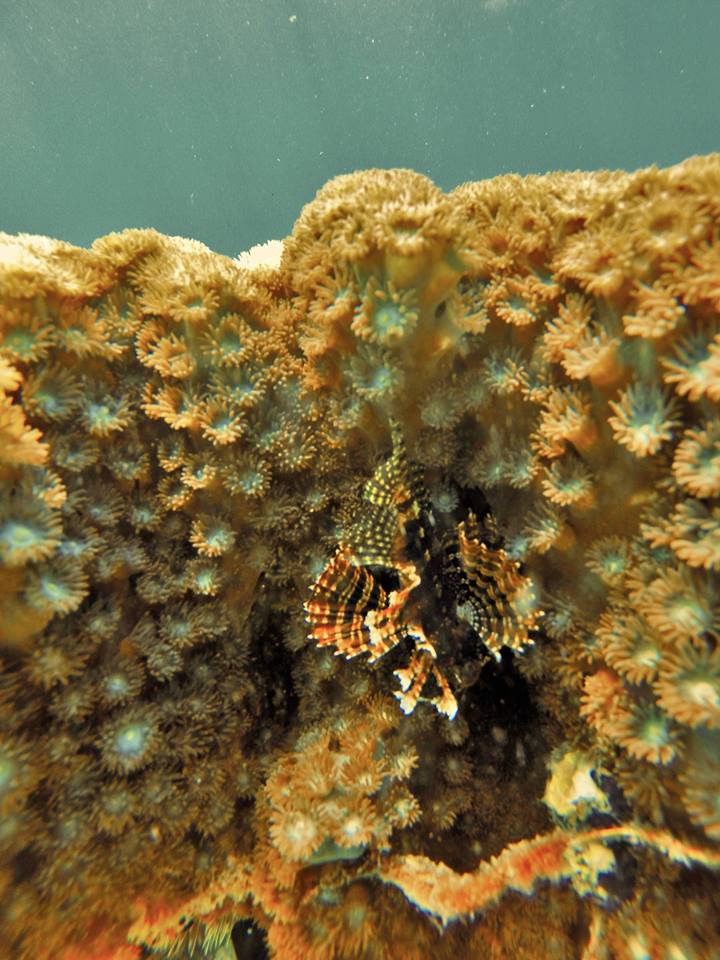
Spot the lion fish! (Photo by: Ian Braga)
Marine identification was also part of the open dive session. We were given a rundown of the different kinds of sea creatures we could encounter in our dives, from clown fishes to sea snakes. This exercise was not only for appreciation purposes. Knowing which fish you’re swimming next to might save your life. ISDA members had their fair share of dangerous encounters in the treacherous waters. Imagine being chased by a titan triggerfish, a fish known to be capable of biting off fingers!
“Take nothing but pictures, leave nothing but bubbles”
Throughout the open dive, ISDA members kept repeating the phrase “Leave No Trace,” a call for a sustainable form of travel. In the context of skin diving, “Leave No Trace” means “being constantly aware of one’s role as a responsible ‘intruder’ to the marine environment.” It’s all about maintaining passive interaction with sea creatures. If you see beautiful shells and corals, don’t take them with you. “Take nothing but pictures and leave nothing but bubbles,” simply and romantically put.
Diaz explained why they promote this mantra., “Being at the center of the center of marine biodiversity in the world, the Philippines is blessed while being at the highest risk,” he said. “With all the problems that linger around our natural resources, specifically the marine environment, [we are] faced with the enormous challenge of stewardship over our environmentally rich lands and waters.”
“While skin diving sounds all fun and exciting, the dangers are real and a human being in the ocean is technically an intrusion to the natural order of the marine ecosystem. Thus, respect for the environment, willingness to learn and accordance to rules are just some of the traits that anyone who wishes to do skin diving should have,” he stressed.
Into the blue
It was already three in the afternoon when we headed back to the ocean for our fun dive. The plan was for us to go down to the shipwreck and see more corals, while finally applying all the techniques we learned.
To go to the shipwreck, you have to follow a rope attached to an orange buoy marker. As we reached the buoy, our team leader Marika –seeing that some of us were pretty tired– asked who among us still wanted to go. Fueled by thrill and my overflowing confidence, I immediately volunteered.
Marika told me to do breathing exercises for a minute or two to relax my lungs and make it better for oxygen storage. Being too excited, I finished in just 30 seconds and followed one of the team leaders, Earl, down to the shipwreck.

Just keep swimming. (Photo by: Ian Braga)
I don’t know how many seconds I spent finning down. You lose track of time when you’re trying to hold your breath, equalize, and swim simultaneously. My only gauge then was my oxygen levels. If I still could hold my breath, then I’m good to go.
I could feel the air running out of my lungs as I reached the end of the line. When I finally saw the tail of the ship resting on the ocean floor, I quickly shifted my head left and right to spot a debris, an anchor, or whatever tell-tale signs of a shipwreck. My vision, however, was starting to get hazy and my rather messy movements made things murky. Sand particles kept dancing to the underwater current.
With my oxygen level reaching critical mode, I immediately started finning up to the surface. I no longer followed the line. All I knew was there was no other way but up, towards the light.
“Forget about the shipwreck. Just try again,” I told myself as I rested, floating in the arms of the open sea.
This is, after all, skin diving. More than allowing you to see the wonders of the ocean, the beauty of this sport lies in how it makes you aware of your limitations. And from there, it inspires you to keep trying and to exceed your limits one dive at a time. — CM, GMA News

