

 GMA Brandtalk
 Tracking
 Archives

ADVERTISEMENT
Filtered By: Newstv
NewsTV
Underweight or obese? 'Investigative Documentaries' looks at the country's health problems
+
Make this your preferred source to get more updates from this publisher on Google.
Data from the Food and Nutrition Research Institute (FNRI) shows that one out of four pregnant Filipinas are nutritionally at risk. This proves problematic not only for the pregnant woman but also for the child inside the mother’s womb. It is not surprising then that two out of 10 Filipino children grow up to be underweight for their age.
GMA News TV’s “Investigative Documentaries” looks into some of the issues behind the numbers.

FNRI’s Imelda Agdeppa said a major factor contributing to the increasing number of underweight children is inadequate dietary intake. This happens when families don’t have enough income to buy three meals a day.
An example is the Pablo family, from Barangay Lantuyang in Baco, Oriental Mindoro, who can only afford to buy rice once a week. The family eats bananas to substitute for rice. In the barangay, there are over 200 families that are left with no other choice but to do the same.
The local government of Baco has a feeding program in place, but Agdeppa said it will be more effective if the fight against malnutrition is concentrated in each barangay. She added that the local government should strengthen the capability of “barangay nutrition scholars,” or trained health workers who disseminate nutrition information to the community.
One of the United Nations’ Millennium Development Goals is to decrease in half the number of underweight children in developing countries by 2015. In the Philippines, the number of underweight children went from 27.3 percent in 1989 to 20.2 percent in 2011. The number is going down, but change is not happening fast enough in time for 2015.
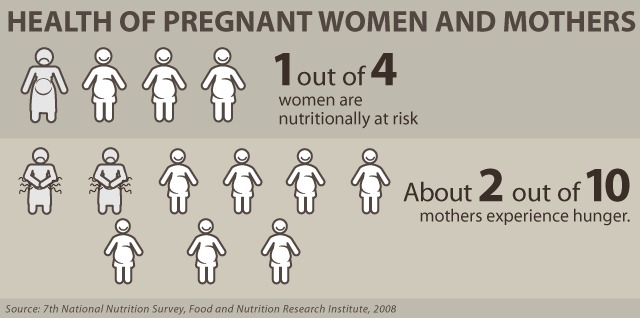
Breastfeeding is recommended for infants, but not all mothers are capable of lactating and providing nutrition, especially if they themselves are undernourished. FNRI data shows that pregnant mothers in different regions like Ilocos, Bicol, Western Visayas and ARMM are considered “nutritionally at risk.”
It is also recommended that babies are fed complementary food or solid food when they reach their sixth month, but many infants coming from poor families are not given solid food at this stage.
But if undernourishment is a problem, so is getting too much nourishment.
Obesity is also a health problem in the country, with about 27 out of 100 Filipino adults being either overweight or obese.

Overweight people are prone to health problems like heart ailments, hypertension, and diabetes. Agdeppa enumerated some factors that contribute to this problem:
Sedentary lifestyle or not having enough physical activities
Preference for sweets
Preference for dried food
According to the FNRI, the number of overweight Filipinos has increased from 24 percent in 2003 to 26.6 percent in 2008.
The government plays a crucial role in addressing these issues by education Filipinos on health and nutrition, assisting pregnant mothers, and providing livelihood to poor families. But the choice to be well-nourished remains personal; only a person can ultimately decide what goes in and out of his body and what choices he or she has to make to remain healthy. — Angelita Bombarda, GMA News

