

 GMA Brandtalk
 Tracking
 Archives

The fresh grad cheat sheet: Job hunting checklist
For fresh graduates, the first job hunting process can be overwhelming – from drafting winning resumes to knowing how to answer basic yet tricky questions like, “What can you tell me about yourself?”
No need to panic and worry. Take things one at a time, and read up on the basics from this “Investigative Documentaries” cheat sheet!
- Where to look for a job
- How to put together a resume
- How to write a cover letter
- What to expect in a pre-employment interview
- What the basic entry-level salary is
- What the pre-employment requirements are
Where do I look for job opportunities?
The first crucial thing in looking for a job is knowing where to look. Going to job fairs and widening your connections are just a few ways to search for job openings.
For a complete list of job fairs for different regions for this year, visit: http://www.phil-jobnet.dole.gov.ph/Schedule.aspx
The Department of Local Employment (DOLE) mapped out a list of job fairs this year. Some upcoming job fairs for the months of May and June:
- Mega Job Fair - May 22, 2014 (Amphitheater, Malabon City)
- Philstar Daily, Inc - May 27-28, 2014 (Trinoma Activity Center, Trinoma Mall)
- Independence Day - June 12, 2014 (Luneta)
- Independence Day Job fair - June 12, 2014 (SM Center Muntinlupa)
You may also look for job openings on online job listings like JobStreet or JobsDB that both have job listings not only for the Philippines but also for other Asian countries. It also helps to check out company’s social media accounts once in a while for announcements about job openings.
You may also ask former professors or friends for jobs that they can recommend you to. Direct connections to companies can help speed up the application process.
How do I put together my resume? 
A resume is a document summarizing information about you: education, achievements and work experience. Employers use your resume to gauge if you’re a perfect fit for their job opening.
JobsDB, an online job portal that operates in several countries in Asia (including the Philippines), recommends the following information to be included in the resumes of fresh graduates:
1. The basic details
- Name
- Address
- Contact Number
- Email Address
2. Career Objective
Keep it short and simple. Make sure that your career objective is specific to the position and the company you are applying for.
Example: “To work in a reputable news organization as a reporter, where I can build on my experience as a former student journalist.”
3. College educational background
- Degree earned
- Name of university
- Year of graduation
- Achievements such as honors received
4. Work experience
Work experience does not necessarily mean paid work. Here, internships and on-the-job trainings come in handy. Include even the internships you took that were not required in school; this shows employers your eagerness to learn beyond the classroom.
5. Extra-curricular activities
Extra-curricular activities show your employers what you’re capable of doing.
"The recruiter who is interviewing new graduates knows that these young people don't have work experience yet so they won't be looking for them. What they will be looking for are knowledge, skills, and specialties," said JobsDB.
As such, skills are revealed through the fresh grad's extra-curricular activities in and outside school. Extra-curricular activities include involvement in student organizational projects, volunteer work, seminars attended and research work done.
6. Skills and interests
Should you include your being a die-hard NBA fan on your resume? Jobstreet recommends that you exclude irrelevant hobbies and interests in this area: “Stick to job-related facts that will help you get hired."
Job-related facts may include:
- Language proficiency
- Soft skills, or skills that show how you relate and interact with other people. Examples are your flexibility, positive attitude, good communication skills and strong work ethic, among others.
- Technical skills that are related to the job. Your illustration skills will prove an advantage, for example, if you’re applying for an art-related position!
- Skills or interests related to the position you’re applying for. For example, if you’re applying for a writing job, mentioning that you maintain a blog may help your chances. Just remember: Don’t fabricate facts just to fill your resume!
11. Character references
Limit your professional references to two to three people. Character references can include professors in college, moderators of your student org, and previous supervisors in internships.
Make sure you inform your character references beforehand when listing them down on your resume.
Other resume-writing tips:
Keep your resume clean and concise. Limit your resume to one to two pages, with all the important information placed on the first page. For hard copy, most companies use letter-sized paper. When sending your resume via email, don’t forget to provide a PDF copy to avoid incompatible Microsoft Word or OpenOffice documents.
Keep all the information updated! Most companies will get in touch with you either via email or your mobile number. Make sure you give them the correct contact information.
Double-check your spelling and grammar. You won’t impress anyone with your “great tpying skills.” Sloppy mistakes turn off potential employers.
Work on a digital resume. Professional networking sites like LinkedIn work as digital resumes and allow you to connect with others who may be scouting for potential applicants. People you know, like orgmates or professors, may also vouch for you by giving you recommendations via the website.
How do I draft a cover letter?
The art of writing a cover letter is ignored by many job-seekers. “The cover letter is a powerful marketing medium in which to underscore your suitability for the position, something the resume cannot quite accomplish on its own,” according to a job-hunting briefer prepared by Jobstreet.
“A good cover letter allows you to explain how your qualifications, experience and skills can contribute to the company’s goals and growth,” it added.
Things to remember about the cover letter:
Make sure the cover letter is addressed to a particular person. Avoid addressing it to the vague "Sir/Madam" or "To whom it may concern." Find out the specific person in charge of the hiring process in the company for which you are applying; this can be the team supervisor or manager, or the HR manager.
Introduce yourself. Briefly describe yourself and say why you are applying for the job.
Be straight to the point. Don’t beat around the bush. Limit your cover letter to a page of about five paragraphs at most.
Keep it simple. Avoid high-falutin words. Convey your objective in the most clear and concise way possible.
Personalize it for the employer. Emphasize right away that you're interested in the company by tying your skills with the qualifications the employer is looking for. Indicate how your skills can contribute to the growth of the company. This part entails research. Impress your potential employer by showing that you exerted effort into knowing more about the company.
Show initiative by indicating that you'll follow through and ask updates about your application within a week. This will also help you avoid the anxiety of waiting for a call.
Include your contact details and affix your signature. Let them know the easiest way to get in touch with you. For hard copies, do not forget to sign your name at the bottom. For soft copies, scan your signature or create a digital signature. Signing your name convey a sense of authenticity and integrity.
How do I send an application via email?
Many companies now accept job applications sent via email. Some companies may have their own preferred format for doing so; confirm with the company for their requirements.
If they do not indicate a preferred format, the best way to go about it is to save PDF files of your resume and cover letter, and send these as an attachment. Make sure your files are named accordingly. (Example: Resume-GBautista.pdf)
Sending your cover letter in the email body is acceptable, too. However, if you prefer to send your cover letter as an attachment, do not forget to still draft a short note for the email body. Do not send a blank email!
Don’t forget to include a proper subject title as well. (Example: ‘Applying for News Reporter position’) This will help employers notice your email, and it will avoid your mail getting junked or marked as spam!
What happens in a job interview?
An interview is one of the most crucial parts of getting a job. It’s a chance for your potential employer to get to know you better apart from what’s written in your resume and cover letter.
According to Philip Ruiz III, who’s worked for human resources of companies like Coca-Cola Export Philippines and Bayan Telecommunications, these are the typical questions asked during an interview: accomplishments in school or in life, your personality and interests, your values and principles.
“Interviewers will be looking for the following characteristics: humility, personableness, capability to learn and work hard, ability to blend with others, level of or standards in being an achiever or not, clarity of thinking, and honesty,” Ruiz said.
“There are many ways and questions to draw this out, so it is important to be just one's self and sincere rather than pretend,” he added. “Anticipate the category of questions, not the questions themselves.”
Questions you may encounter (and guide sample answers)
“Tell me something about yourself.”
Avoid saying something that’s already in your resume. Chances are, your interviewer already knows that. Angle your answer so it fits the job description for which you’re applying.
Sample answer:
“I am an Architecture graduate. Drawing and designing are just a few of my favorite hobbies. I also like browsing the web and reading books to find ideas and further develop my craft.”
“Why did you apply for this position?”
Emphasize how your values align with the values of the company. You may also describe how your skills match with the required skills to fill the position.
Sample answer:
“This company is known for being the best in the field of advertising while maintaining good relationship with its clients. I’ve always wanted to work in that kind of environment and I know that this job will help develop my skills as an account executive.”
“What are your career plans? Where do you see yourself in 5 years?”
Even if you don’t yet have a clear vision of what you see yourself doing in the future, it’s best to give your interviewer an idea of your professional goals (i.e. plans of working abroad, pursuing further studies, etc.)
Sample answer:
“I’d like this teaching job to jumpstart my dream of having my own preschool someday. I plan to take a masters degree in childhood education in about two to three years, and I’m hoping this job will help enrich that experience.”
“What are your strengths and weaknesses?”
For strengths, give them what you consider an asset about yourself. For weaknesses, give those that can be considered a strength when looked at differently, or show that you are working on improving that weakness.
Sample answer:
“I have very good organizational and time management skills. I can also handle pressure well and can adapt to change. However, I am working on improving my communication skills. I recently enrolled in public speaking class and I find it really helpful.”
What to bring for the interview
1. A hard copy of your resume
2. A valid ID (any government ID, or your school ID)
3. Portfolio (if required)
Interviews can be nerve-wracking because it can make or break your application. Here are some tips to nail that interview!
Do your research. Learn about the company (its history and what it does) and the specific job you’re applying for.
“Know something about the company [before] going into the interview. This manifests interest and intelligence,” Ruiz said.
Arrive early. Arriving 15 to 30 minutes before your schedule allows you to relax, get comfortable, and do last minute preparations before the actual interview.
Don’t be late! If it can’t be helped, inform your interviewer beforehand.
Wear appropriate clothing. It’s important to make a good first impression by wearing the right outfit. The best gauge of what to wear during an interview is the office dress code. Coming in smart casual clothing should be fine if their employees come to work dressed in jeans. But coming in simple business attire is your best bet.
Men can wear a dark-colored suit or long-sleeved shirt, or a button-down collared shirt. Wearing a tie is optional but recommended. Wear this with dark-colored slacks, a belt, and leather shoes.
Women can wear a business suit and/or blouse with slacks or a mid-length skirt. Avoid wearing short skirts or dresses, and do not come in shorts (no matter how hot it is outside!). Choose a pair of closed shoes (flat or heeled) over a pair of strappy sandals. Wear light makeup and simple jewelry.
Be well-groomed for the interview. Before going in, do a quick check in the washroom – make sure your hair is in place, your face is sweat-free, and you smell good (but not overpowering!). Make sure your hands and nails are clean. For the ladies, skip the neon green nail polish, and take out polish that’s already chipped!
Greet the interviewer politely and appropriately. A polite greeting and a firm handshake go a long way. Make eye contact – it’s important to make a connection between yourself and your potential employer.
Ask your interviewer questions about the company. Ruiz said the best questions to ask an interviewer should be “about the company’s history, values and vision; and about the demands of the job such as the demands of the job, expectations, and role in the company.”
Questions you may ask:
- What’s the company culture like?
- How would you describe your management style?
- What’s the next step in the hiring process?
Thank your interviewer. After the interview, send an e-mail expressing thanks for the interview and for giving you a chance to get to know the company. This simple gesture of gratitude may help you land your dream job!
What is the basic entry-level salary for fresh graduates?
JobStreet listed the highest-paying industries for fresh graduates in their Annual Salary Report released in April 2014. JobStreet indicated the industries and the average salaries of entry-level positions available.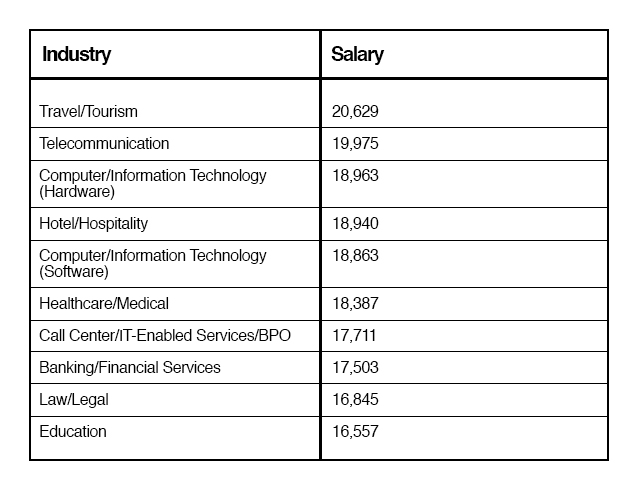
According to their report, fresh graduates eyeing a job in the tourism industry may expect a salary of up to P20,000, while those applying for call centers and other business process outsourcing companies may get about P18,000 as initial salary.
According to the Department of Labor and Employment-National Wages and Productivity Commission, the daily minimum wage for employees in NCR is at P466.00 or about P13,000 per month. Most professional entry-level positions, however, offer a little more than minimum wage – about 200,000 job openings listed for fresh graduates on JobStreet.com offer an average salary of up to P16,700.
Click here for a complete list of minimum wages around the Philippines.
Is it okay to ask about (and negotiate) salary and compensation during the job interview
The compensation is a big factor in the job-hunting process. Some companies include the salary and benefits in their callout for a job vacancy, but most companies will not disclose this until after they hire you for the job.
While it is okay to inquire about the compensation during the interview, it may be a little uncomfortable to ask this directly during the first interview, especially if your interviewer does not volunteer the information.
According to Ruiz, "Try to avoid asking about salaries in the first interview. Ask about it when [the company] already wants to hire you."
According also to a survey done by JobStreet, 64 percent of employers rejected fresh graduates after the interview session because the candidates were asking for unrealistic salary or benefits. However, you may still ask about the salary (and even negotiate for higher compensation, once accepted) if you know the right questions to ask, and when to ask them.
JobsDB provided some tips on how to gracefully negotiate your salary:
Qualifications first, money later. Establish the qualifications that you think make you the perfect fit for the job before saying anything salary-related.
If your employer initiated the salary-talk without you having established your qualifications first, navigate the interview and highlight why they should hire you.
Know the standards. Before negotiating for your salary, it’s always good to know the company’s points of reference when deciding how much they are willing to pay for a position. These could be:
- Average salary offered by companies in the same industry
- Average salary based on your level of experience or education
- Average salary offered to employees within the city or region
Once you have these information, you should be able to set a realistic salary expectation.
Try before you buy. If you’re facing the challenge of being offered a low salary grade in a company or position you really like, don’t be afraid to talk about performance-based incentives.
Performance-based incentives are salary increase discussions done at a later stage of the employment. For example, if based on your work you are able to prove after six months that you are worth more than the salary they initially offered you, then a salary increase may be given. You may discuss this with your employer, and have it documented if he or she agrees.
Salary or incentives can be non-monetary. What you’ll get from a company as compensation may go beyond the salary you receive every 15th and 30th of the month. Ask about other benefits you may receive as an employee: paid vacation leaves, food allowances, free medical insurance, or discounts on gym memberships and other services.
Pre-employment requirements checklist 
Once you make the cut, it’s time to prepare the necessary documents to formalize your employment. The pre-employment requirements of companies vary, but it helps to have these papers early – making you immediately available to start working!
a. School records: transcript of records, diploma, certificate of graduation
You may secure copies of these documents from your school’s registrar. Companies will typically ask for validated (or certified true copies) of your diploma, so it may not be enough to just photocopy the one you have framed at home.
b. Social Security System (SSS) ID number
To register for an SSS ID Number, accomplish the SSS Form E-1. You can get this in your nearby SSS branch or online. Submit the accomplished E-1 form with the the original/certified true copy and photocopy of any of the following supporting documents:
- Birth Certificate
- Baptismal Certificate
- Passport
- Driver’s License
- Voter’s ID
c. Tax Identification Number (TIN)
When you start working and earning money, you need to start paying taxes! Register your TIN with the Bureau of Internal Revenue. Check out BIR’s website for the guide and online application forms.
d. NBI clearance
Get your National Bureau of Investigation (NBI) clearance by filling out a complete form online.
e. Cedula or community tax certificate
Apply for your cedula at your municipal or city hall. Make sure to bring an application fee. Fees for cedula vary.
f. Barangay clearance
Head to your respective Barangay Hall. Ask for the barangay clearance application form. Bring the following:
- 1x1 ID photo
- Clearance fee (fee varies)
- Cedula (or if you live in a subdivision or condominium, a certificate of residence from your subdivision or building administration)
- Valid ID
g. Police clearance
You may get a police clearance from the PNP headquarters of from your municipality or city. Get the application form and prepare an original and photocopy of your cedula and barangay clearance.
h. Copy of birth certificate
Prepare an NSO-certified copy of your birth certificate.
i. Medical clearance
You may be asked to get a medical clearance and/or a drug clearance from a hospital or clinic. Most companies will ask you to proceed to a partner hospital or clinic, and some may shoulder the fee for the clearance. — with Candice Montenegro, GMA News

