

 GMA Brandtalk
 Tracking
 Archives

ADVERTISEMENT
Filtered By: Topstories
News
The city and the sea: A Taclobanon contemplates the death of his hometown
The inevitability of things.
In our country, as in many other places around the world, people in urban areas live near the throat of live volcanoes, in the mouth of rivers that get flooded, or on top of seismic fault lines.
In Waray, the language spoken by the people living in the islands of Samar and Leyte, Tacloban comes from the verb “taklob”, meaning “to cover.”
This is not to correlate the name of a city with the utter destruction that has been inflicted on it. And neither is this a form of nonchalant blogging by someone pretending to be an armchair cognoscenti.
This is about waiting in line for three days trying to get a chance to board a military cargo plane to a place I call home, a place that has been wiped out from the face of the earth.
This is about the emotional pendulum one feels when truly faced with fear at its crudest form and in various guises: horror, sadness, desperation.
The ability of nature to inflict such apocalyptic devastation and take life in such great numbers is truly horrific. Death when it is truly personal is both literal and sentient and comes at you in a series of knocks: first is the unfolding death of a place, then of its people, and then of the memory of that place and those people. That is both saddening and deflating.
As for desperation, I was trying hard not to show it, along with hundreds of others waiting in line at the Villamor Airbase. In the long wait I resorted to rationalizing and nostalgia – common psychological tools used by torture victims, prisoners, and families observing the funeral of a loved one.
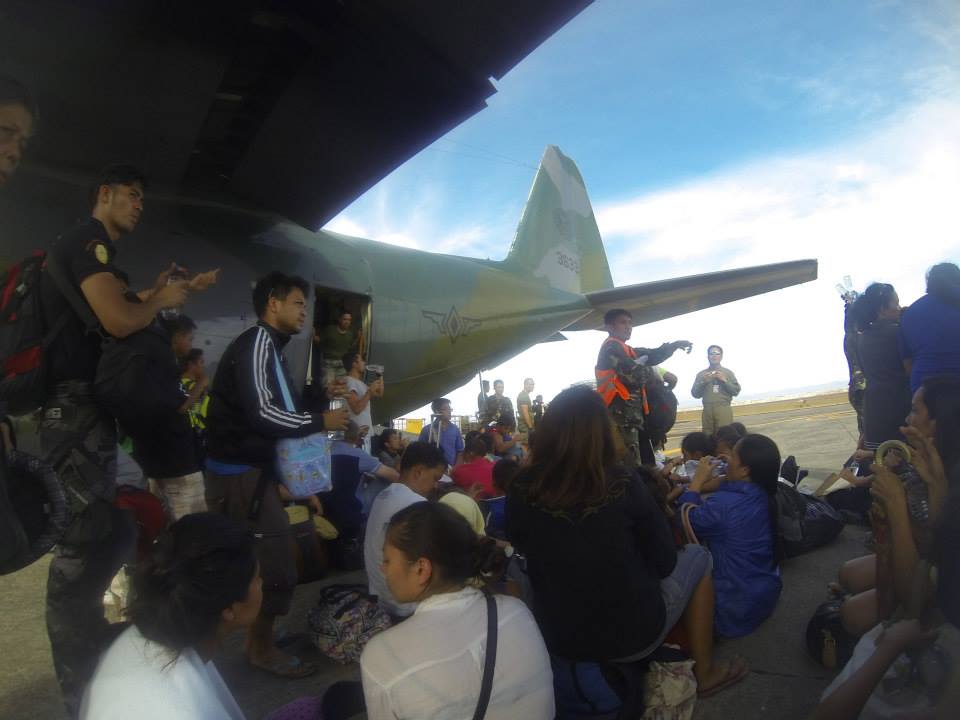
Military C130 planes have been seeing frequent use in flying people out of Tacloban to Cebu and Manila. (Photo: Maelene Alcala)
Tacloban, the name itself, comes from the sea. As a derivative noun, it pertains to a fisherman’s implement the size of a basket made of bamboo mesh and used by our forebears to cover and trap fish in the quiet Cancabato – the small curving bay that gives the city its rustic air and affinity with the sea. It is where I learned to swim as a boy, not knowing in my wildest imagination that the gentle bay with its lapping waves and pebbled shores would one day rise up to cover and smother the people living beside it.
A perfect storm is only perfect when the right elements are in place: strength and speed, the water it packs, topography, and dense populations. Like many other provincial centers, Tacloban is wedged between its hilly side that separates it from the town of Palo to its north and its undulating coastline that wends along San Juanico Strait and Cancabato Bay. Cancabato curves from the small hill that holds the city hall toward the airport which juts out like a sore thumb into the sea, a feature described by aviation officials as perhaps the most ideal mid-sized domestic airport, for it sits like a flat island with no obstruction on its sides.
It now seems that what made the surge so perfect and deadly was because the larger sea that sits between Leyte and the southern tip of Samar forms into a funnel. The wider southeastern base of this triangle is Leyte Gulf, which opens into the Pacific, while at the narrow tip of this funnel sits the city of Tacloban. During the height of the storm, Cancabato Bay and its gently sloping seabed apparently acted as the ramp that washed ashore the raging waters whipped up from the open sea.
The 315kph winds drove the water into a city devoid of any levee that would have slowed the rampaging waters. The seawater rose, filling the city like an aquarium. It rose so high it engulfed all the areas along Cancabato Bay and San Juanico Strait, inundating entire communities, such as the downtown area and the area near the capitol which housed the biggest public hospital in Region 8, and smothering the dense communities of informal settlers near the public market and those that dot the length of Cancabato Bay.
On hindsight, both the inability of the average Waray to grasp the sinister meaning attached to such an alien term as “storm surge”, and the inability of those in government who knew what it meant but failed to drive its deadly meaning home, serve as the salt that has been rubbed in our collective wounds.
We could have shrugged off the ferocity of the wind as our ancestors did centuries before, but the sea’s deadly embrace has left us dispirited. This is the reason why some say the Warays have a dark affinity with the sea and its typhoons.
Dona Paz, December 1987: more than 4,000 people dead, almost all from Leyte and Samar. I vividly recall as a young man how candles burned throughout the province in wakes devoid of cadavers. The death toll was such that it was hard to find someone who did not have a relative, friend, or acquaintance aboard that fateful ship whose name carries with it the ignominy of being the world’s worst maritime ferry disaster.
Dona Marilyn, October 1988: more than 400 dead. Ormoc, Leyte 1991: 5,000 people killed in one of the worst landslides. Guinsaugon in Southern Leyte, February 2006: 1,126 people dead.
I recall the times my boyhood friends and I would troop to a nearby beach to watch outriggers pull in their grisly haul—bloated bodies strung together, their skins made alabaster by the sea, the overpowering stench, and how we avoided buying fish in the days after such mishaps. These were the constant toll of local sea mishaps – overloaded pump boats capsizing, outriggers colliding, or fishing boats sundered by an angry sea.
The sea mishaps only dwindled when commercial airlines put the ferries out of business. But even with the ferries gone the sea has risen to take even more of us, rising so high that it covered entire communities and smothering entire families from where they hunkered and hid from the terrifying winds.
Outside of war, it seems uncanny that an entire city can be wiped out in an instant. But Tacloban is no more and like others who grew up in this city, all I have is a clutch of memories of the place and the people there, memories both happy and sad. I recall the boy that I was, growing in one of its slums similar to those washed to sea. The various typhoons that battered but never defeated us.
I left Tacloban a long time ago, knowing that it had nothing to offer me. But I cannot deny my affinity with it. Other cities envied it, especially during the reign of its favorite daughter, during which it aspired to a semblance of pseudo majesty: the San Juanico Bridge was constructed, religious shrines, the lavish fiestas where residents lined up for a week for free food cooked by chefs brought in from Manila.
Some features of this era remained—the verdure of the hill where the city hall sits overlooking Cancabato and its wide garden and the beautiful pine tree-lined boulevard running below it, the botanical garden nearby, the small satellite campus of the University of the Philippines, the once grand Leyte Park Hotel, Sto. Nino Shrine, the old Capitol Building, which would look like any other provincial capitol building if not for its imposing murals on its right and left wings depicting General MacArthur’s landing and the first Catholic Mass held by the Spanish conquistadors on Limasawa Island.
I write these thoughts as the long interminable meantime at the airport merges into the next, sometimes imagining a call that would finally patch me through my dark passage; of a trip I know will not mean the welcoming arms of my family but the dark embrace of death, destruction, and despair.
So I wait and wait, the news on TV blurring into a single sound of waste and desperation – the Warays, whose character perhaps formed the stereotypical urban grit, squalor, and criminality associated with the slums in Metro Manila, have started to riot and loot. In the chaos, the criminals in the local jails have escaped. Malls and department stores and bank ATMs were being broken into.
The cruelty of things, the storm, life, memories, truth. It’s been there on the TV screen for the last 71 hours and will perhaps be in the nation’s battered psyche for the next 71 years.
Yes, nature has decimated the place I call home, but even that truth, I have to admit, has to slide over for the bigger truth that has been wracking my brains as I try to find a flight home. And this is the fear that—among the rubble and widespread devastation one of those corpses by the side of the road could be that of my 90-year old mother, brother, nephew, niece, or friend.
As I write this, my youngest brother, serious and elfin, a stubborn and loving fireman with the city fire department, whom I know has been sort of a hero not only to his wife and son but to those whom he had helped protect, is still missing, while an older brother has yet to be accounted for. – KDM, GMA News
Editor's Note: Noel finally managed to arrive in Tacloban on Friday, Nov. 15. His mother is “relatively okay” in a subdivision where she sought refuge during the storm. His two brothers have been accounted for, but there is no word yet on the family of his younger brother.
Noel Luna was born in Palo, Leyte and grew up in Tacloban City. We are reposting this note with permission.

