

 GMA Brandtalk
 Tracking
 Archives

ADVERTISEMENT
Filtered By: Topstories
News
Pinoy secrets: An American learns lessons on life, love, and death-by-videoke
Editor's Note: American traveler Nathan Allen spent a year living all over the Philippines and documenting its culture. He's also written about being in the country during Typhoon Yolanda. Here, he lists five ways the country changed him.

The Philippines taught me how to make peace with death
Nathan Allen
The Philippines taught me how to make peace with death
"If it's my time, it's my time"
Okay, now that I have your attention, let me explain: I had a 55-year-old Filipino friend who talked to me about death quite a bit. He wanted to move out to the provinces to retire and live out old age. His wife (a nurse in a big city) was worried that they would be too far removed from hospitals and medical care if something should happen to him. He wasn't concerned. "If it's my time, it's my time," he said. This really stuck with me. It wasn't just the words, it was how he said them.
They came from somebody who seemed to truly be okay with this possibility – somebody happy, who had already lived a full, contented life. That's how I feel now. I am fortunate to have seen and experienced so much, I was born into a wonderful family and met so many incredible people throughout my life. I feel I have already lived many lifetimes!
Death is all around
I think this Filipino attitude about death was born out of necessity. Quite frankly, the population is massive and there are a LOT of people dying here every day. Yes, because of lack of health care, many people may not live as long as those in the West. I'm not sure that's a bad thing, though. Everybody wants more "quality" years and less suffering, right? In the Philippines, the view and actual process of death seems more "natural" to me.
Dying is just an every day part of life
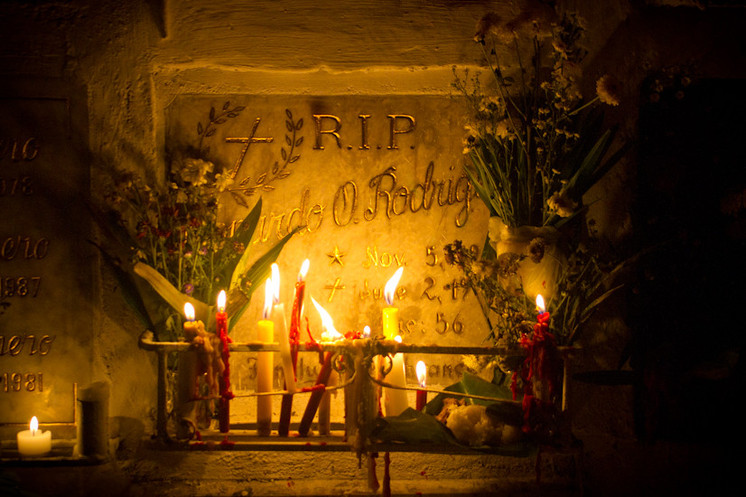
Little children here know this, and don't seem to be afraid of death the way we are in the West. I had the opportunity to spend the night at a cemetery for All Souls' Day. This is a perfect example of what I'm talking about - the thought of spending a candle-lit night in a cemetery on Hallowe'en is terrifying to people in the West. By contrast, for the Filipino family I was with, it was a chance to reconnect with and celebrate the lives of their departed relatives. At their grave sites we ate, laughed, visited, and told stories for hours.
Here today, gone tomorrow
The same goes for the experience at the time of death. On Christmas day last year, I was with a family in Nasugbu, Batangas. We went to a wake for a classmate of my friend. It was held right in her home, and all her friends and family were there to greet us with smiles. The overall mood was peaceful, but somehow cheerful at the same time. Judging by everybody's reactions around me, I assumed she had been dead for at least a few days, and that she was probably quite old. When I asked tito when she passed, he said "5 o'clock." I was shocked. When he told me she was only 55, it was quite a reality check! She had just unexpectedly died onChristmas day and everybody seemed quite "matter-of-fact" about it!
All the decor, the casket. . .it was waiting and ready to go. To some extent so are the friends and family, because again, death is such an every day part of life. I think viewing death in this way can have a profound effect on one's view of life, and that's what I'll get to next.
The Philppines taught me how to live (and LOVE)
The Philppines taught me how to live (and LOVE)
"Don’t be afraid of death; be afraid of an unlived life. You don’t have to live forever; you just have to live." – Natalie Babbitt
Going hand-in-hand with being able to accept death is knowing how to make the most out of life. Filipinos have a reputaton for being some of the most happy-go-lucky people in the world. Compared to other countries, they seem to be better at consistent overall contentment – regardless of economic status or circumstance. They understand the vital importance of friends and family, and treasure each of their relationships. Even in big, bad Manila, people hold on to these values.
As for love, Filipinos seem to wear their hearts on their sleeves. It is such a passionate, romantic culture, and while in the past I have mentioned some of the drama that can go along with it, for the most part I find it refreshing. Perhaps it speaks to the hopeless romantic in me. Yes, in the Philippines I loved,too. . .and I did it with all my heart. It may have not worked out in the end but I regret nothing, and am glad that I was open to feeling and expressing that love. In the West, I often think fear holds people back – especially when they come to be at my age.
Coming back to California after a year, I see and appreciate each and every one of my relationships in a new light. My patience and compassion has grown tenfold, as has my appreciation for the little things in life. I realize more than ever that my life isn't just for me, it's for those around me as well. I believe these are some of the Filipino secrets to happiness, and I'm thankful to have been a student.
The Philippines taught me to sing - while dodging bullets!
I never sang before I came to the Philppines. EVER. Videoke is a way of life here and it's amazing how many love ballads from the 70s everybody seems to know. I actually learned a lot about American music in these videoke bars - Even though I'm American and music is my job! There is very little sense of shame or irony when it comes to singing videoke in the Philippines, I guess that is why I felt so comfortable "spreading my videoke wings" for the first time here.
Let the bullets fly. . .as I do it “My Way”
The king of all videoke songs in the Philippines is Frank Sinatra's "My Way", and this might be the one exception to the "no shame" rule. Interestingly, this song is notoriously linked with killings in the country. It is SO popular that just about everybody can (and wants to) sing it, and it's usually sung while men are sobrang lasing and astig (drunk and acting tough).
Late in the night, if you sing it in front of somebody else who had been waiting to sing it, (and heaven forbid you sing it badly), things might escalate between your group and the theirs. This is when fights can lead to stabbings and shootings.
Well, would you believe that my all-time favorite song to sing is "My Way"? People joke about how I'm Filipino on the inside and sometimes I really think it's true. I sang this song in more videoke bars than I can count, and I never had any problems. Perhaps it's just because these older men are shocked to see a young(ish) foreigner singing the song, but I like to think that it's because I don't sing it badly! Haha! That may be open for debate.
Applause, not gunshots
The one "close call" I had was when I was with a family in Siquijor and the "applause" came through the speakers when I finished singing and got my score. It was so loud and distorted that the family I was with got down and covered their heads, thinking bullets were flying! They couldn't believe I was crazy enough to sing the song in the first place.
The Philippines taught me how to be truly thankful – and a bit more humble
In a country where you can lose everything in an instant (due to typhoons or earthquakes or robberies, depending on where you live), people know how to appreciate the things that money can't buy. As for things that money CAN buy, those certainly aren't taken for granted, either.
It was a simple life, but I was lucky enough to stay in the stunning paradise of El Nido, Palawan for two months. I specifically remember waking up each morning, looking around and feeling like my heart was going to burst with gratitude for all that I was seeing around me. I never experienced such a feeling in my life. It was a combination of many things. . .the awe-inspiring landscapes around me, the warmth and hospitality of the family I was staying with, and the simplicity of my bahay kubo (hut) on the beach.
Teasing (for the sake of promoting modesty)
I didn't talk about this in my last article, but I read about (and noticed how) Filipinos have a "culture of teasing". I think parents use teasing to get their children to lose weight, study harder, or just to keep them from getting too boastful. I bring this up, because my Filipino friends did a good job making sure I didn't take myself too seriously, either. Let's put it this way: "Nat-Nat" is one of many nicknames I received! No comment on the others.
The Philippines taught me to "Stop complaining and deal with it"
Filipinos may be many things, but sympathetic is not one of them – at least not when it came to my misfortune/carelessness. Before I came to the Philippines, I had injured my knee and was really depressed about it. I rarerly hurt myself, and the thought of being less mobile during my upcoming travels really affected me.
Well, at this time I was spending a lot of time with a Filipino friend in the U.S., and not only was she not very sympathetic, she almost seemed to be slightly annoyed by my complaints. This was very hard for me to understand, but after a year in the Philippines, I think I get it now.
Filipinos are the kings and queens of adversity and misfortune. Due to geographic location and governmental woes, it's just a part of life here. They smile through it all, and while my minor knee injury seemed like a big deal to me, to them it wouldn't even be worth mentioning. They would just carry on without complaint. Americans (and especially American men) can turn into "big babies" when they get sick or injured. I've heard women complain about it a lot!
Even a nice, old lady laughed at my bad luck
About a month before I left the Philippines, I had one day FULL of misfortune. In Legazpi, at a waterfall, I slipped on a rock and hit my tailbone. To add "insult to injury," that night I took a short walk in the dark to see the starry sky.
I didn't realize there was a two-meter deep canal that runs along the road and I fell right into it. I smashed my previously-injured knee into the rock wall and slammed my chin on the surface of the road. I had a very deep cut on my chin and my teeth had cut my mouth and tongue in about 10 different places. The next morning I awoke to the most pain I've experienced in my life! I couldn't walk, and every bite of food was excruciating.
I didn't realize there was a two-meter deep canal that runs along the road and I fell right into it. I smashed my previously-injured knee into the rock wall and slammed my chin on the surface of the road. I had a very deep cut on my chin and my teeth had cut my mouth and tongue in about 10 different places. The next morning I awoke to the most pain I've experienced in my life! I couldn't walk, and every bite of food was excruciating.
Of course, my Filipino friends just laughed at me but at this point I was used to it. However, considering where I come from, I was actually very optimistic about my healing and even able to laugh at myself, even through all that pain. That is a very new thing for me, and I believe it's a good quality to have. This is what I meant in my last article when I said my experience in the Philippines "hardened me."
So, again, I want to say. . .salamat, Pilipinas! – KDM, GMA News
So, again, I want to say. . .salamat, Pilipinas! – KDM, GMA News
Nathan Allen's essay originally appeared on the I Dreamed of This blog. We are re-posting it here with permission. You can follow Nathan's journey by liking the "I Dreamed Of This" Facebook page.

