

 GMA Brandtalk
 Tracking
 Archives

ADVERTISEMENT
Filtered By: Topstories
News
Three challenges for the Philippines in 2014
Three years into his term, President Benigno Aquino has helped the Philippines regain its long-lost confidence. With the Philippines emerging as one of Asia’s fastest-growing economies, gone are the days when our country was dismissed as the “sick man of Asia.”

Richard Javad Heydarian
Once again, the Philippines is becoming a regional growth pole, catching the attention of international observers, who have come to see our country in a more positive light. Finally, we can legitimately lay claim to the idea that it is “more fun in the Philippines.”
But the purported turnabout in our economic fortunes has been underwritten by a shift in the political landscape. After all, the Philippines has been gifted with an auspicious cocktail of robust demographics, bountiful natural resources, strategic location, and an educated population.
Such potentials, which today are driving growth and fueling optimism in the economy, are not unique to recent years.
Instead, it is the rising confidence in the political leadership, which has facilitated a revival of confidence in our markets. Aquino’s “good governance” (daan na matuwid) initiatives, couched in a moralistic crusade against age-old institutions of corruption, played a pivotal role in recasting the Philippines’ image as a country in search of self-regeneration. As a result, slowly but surely, more and more individuals are beginning to once again envision the Philippines as a beacon of prosperity and democracy in the region.
A maturing democracy
It was precisely such initial positive steps, however, which explains the contentious nature of our politics in recent months. After decades of hibernation, the Filipino middle classes have finally regained their rightful place in the democratic playground.
With growing hopes in the fortunes of their country, it is increasingly impossible to expect a passive, demobilized electorate, which is willing to accommodate political ineptitude, oligarchic collusion, and lack of democratic accountability in state institutions. They will no longer be satisfied by empty rhetoric and populist dole-outs. There are growing signs that we are finally moving in the direction of a more mature democracy.
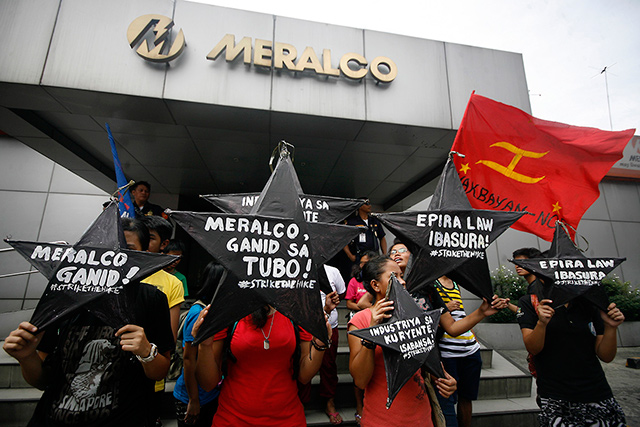
If there is one thing that history tells, it is this: Decisive movements behind political reform as well as revolutionary upheaval are most likely to emerge in periods of rising expectations. As the middle classes gain a greater stake in the economy, there is a proportional increase in their demand for political reforms and greater democratic accountability. No surprise, then, to see the massive expression of outrage by the Filipino middle classes at the alleged embezzlement of the Priority Development Assistance Fund (PDAF) by leading legislators, or the perceived incompetence of state institutions in responding to the Yolanda crisis, or the alleged oligarchic collusion to jack up electricity prices at the expense of the country and the broader economy.
Key challenges ahead
Against the backdrop of an energized middle class, the Philippines will face at least three major challenges in the year ahead.
Aquino’s declining political capital
Aquino’s declining popularity is a reflection of an increasingly critical electorate, which is more rigorously scrutinizing the mettle of political leadership in the country. The problem, however, is that historically, as a reformist leader faces growing domestic opposition, he tends to become either more defensive and cloistered or weakened and wobbly. So, quite paradoxically, an incessant “bottom-up” pressure tends to extinguish “top-down” reformist forces, allowing the opponents of reform to undermine recent democratic gains.
A wholesale critique against all forms of discretionary funds and all government officials could translate into a counterproductive situation whereby pro-reform movements could unintentionally throw out the proverbial baby with the bathwater. What we need, instead, is a coordinated, targeted effort between reformist forces within the government and the broader civil society to usher in a new period of democratic accountability and effective governance.
Lack of inclusive economic growth
While the recent macroeconomic gains (e.g., stable inflation, moderate interest rates, strong GDP growth, and healthy balance of payments) are certainly laudable, the Philippines has yet to decisively tackle double-digit underemployment and poverty. The Yolanda fallout also exposed how low infrastructure spending, regulatory uncertainty, and corruption undermine the nation's ability to cope with natural disasters. With roughly two years before the next presidential election campaign, it becomes crucial for the Aquino administration to undertake a concerted effort at ensuring that the fruits of recent economic gains are not concentrated in the hands of few and (unproductive) sectors.
It should also make sure that we don’t compromise the interest of our agricultural and manufacturing sectors in the ongoing negotiations over establishing a common ASEAN market in 2015.
Rising tensions in the West Philippine Sea
Despite earlier hopes of a multilateral, diplomatic resolution of territorial disputes across the Western Pacific, what we have seen, so far, is instead greater military mobilization, more aggressive territorial jostling, and less room for meaningful compromise. More than ever, the Philippines will need to revisit its current foreign policy, and ensure that it adopts a more effective means of reaching out to the moderates in China, garnering support from the international community, pushing the ASEAN to implement a binding Code of Conduct in the West Philippine Sea, and developing our own military capacity before the end of Aquino’s term in 2016. Otherwise, we face the real possibility of a major military conflict in the region. — KDM/HS, GMA News
Richard Javad Heydarian is a lecturer at the Political Science Department, Ateneo De Manila University, and a contributor to the Asia Times and Huffington Post on Asian geopolitical and economic affairs. He can be reached at jrheydarian@gmail.com

