

 GMA Brandtalk
 Tracking
 Archives

ADVERTISEMENT
Filtered By: Topstories
News
Faith, tenfold: Scaling the Black Nazarene’s float and back again
The float isn't due to move for a few more minutes, but there is already a buzz in the air. I can't see my feet, but I feel those of a hundred others slipping and sliding on sweat, mud, and rainwater beneath me.
"Wait for the float to move. Everyone will have a chance to touch the Black Nazarene," a marshal screams over the megaphone above me, pointing frantically somewhere to my left.
About a dozen men and women are already swarming toward the float from the leftmost section of the grandstand, using the heads and shoulders of the other devotees as stepping stones.
Like many of the devotees, I've come here with prayers for my family's health and well-being. But I also brought with me hope for a certain middle-aged man from Cotabato City who is currently recovering from a kidney transplant.
Abet Seblos, or Mang Abet as he is fondly called by GMA news personnel, is our trusted driver in Central Mindanao. He has been with us since the 90s, covering the intermittent conflict between Muslim rebels and the government.
A fellow reporter recently told me Mang Abet was a devotee of the Black Nazarene and wanted a t-shirt with a printed image.
Many beliefs surround the Black Nazarene, but the more common ones imply that God grants the wishes of true devotees, at least according to His will. My plan was to scale the steep sides of the float and wipe the shirt I would give Mang Abet on the Black Nazarene.
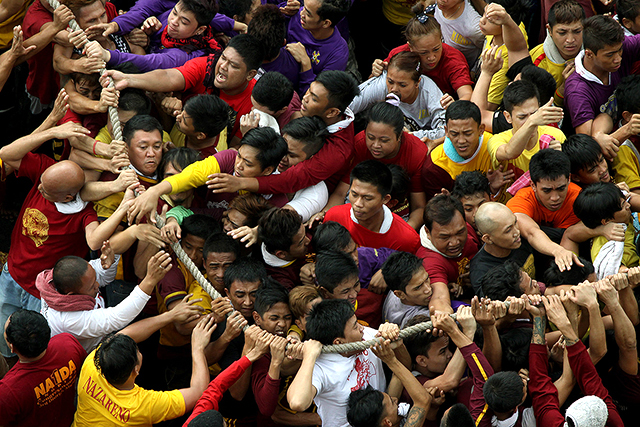
Catholic devotees hold on to the rope that pulls the carriage carrying the image of the Black Nazarene during the Traslacion in Manila on Friday, January 9. The image was brought to the Philippines by a Spanish priest from Mexico in 1606. Friday's event had resulted in the death of one devotee, with hundreds rushed to hospitals and emergency tents due to their injuries. Danny Pata
A wiry young man of about 20 emerges from nowhere, steps on my head and leaps at the float. He grabs hold of the steel support below the rear end of the statue's cross and swings himself up. He feverishly plants kisses on the blackened wood, oblivious to the blows the marshals were raining on his arms to make him let go.
Someone gives the young man a violent shove and he falls into the crowd without a sound, like a pale burned moth kissed by candle flame. I catch a glimpse of his face and realize he is utterly spent from his effort. For a second, he seems to float on the myriad hands that had cushioned his fall, before disappearing into the sea of humanity around the Black Nazarene.
Amid the sweltering, taxing conditions, I realize joining this procession is not only an act, but also a test of faith. It takes true devotion to endure the chaos and still wish no ill upon the people who have no compunction of turning you into a makeshift ladder and landing cushion—all in the span of a few seconds.
All this for a chance to kiss a part of the Black Nazarene or perhaps wipe a piece of cloth over it to take back home as a keepsake and religious item.
I see total strangers volunteering themselves to be stepped on by devotees seeking to reach the top of the float. Someone from the float pours drinking water over us and we simply open our mouths to receive the much-needed relief.
Despite the oppressive conditions, I can't help but wax hopeful. Our country would no doubt make great social and economic strides if we could somehow channel this community spirit into other aspects of Philippine society.
The loudspeaker in the grandstand comes to life.
“Viva Nazareno!”
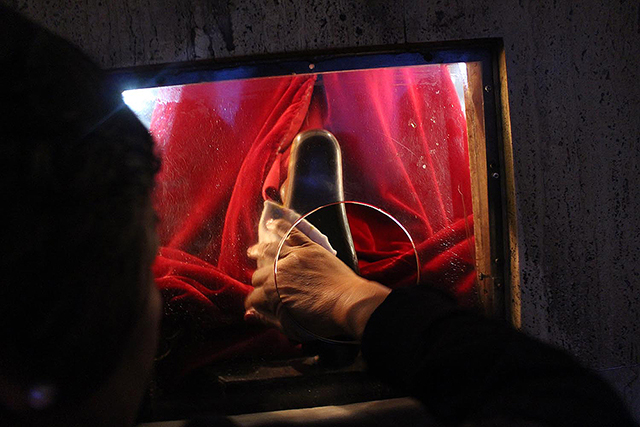
A Catholic devotee touches the foot of the Black Nazarene at Quiapo Church on Thursday, January 8, a day before the Traslacion. Roy Lozano
“Viva!” the crowd, including myself, roars back, steeling ourselves for the ordeal still ahead.
A member of the group I was with stuffed the t-shirt I was to give Mang Abet around the collar of my own shirt. That way he explains, it would not fall when I make the assault to the top.
"Sampa ka na!" The devotee beside me shouts, bending his knees so I could step up and use his shoulders as a springboard.
I launch myself upwards, grabbing hold of the steel support holding up the cross of the Black Nazarene. But as soon as I lift my legs over the edge of the float, three other devotees fly in from the left and use my shoulders as a handhold.
I struggle with their combined weight before the three of us fall back into the crowd.
“Akyat ka ulit!" Someone screams from under me.
I use someone's head as a step and expend all my remaining strength to hook myself onto the base of the cross and wipe Mang Abet's shirt on it. I felt my strength ebbing and could no longer breathe. I loosened my hold and fell.
On my way down, another devotee crashes on top of me, hitting my jaw with his foot. I hardly feel the other blows that follow.
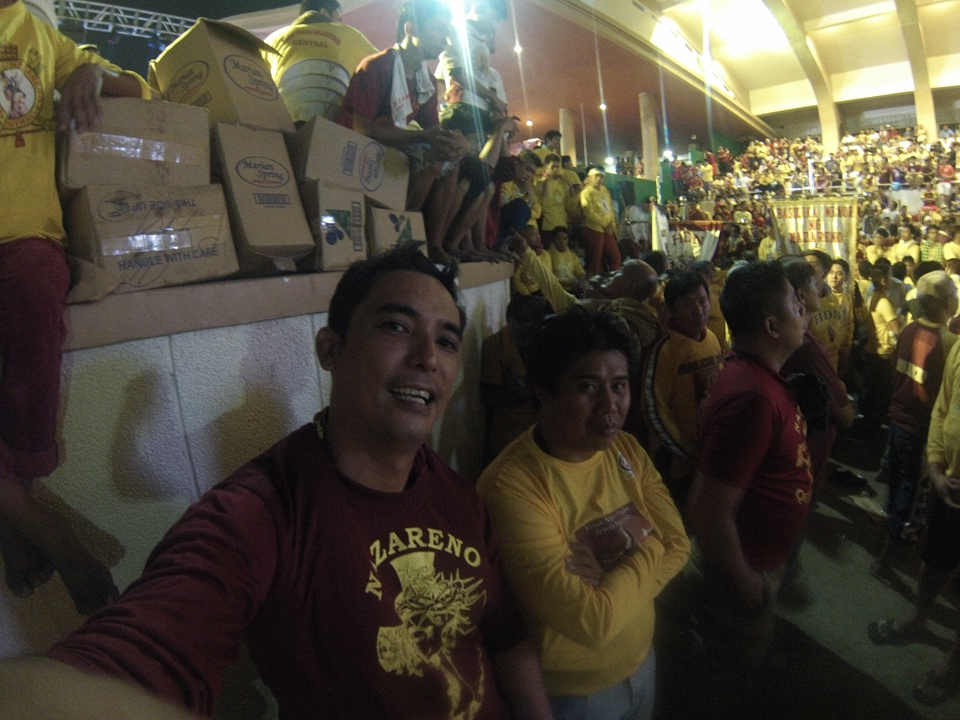
By that time the float began to move, the crowd had become a frenzied mass of heads and appendages. With my vision blurring and my lungs laboring for air, I only had one thought: to break through the sea of people and reach the fresh air and relative peace of the grandstand bleachers.
Chino with Rodel Gonzales, a devotee who helped the author during the procession. Photo courtesy of Chino Gaston
By that time the float began to move, the crowd had become a frenzied mass of heads and appendages. With my vision blurring and my lungs laboring for air, I only had one thought: to break through the sea of people and reach the fresh air and relative peace of the grandstand bleachers.
I am on the verge of panic. Everyone surges toward the float. If I get swept back near the float, I will probably lose consciousness.
I fight with whatever strength was left in me, hurling myself against the wall of people using my elbows and shoulders as a wedge.
I was shouting for the people to let me pass when suddenly, like a benevolent wave, I got a big push from behind, parting the last curtain of devotees and revealing the steps to the bleachers.
Carefully folding Mang Abet's t-shirt, I stuff it into my back pocket. Mission accomplished.
At the end of the day, what is the image of the Black Nazarene but a statue made of wood? But what makes it exceptional is the way it brings out people's faith and beliefs, through the intense devotion of believers who risk life and limb year after year.
As for myself, I come away with the realization that the Black Nazarene not only strengthened my faith in God, but my faith in my fellow men as well. — VC/NB, GMA News

