

 GMA Brandtalk
 Tracking
 Archives

A hala-man’s quiet reprisal against Covid
A couple of months after the pandemic started last year, over 12,000 Filipino fatalities ago, or a few weeks into my life as a Covid survivor, I began writing Covid that way, with a capital C and small letters the rest of the way.
In a public yet unspoken way, I wanted to cut Covid down to size, deprive it of the loud self-importance of the more common ALL-CAPS SPELLING OF COVID.
In my mind warped by weeks of isolation, not to mention the possible addling caused by experimental drug therapy, this diminution of the mother of all diseases was perhaps a subliminal form of revenge against an affliction that by last April had taken the lives of three of my friends, one of them perhaps the country’s leading expert on China; and left me with survivor’s guilt and a constant fear of permanent damage.
This unbecoming feeling of vindictiveness was given cover by my reasonable tendency to obsess over spellings and text styles, a habit formed from years of editing newspapers, magazines and news websites (including this one a decade ago).
So I dutifully obsessed over the awkward aesthetics of COVID, often followed by “-19” (which gave it the marketing mystique of a brand formula), convincing myself that “Covid” was not only easier to type but more elegant.
Besides, even as a pre-millennial, I still knew enough of modern communications to know that writing anything in all caps, like COVID, smacked of screaming, as in, WAAH, BAKA PATI AKO MAY COVID!!!
Alas, just as I was trying to make Covid appear like any other proper noun, an editor turned it into COVID-19 again in an article I wrote, referencing the style set by the World Health Organization or WHO (all caps always).
Writers and journalists are not doctors of course, and need not be tied to scientific orthodoxy, especially with the pretentious swagger of a disease that has a number in its name.
Just as fashion has style, so does journalism. That’s why many news organizations have “stylebooks” that explain how they as journalists and editors use language, which is constantly evolving. The venerable Associated Press stylebook has become somewhat of a bible for the journalism community, and still prescribes COVID-19 as the convention. However, it allows some daylight for those of us in a hurry:
“The shortened form COVID is acceptable if necessary for space in headlines, and in direct quotations and proper names.”
This news site, GMA News Online, consistently uses COVID-19, even in headlines.
However, a quick review of various major news brands shows a lack of orthodoxy on the matter. The BBC has done away with the all caps and uses both Covid and Covid-19, while the New York Times still commonly refers to Covid-19. (My iPhone 11 just auto-corrected that to COVID-19, which I quickly reverted to my preference.)
I’ll allow any editor to edit my Covid into their house style whether it’s COVID, COVID-19, or Covid-19.
But in this article, it obviously wouldn’t make much sense to do that, and on my social media accounts I’ll veto any auto-spell attempts to revert it to the inelegant, self-important all caps version.
As the lockdown, my own bout with Covid, and so many other things in this topsy-turvy era mark their first-year milestone in the coming days and weeks, there’s still so much in this pandemic we can’t control. But I can control how many upper-case letters Covid will contain in my social media posts.
Perhaps that helps explain this bit of navel gazing about what may seem like an inconsequential aspect of the deadliest crisis of our time.
Millions of us lost friends and loved ones to this disease, but what the entire world lost together was also freedom and control.
One could say climate change is the only other crisis in our lifetimes that has affected every corner of the globe. Not even world wars did that.
But climate change has not shut down schools and malls, postponed weddings indefinitely, and emptied city streets. Not yet anyway.
The pandemic has deprived us all of the power to plan our lives. It has made even visiting relatives a life-threatening decision. Even touching your own face can turn a friend into the Covid police.
In a more innocent time, we urged people to simply “think before you click.” Now the mantra needs to be, “think before you move.”
Trapped at home and fearful of the world outside, many of us have sought to control our lives in front of screens, with countless zoom reunions and group conversations, not to mention the work meetings that have enabled us to continue making a living.
Many others suddenly have time to cultivate inner lives by reading more books, learning new languages or skills, trying new recipes, and listening to the operas and other less popular music that we previously had no interest in.
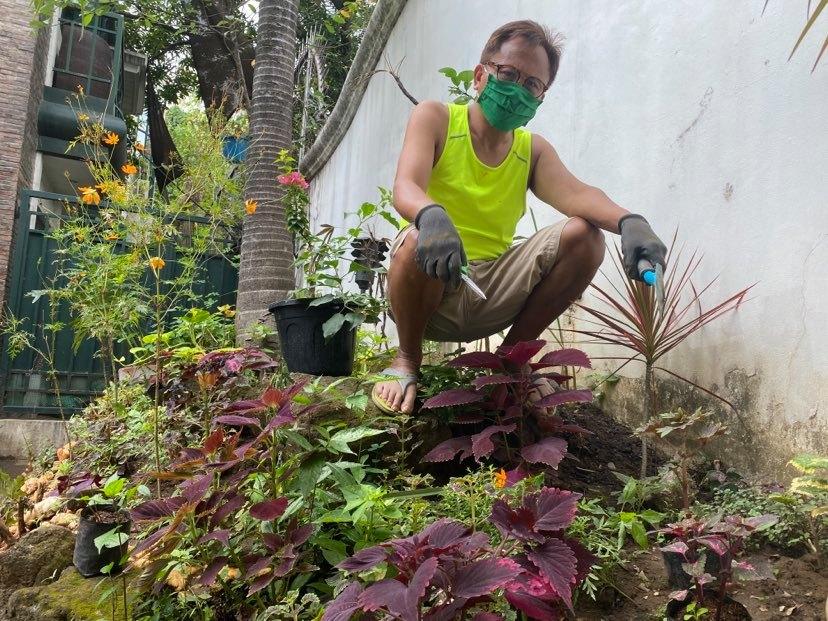
Then there’s the cultivation of other living things. I’m one of those who jumped on the plantito bandwagon (I tell friends I prefer to be called a “hala-man”), and quickly discovered its calming, therapeutic effects. In a less stressed out time, I had gently raised eyebrows at friends and family members who said they talked to their plants. Today I still reserve my real-world conversations for fellow human beings, but I do feel I’ve formed relationships with the plants I started growing during the lockdown. In my daily visits with each plant, I know when one is literally down and needs the rejuvenating effect that only a human friend with a pail of water can give. To see a new bloom on an orange cosmos can make my day, or at least the morning part until one begins to see work-related emails.
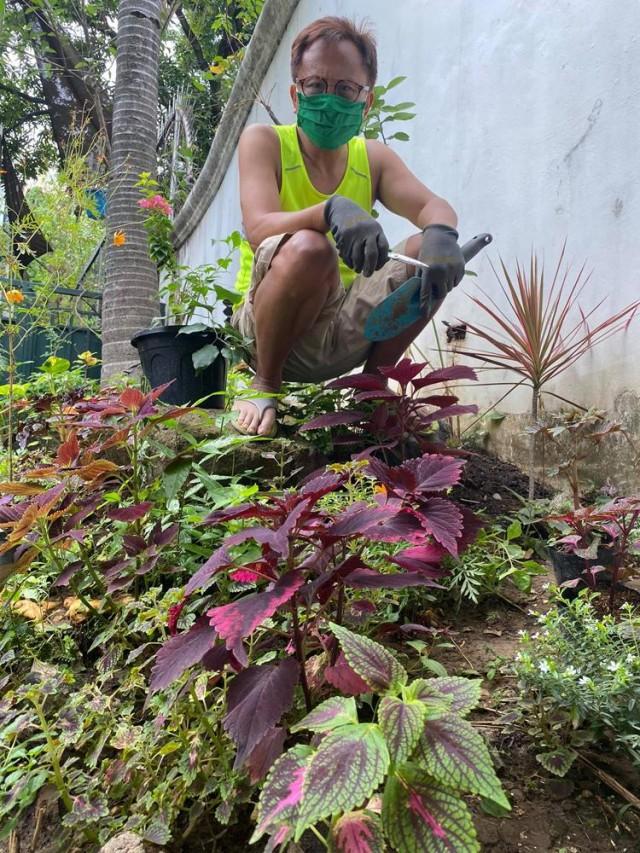
Then there’s the vastly underappreciated aspect of plants that few of us talk about – gardening allows decline and demise without the emotional devastation of other kinds of loss that one dreads during this time.
Sure, that row of rhapis palm plants that you once envisioned to mark the edge of your garden slowly died together. But never mind, maybe they were never meant to be in that spot. Now vibrant reeds of papyrus stand gallantly in the same place. It’s impossible to replace a human loved one or even a longtime pet. But one can find another gorgeous Alocasia. A hala-man’s woes are easily cured.
If only the rest of our problems today were so curable.
So in the sea of troubles the world has found itself in, one grasps any form of control or freedom that’s available, somewhat like not being choosy with life vests when a few drift by as you’re bobbing helplessly in the water.
For people who work with words, style can still offer that freedom and control, especially if you self-publish like most of us do on social media. You can misspell too and just ignore the language nazis.
So no one can tell me that “Covid” is wrong, and only “COVID-19” is right.
Language and styles change. There was once a time when everyone capitalized “the Internet.” Today, the Oxford English Dictionary tells us internet with a small i is also correct, while the Associated Press revised its stylebook back in 2016 to standardize lower case internet, in keeping with a long tradition of de-capitalizing words like Television when these become commonly used generic terms.
With coronavirus variants popping up like poisonous mushrooms on various continents, is Covid on the way too to becoming just another generic word like “cancer” to connote a whole family of diseases? For the sake of the unvaccinated masses, we certainly hope not.
But for those of us who treasure our control over little things like the words on our social media posts, we should be able to exercise our freedom to decapitalize Covid as well, if only to derive a quiet satisfaction from cutting covid further down to size. —JST, GMA News

