

 GMA Brandtalk
 Tracking
 Archives


DMW mulls 'high-risk' label for southwestern Black Sea amid drone attacks
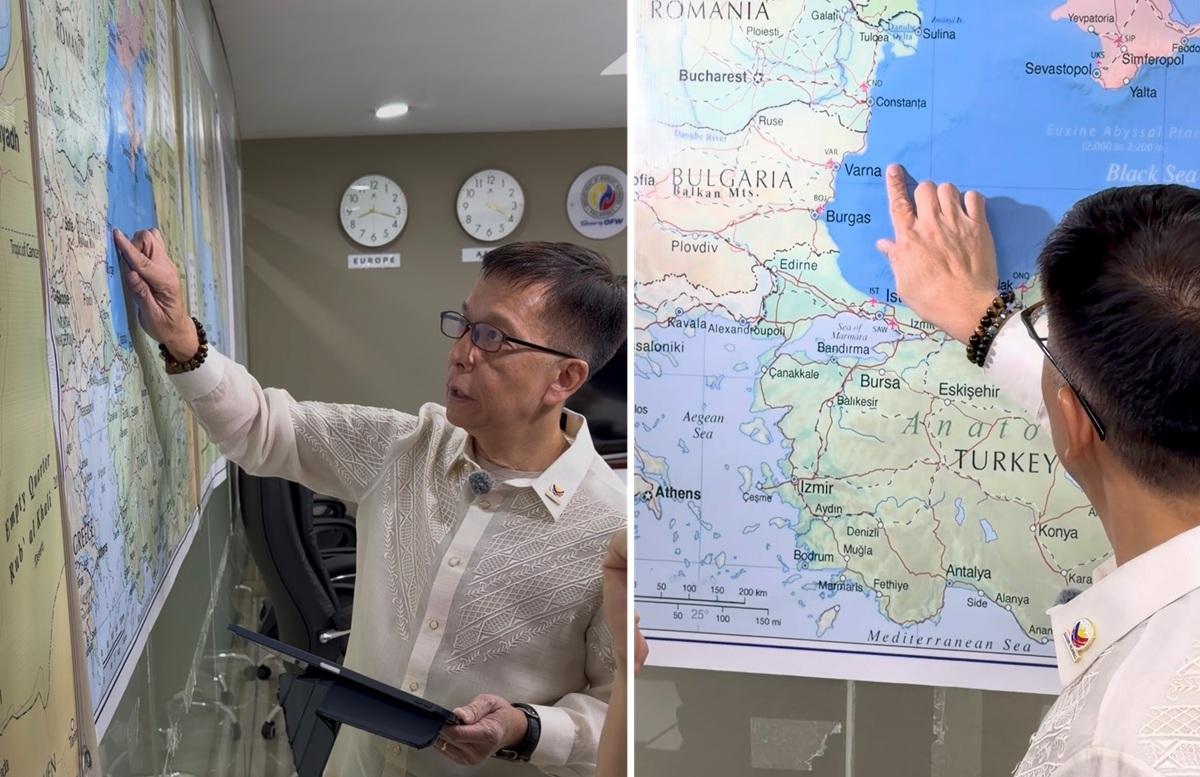
The Department of Migrant Workers (DMW) is preparing to recommend a review of existing maritime high-risk and warlike zone classifications to determine whether the southwestern Black Sea should be included, following a reported drone attack on a liquefied petroleum gas tanker carrying 19 Filipino seafarers off the coast of Bulgaria.
Migrant Workers Secretary Hans Leo Cacdac say Wednesday that reports of attacks on commercial vessels in the southwestern Black Sea have raised serious concerns over the safety of Filipino seafarers operating in the area.
“Nakikita na natin yung panganib sa southwestern side kaya yung ay papanukala natin ay isama yung southwestern side ng Black Sea sa pag-aralan, na isama yung southwestern side ng Black Sea sa high-risk or warlike zones,” Cacdac said.
(We saw that there is a risk in the southwestern part of the Black Sea, so our proposal is to include the area in the list of high-risk or war-like zones.)
“Rest assured we will make a recommendation na pag-aralan whether isasama na itong [to study whether to include the] southwestern part sa high-risk or warlike zone,” he added.
At least 14 merchant ships have been hit by drones in the Black Sea off Romania and Bulgaria since early October, leaving more than 30 sailors dead or missing.
Romania and Bulgaria have both pointed the finger at Russia over the attacks, though Bulgaria has underlined that there is no proof of who was behind them.
At present, the International Bargaining Forum (IBF) designates specific portions of the Black Sea as high-risk or warlike areas, including the northern region affected by the ongoing Russia-Ukraine war. The classifications do not cover the entire Black Sea.
Under existing maritime safety arrangements, Filipino seafarers who sail in areas designated as having risks are entitled to certain protections, including the right to refuse sailing, repatriation at the company's expense, additional compensation and enhanced security measures, depending on the applicable designation.
Cacdac said the recent incidents demonstrate the need to reassess whether these protections should be extended to waters farther southwest, including areas near Bulgaria and Romania.
The proposal remains subject to further study and the applicable processes for changing maritime risk classifications.
Drone strikes
The Liberian-flagged LPG tanker Gas Husky sank on Tuesday, November 17, approximately 50 nautical miles off the coast of Bulgaria.
The vessel was reportedly traveling from Egypt and carrying some 3,400 metric tons of LPG when it encountered an emergency in the Black Sea.
The incident comes just one day after another cargo ship, the Betul 8, capsized off Bulgaria after what rescued crew members described as a drone strike.
According to Cacdac, reports received by the DMW indicated that the tanker was struck by drones, causing it to list and eventually sink.
The exact circumstances of the reported strike remain unclear, and the party responsible has not been conclusively identified.
The 19 Filipino crew members managed to abandon the vessel and board a life raft before it sank.
Bulgarian authorities subsequently launched a rescue operation, deploying helicopters to evacuate the stranded seafarers and bring them to safety.
Cacdac said two of the 19 Filipinos sustained minor injuries, but all crew members survived.
“Na-disembark sila at the right time, everybody ligtas at naisakay sa life raft at merong helicopter na sumagip sa kanila from the life raft. Ngayon, dinala na sila sa isang lugar, nasa hotel ngayon sa Bulgaria, at doon pupunta ang ating labor attaché,” he said.
(They disembarked at the right time and a helicopter retrieved them from the life raft. Now they are at a hotel in Bulgaria, and our labor attache will go theré.)
The DMW is coordinating with the Philippine labor attaché, the Department of Foreign Affairs and the vessel's Philippine manning agency to provide assistance and arrange the crew members' repatriation.
The incident underscores the risks to commercial shipping beyond the northern Black Sea, where maritime security concerns have persisted since Russia launched its full-scale invasion of Ukraine in February 2022.
The reported attack near Bulgaria has raised concerns that the dangers associated with the conflict could affect shipping routes beyond the areas currently classified as the most dangerous.
The DMW's proposed review could have implications for Filipino seafarers assigned to ships transiting the southwestern Black Sea, particularly in determining whether additional safety guarantees and the right to refuse sailing should apply.
Beyond the immediate safety concerns, Cacdac reiterated the Philippines' call for peace amid continuing conflicts that threaten overseas Filipino workers and international commercial shipping.
The appeal is consistent with the broader position advanced by the Philippines and the Association of Southeast Asian Nations (ASEAN), which emphasizes dialogue, diplomacy, respect for international law and the peaceful settlement of disputes.
During the recently concluded 49th ASEAN Summit and Related Summits in Manila, regional leaders also emphasized the importance of maintaining peace and stability amid geopolitical tensions.
While ASEAN is not directly involved in resolving the Russia-Ukraine war, its longstanding principle of peaceful dispute settlement remains relevant to international conflicts whose consequences extend beyond the countries directly involved.
For the Philippines, these consequences are particularly significant because of the large number of Filipinos employed aboard international commercial vessels, including ships operating near conflict-affected waters in the Black Sea, the Strait of Hormuz and other parts of the Middle East.
The risks extend beyond disruptions to global trade and energy supplies, directly affecting the lives and livelihoods of Filipino maritime workers.
“Panawagan talaga ay magkaroon ng kapayapaan at manaig ang komersyo, manaig ang pagkakaroon ng malaya at mapayapang pamumuhay, lalo na yung mga OFWs natin doon, yung ligtas ang ating OFWs doon,” Cacdac said.
(Our call is for peace, and for commerce and freedom to prevail, especially for our OFWs.)
The DMW said it would continue coordinating with relevant agencies and maritime stakeholders to strengthen protections for Filipino seafarers as security threats affect commercial shipping routes. — BM, GMA News
Follow facebook.com/gmanewsonline for real-time news and developments in the Philippines and around the world.

