

 GMA Brandtalk
 Tracking
 Archives

Sabatini Esteban Fernandez: Keeping the flame of mother tongue lit
The camera is set. The subject is ready. And, in between the digital camera exposures is the subject’s intense zealousness and preoccupation – scribbling a “tula” or poem written in Filipino on a white sheet of paper. After the pictorial session is through (just several minutes short), the poem is handed to this writer/photographer, all metered, eloquent and meaningful.
Our consummate subject -- Sabatini Esteban Fernandez, a well-known radio, TV, and stage actor -- happens to be nearing his 84th birthday. Besides these theatrical talents, he is also a philosopher and is well-versed in the subject of world history and literature. 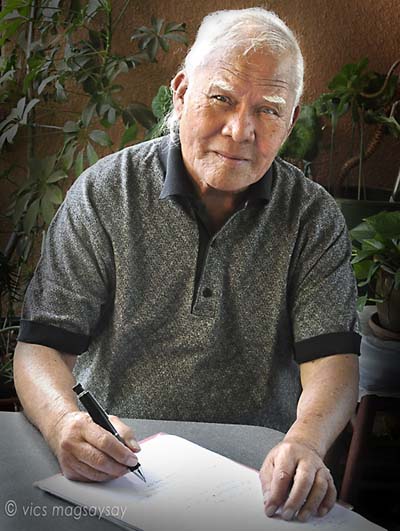
Written with such exquisite flair, his book “Kalansing ng Hinog na Diwa (Vibrations of Great Minds)," a veritable repository of all-metered Pilipino poems, delves into culture, philosophy, human values, and great historical figures that have left an indelible mark on this planet. And don’t get fooled by its nondescript cover – his book of poems echoes a stimulating tapestry of subjects and thoughts soaked most likely from his lengthy periods of reading and the concomitant retention of facts and figures.
Before we continue, let me tell you first what happened before I met Sabatini or Mang Bating (“Mang” is a polite way of addressing males, mostly those older than yourself, in Pilipino). It was at the Kawit Town Fiesta celebrated at the El Dorado Park in Long Beach, California, where Robert “Bob” Shroder, FASO conductor, flutist and sax player, introduced me to Mang Bating. Both of them hail from the same town. Standing straight and elegant in an all-white outfit, he amazed me with his wit, memory and sharpness on every subject we discussed. It seemed as if his incredible thoughts were bursting at the seams.
Chancing upon such a talented poet was not a coincidence – I think it was a part of resonance, synchronicity. Before meeting this seasoned “makata” (poet) our group of Pilipino poets in L.A. came up with a night of Philippine poetry and culture held at the Philippine Consulate General in Los Angeles. Our main objective was to promote and propagate our mother tongue. I know there’s an urgent need to revive the use of our language in this literary art form. If not, it will follow the tragic fate of the proverbial dodo bird – extinct.
Just recently, Benjamin “Boying” Pimentel, a San Francisco-based journalist and author was in the Philippines to promote his new book, “How My Sons Lost their Tagalog.” That’s very sad. It just shows that many second-generation Filipino Americans are losing their parents’ mother tongue. What more of the third generation? Mang Bating, in one way or another, truly has a catalytic value in keeping our literary culture intact – a linguistic keeper of the flame, so to speak.
Our friend Mang Bating is not getting any younger; he is already in the winter of his life. But what’s astounding about him is his mind. “The late Filipino broadcaster and inventor Ernie Baron, popularly known as the ‘Walking Encylopedia,’ calls me the ‘Walking Almanac’,” he quipped. Ask him almost any date or mention the name of a movie and he will tell you what happened during those year or the actors, actresses or directors of the given movie. That’s how good a memory this enigmatic person has. Many people aged in their 50s or 60s have a hard time making their synapses connect.
He was born from a humble beginning in Binakayan, Kawit, Cavite on December 5, 1930. Even at an early age poetry was second nature to Mang Bating. While other children were out frolicking at the age of nine, he was already going overdrive on writing poems. “When I reached 16 I was already a 'mambabalagtas' (one who uses poetry in a debate specifically in Tagalog or Pilipino),” he explained. “And at age 17, I used to become popular for reciting poems (for introduction) and crowning beauty queens in a town fiesta,” the poet added with zing.
Mang Bating was ahead of the curve: he was only 18 – the youngest educator in the province of Mindoro – when he became a schoolteacher. At 21 he worked as a utility crew member in PAL. During those times he was already a radio talent; airline and airlane were the two industries he had to apportion his energies between, with different intensities. In his working stint with the country’s flag carrier, he also served as a union officer while, during another time frame, an announcer at DZSS and DZME. In addition to this he was also writing radio scripts.
“During the 1950s I observed that ‘harana,’ an old Filipino courtship tradition of serenading women, was starting to wane,” he noted. (Over 60 years after, he sang “harana” songs at this 22nd year Festival of Philippine Arts and Culture in San Pedro, California). According to him, being a “makata” or poet means “busog ang puso sa kabutihan” (heart is filled with goodness); and he describes “tula” (poem) as “a spontaneous overflow of emotion and with heart and mind as one.” He displays this goodness of the heart by continuously helping the Mangyans, minorities of the province where he once was a schoolteacher.
He was hailed as a number one councilor in his town of Kawit prior to migrating to the U.S.A. (He was petitioned in 1981 and settled first in Washington State before moving to California.)
Whether in the Philippines or U.S.A., this multi-awarded poet, stage actor and freethinker has achieved so many accomplishments. To name a few: many will remember him in the TV sitcom Baryo Balimbing as the hard-of-hearing father of Lou Veloso, in the Untouchable Family as Don Vito, in Doña Clara as the 85-year-old judge, Cornelio Diaz, and in Missing in Action, a Chuck Norris film, as Sgt. Din of Vietnam. He was even called “actor’s actor” by his peers when he delivered his monologue “Ako ay Pilipino” at the Wilshire Hilton in 1991.
Humans, like wines, become mellow when they age. But for Sabatini Fernandez passion knows no sabbatical, no rest. There’s no stopping in sharing his indefatigable and fervent literary talent with we Filipinos and with the world. If only our passion for our “Inang Wika” [mother tongue] can be continued, there is still hope that other sons and daughters of our first generation Filipino Americans will embrace the beauty of our language...and proliferate further. -- KBK, GMA News

