

 GMA Brandtalk
 Tracking
 Archives

Pinay among volunteers providing meals for jobless students in Australia
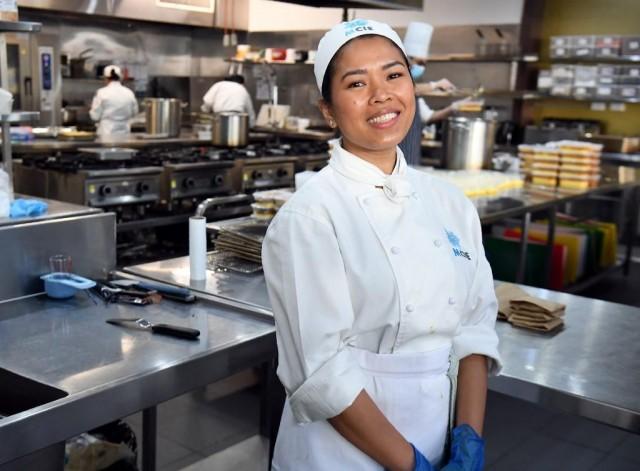
MELBOURNE - Australia wooed hundreds of thousands of international students to its shores with the promise of a first-class education and fun-kissed adventure, but the coronavirus disease (COVID-19) crisis has left many jobless and dependent on food handouts.
Each day up to 100 students from Asia, Latin America and beyond stand on carefully spaced fluro-pink crosses outside a Melbourne cooking school, waiting to pick up free freshly prepared meals.
The students -- just the tip of the iceberg -- pay several thousands of US dollars each year to study Down Under but now find themselves counting cents to survive.
Volunteer chef Laarni Byrne had started a certificate in commercial cookery when she made the choice to stay in Australia.
The single mum with two children in the Philippines said returning was not an option.
"I'm really lucky that I managed to get to Australia. It took a lot of hard work for me to be here," she said.
An easing of restrictions from June 1 will mean restaurants and cafes will be able to seat and serve more customers and some students told AFP they have already been contacted by their bosses with shifts lined-up.
However, an expected slow return to business will mean not all international students will be able to return to their previous jobs.
After losing both her online marketing and hospitality work, Byrne said: "It's better to be productive than think about the impact of the COVID-19."
Colombian student Santiago Castillo, 26, worked at a cafe before the pandemic broke out -- one of the almost one million jobs that have been lost in Australia because of lockdown measures.
After paying his rent and borrowing money from friends, he now counts less than US$66 in his savings account -- a meagre amount to get by in one of the world's most expensive cities.
Vast government subsidies to laid-off workers do not apply to non-residents -- even if they pay local taxes and bring billions of dollars into the Australian economy.
To fill the void student soup kitchens have popped up across the country.
"It's really stressful," Castillo told AFP, pointing to cysts that have developed on his lips and bottom of both eyes since he became jobless.
"I have developed skin problems... It's like I can handle the stress in my mind, but my body is reacting," he said.
The allowance of two meals a day -- usually curry or chicken and a vegetarian dish -- at the Melbourne City Institute of Education has been a lifeline.
Hunger and desperation
Brazilian international student Marilia da Silva has also leaned on food handouts. She was juggling English study with 20 hours of work a week in a cafe before she lost her job.
Some cleaners she knows also offered to help with food: "They said, 'if you need something, please let me know'... I felt a lot of support and that's what's good."
Student welfare officer Michelle Cassell said that "in situations like this, students will generally go without meals to be able to provide a roof over their heads".
She says the desperate plight of students has become obvious in the past six weeks, with the school's kitchen operating daily at maximum capacity.
The institute has partnered with local charity Charon Foundation to fund and provide 900 meals a week since March 30 for those hard-hit.
Cassell says the program could possibly run until September or "until students can get back on their feet".
There are more than 500,000 international students in Australia, worth around Aus$32 (US$22) billion to the economy.
'Go home': Morrison
Universities were almost halfway through their first semester when Prime Minister Scott Morrison controversially told struggling international students to "go home" on April 3.
"When he made that call, flights had already stopped," Coonar told AFP. "People who wanted to leave the country couldn't even do so.". -- Agence France-Presse

