

 GMA Brandtalk
 Tracking
 Archives

Pope Leo XIV urges educators to focus on situation of youth, technology — Bro. Luistro
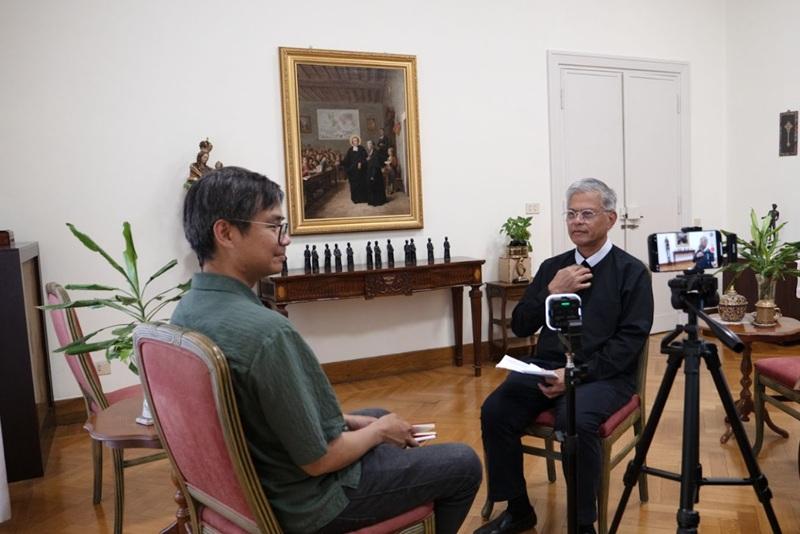
ROME, Italy – Days after his audience with Pope Leo XIV, former Education Secretary Brother Armin Luistro said that among the pontiff’s message is for educators to understand the situation of today’s youth, education is much more profound than just a school to dish out ideas, and to view technology not as a distraction but tools for learning.
“What are the most urgent challenges to face today in the world of youth? What values need to be promoted? What resources can we rely on?” Pope Leo XIV asked his audience on May 15. His attendees comprised educators and nuns from the Brothers of the Christian Schools (or Christian Brothers), in which Luistro is now superior general.
“The reason why I truly appreciate the message that Pope Leo XIV gave us – and to be very honest, I still need to unpack this because it is so rich – it gives us a lot of direction, to encourage us on what is at the very heart of our vocation as teachers today,” Luistro told GMA Integrated News.
“He actually began with something that grounded his message and his directives. And [then he said,] ‘Young people today are a volcano of life’.”
“Being a Filipino and having experienced Pinatubo, Taal, and Mayon, [the word] volcano does not bring a very good image to me. But ‘volcano of life’ in Spanish talks about the exuberance of life, of emotions, and the abundance that comes from within.”
A real surprise
Bro. Luistro told GMA Integrated News that the confirmation of their papal audience came as a “real surprise” as they had requested for such a meeting at least six months ago, during the time of Pope Francis. It was timed for the feast day of the Christian Brothers’ patron saint, St. John Baptist de la Salle.
“I was doing my sweet time visiting [the Christian Brothers’] communities in Benin. And lo and behold, I got this message: ‘It is confirmed’ [the audience with Pope Leo XIV]. I came back a day before [on May 14] and everything was worked out. It was the greatest and best blessing for us and for the Brothers this year.”
At the audience, Pope Leo XIV referenced St. John Baptist de la Salle and the Christian Brothers’ history about their “attention to the present moment” and “the ministerial and missionary dimension of teaching within the community.”
For Luistro, the pope’s message meant he “knows what is happening, not only within the church, but outside in the real lives of people.”
“That’s a wonderful gift that can only come from the heart of a missionary because [Pope Leo XIV] was a bishop for not too long. He has been out there on the field [as a missionary], and therefore, his thoughts, heart, [and] actions are all grounded in the reality of people’s life,” Luistro shared.
“So when he talks about young people as a volcano of life and of emotions, then he also relates that with what not only the positives, but also the real challenges that they are facing.”
Addressing “isolation” among the youth
Pope Leo XIV shared observations on the “isolation” among the youth “caused by widespread relational models” marked by “superficiality, individualism, and emotional instability.”
He also warned about “the spread of thought patterns weakened by relativism”, and loneliness resulting from the “dominance of lifestyles and rhythms in which there is not enough space for listening, reflection, and dialogue — in school, in the family, and sometimes even among peers.”
For Luistro, Pope Leo XIV “understands that curriculum, policies, educational systems will have to take a back seat”, and that educators’ first priority “is actually to know young people today.”
“[We have to] ground ourselves in their human experience because it is from there that our educational programs [and] reforms will have to be based. It cannot be just from books or some ideas generated by artificial intelligence.”
Luistro also calls for a reform so government institutions, such as the Department of Education (DepEd), would be able to respond to the challenges of superficiality, individualism, and emotional instability that Pope Leo XIV observed among the current generation.
“We are trained to look at government as boxes that are unfeeling. But I think this is exactly the reform that we need in DepEd, the Commission on Higher Education [CHED], the Technical Education and Skills Development Authority [TESDA], and in all educational institutions because we assume that programs can be just up here,” Luistro said.
“Education is a deeply human encounter that changes lives. And I think that is critical to the message of Pope Leo XIV. It’s not romanticizing education [or] spiritualizing what is secular. He's just saying that education is much more profound than just a school to dish out ideas or to debate.”
Technology and education
Earlier this year, the Vatican City State adopted its guidelines on AI, which quoted the late Pope Francis in its theological structure. It states that AI technology “should not be seen as an artificial form of human intelligence, but as a product of it.”
In a separate audience with journalists and media, Pope Leo XIV commented on artificial intelligence and pressed the need for discernment and ethical responsibility which “concerns everyone in proportion to his or her age and role in society.”
Luistro welcomed Pope Leo XIV’s stance on this issue, particularly his awareness of a “major earth-shaking paradigm shift in terms of technology”.
“I did not expect that Pope Leo XIV would see AI as a central issue early on in his papacy. … I think [his] real message is not to be afraid of AI, not even to push AI and resources, but to embrace it and look at it from the perspective of how we could make an influence so that it becomes a positive change instead of degrading,” Luistro commented.
The former education secretary also urged educators and the government to reframe the perspectives on such technologies and view them not as a distraction but tools for learning.
“Especially when we look at our rankings in the world and the ongoing debate in Congress in terms of educational reforms, [the challenge] is how do we use existing technologies so that these can actually benefit our learners today. That is so critical because on many occasions, we are skeptical about anything that’s modern and shifting.” — BAP, GMA Integrated News

