

 GMA Brandtalk
 Tracking
 Archives

For Filipino migrants in Poland, community solidarity makes them visible
WARSAW, Poland – In the Polish capital, there is a “Proud Mary” from the Philippines: Mary Huerta and her restaurant business have kept on rolling for four years and counting.
Her restaurant, which has consistently welcomed Poles and other tourists, has also become a community place for new and long-term Filipino residents in the Polish capital.
“Nagustuhan ng mga Polish ang pagkaing Pinoy. Nakaka-proud na unti-unti nilang nakikilala ang ating bansa sa pamamagitan ng ating pagkain,” Huerta told GMA News.
(My Polish customers have grown fond of Philippine cuisine, and it makes me proud that our food has become a way for them to learn about our country.)
Huerta arrived in Poland nearly a decade ago, when the number of Filipino migrants there was still around 5,000.
That number was based on the estimates of Polish sociologist Olga Wanicka, an academic who has studied Filipinos in Poland for around seven years.
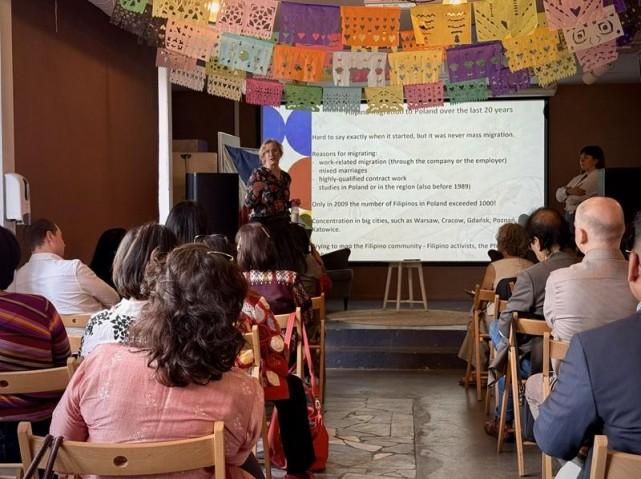
“It’s hard to say exactly when it started, but their arrival in Poland was never a mass migration,” Wanicka shared at a recent gathering of Filipino community leaders and Polish civil society workers in Warsaw.
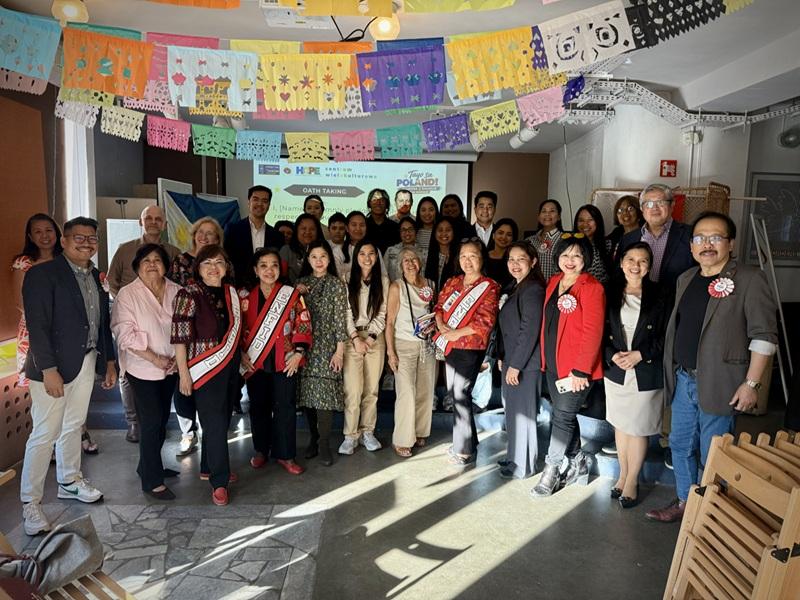
This event, led by the European Network of Filipino Diaspora (ENFiD), focused on the realities of Filipino integration in Poland, with guests such as Huerta and other speakers sharing insights and opportunities to connect with fellow kababayan.
Wanicka noted that a demographic shift occurred around 2019, when Polish industries began hiring migrants.
At the time, she said, “migration from the Philippines to Poland was very low-scale, almost invisible,” and that new arrivals were mostly concentrated in big cities such as Warsaw, Kraków, Gdańsk, Poznań, and Katowice.
Now, as many as 15,700 Filipinos are enrolled in Poland’s national insurance system (ZUS), according to Janina Owczarek, a national program officer at the International Organization for Migration (IOM) in Poland.
The figures, she explained, are for Filipinos with a valid visa or residence permit in Poland, including workers with valid documentation, students, spouses of Polish nationals, and children of Filipino-Polish families.
According to the Philippine Embassy in Warsaw, Filipino workers are mostly in the manufacturing and production sectors (such as factories, plastics, food production, electronics, and automotive parts). Others are in administrative services, construction, transportation and logistics, professional sectors (such as banking and IT), and in the hospitality, tourism, and agriculture sectors.
In the past three years, as many as 30,000 work permits have been issued by Poland to Filipinos, according to the embassy’s minister and consul general, Mr. Conrado Demdem, Jr.
But the total Filipino population in the Central European country remains an estimate due to irregular migration.
“Extrapolating from those figures,” Demdem said, “the Embassy pegs the number of Filipinos in Poland at between 21,000 and 25,000. The number includes those outside ZUS and those who are irregular or undocumented.”
Catalysts for solidarity
In their presentation, Wanicka and Dr. Helena Patzer, a sociologist at the University of Warsaw, discussed the “scandals” surrounding the first major attempts to bring large numbers of Filipino laborers to Poland, which led to labor-exploitation scams.
In 2009, nearly 100 Filipinos pleaded for help because of unjust working conditions in a window-manufacturing company in Aleksandrow Lodzki, a Polish town 144 kilometers west of Warsaw.
A year later, the Philippine Embassy in Warsaw, which had just been reopened, warned Filipinos against seeking employment in “mushroom picking” jobs in Poland due to alleged inhumane working conditions.
“The victims of that mushroom-picking job were mostly women. This was really a sad story,” Patzer said of the scandal that became widely televised and discussed in Polish society at the time.
Both academics noted that the crises became catalysts for solidarity, with other Filipino migrants and embassy staff working together to accommodate workers who had been deceived by illegal employers.
For her part, Huerta—the Filipino restaurant owner—always reminds her customers to “stay on the right track”.
“Piliin po nating maging legal, at sumunod sa rules and regulations ng Poland (Always choose to be legal and follow the rules in Poland),” she said.
Meanwhile, other community figures have provided emotional refuge to fellow Filipinos and have become the foundation of support groups.
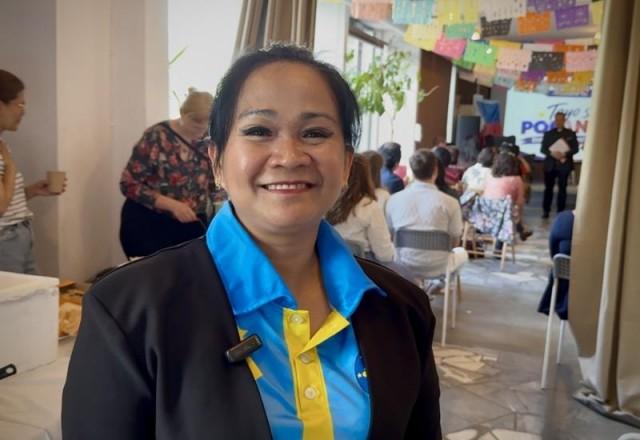
One of them is the Humanitarian Organization of Pinoys in Europe (HOPE), founded in 2017 by a community leader in response to the needs of several Filipinos seeking help with working and living in Poland.
Some of HOPE’s clients, according to its vice president Clarisse Biglain, are migrants who “jumped” (a colloquialism for migrant workers who have moved to another European country without finishing their contracts), or other workers discontented with their salaries or work environments, and those dissatisfied with the lengthy process for their temporary residency in Poland.
“I’ve noticed that many of those Filipinos make rash decisions without thinking about the repercussions of their actions. Others are being influenced by social media posts without even confirming everything. Hearing about the scandals, I think it is discouraging and unfair to other Filipinos who follow the rules and have obtained their work legally,” Biglain told GMA News.
For Biglain, the recent dialogue “helps create a safe and meaningful space” where Filipino migrants can address the issues they face in Poland.
Meanwhile, the event organizers said the gathering “reminded Filipinos in Poland that they are no longer invisible.”
“It also showed that many forms of support already exist for migrants here, from fellow Filipinos, NGOs, public institutions, and local organizations. What matters now is awareness, connection, and feeling empowered to make use of these opportunities and support systems,” ENFiD-Poland director Aieshah Balmori said.
“Know it, live it”
When asked about Polish perceptions of Filipinos, Wanicka spoke of shared cultural values that make it easier for the latter to integrate into Polish society.
“Being Catholics—having a similar religion has an impact. For example, Filipinos attend Mass in different parts of Poland. For Poles, it is easy to start a conversation when they see Filipinos in the churches. And it’s also about Filipinos’ attitude. They are open and care about other people, like Poles and Ukrainians,” Wanicka told GMA News.
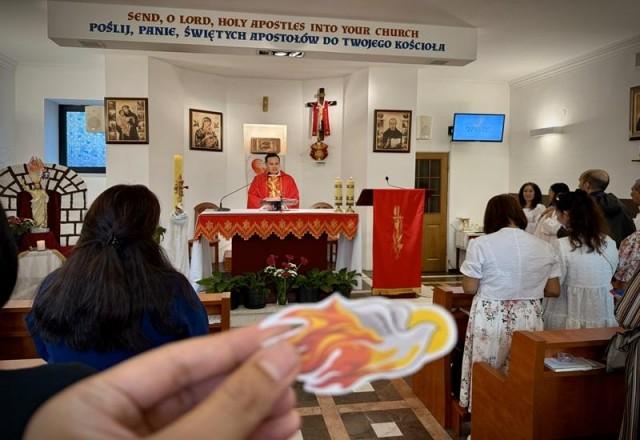
For Fr. Tirso Alcover, a priest who has been celebrating Mass for Filipino communities in Warsaw, it is not just being Catholic but also being hospitable that helps Pinoys adapt well to their new host country.
“With our smile, it is an invitation for friendship and for something that could allow us to be deeper in our relationship,” Fr. Alcover said.
One of the activities he does after Mass is “Know it, live it”— what he calls a weekly “on-the-go catechesis” to help Filipino migrants and Poles learn about the Catholic sacraments.
Just before the Pentecost Sunday Mass wrapped up, Fr. Alcover asked Filipino and Polish churchgoers to pick up a piece of paper that had a “gift of the Holy Spirit”—or a value that they were encouraged to live through for the entire year.
For other community figures, such as Dr. Lorico Lapitan Jr., who leads a group of Filipino students and academics in Poland, new arrivals and old-timers alike need to prepare for the opportunities and challenges they might face in the Central European country.
“Read about Filipino experiences here. Look for a community because it is not a luxury but a matter of survival. You also need a lot of perseverance and patience, especially when dealing with legalities,” Lapitan shared.
Huerta also tells customers to reach out to support groups and avoid broadcasting their plights to their social accounts.
“Marami na pong malalapitan ngayon, so nandiyan yung Philippine Embassy at mga non-government organizations dito sa Poland na tumutulong sa mga galing sa ibang bansa kung may problema ka. At kung hindi gumagawa ng mali yung tao, wala rin silang magiging problema.”
(Filipino migrants can reach out to the Philippine Embassy and other NGOs in Poland that help those coming from different countries, especially if they have issues. And as a general reminder, if someone doesn’t do anything wrong or illegal, they will not have any issues here.)
The Philippine Embassy in Warsaw, for its part, reminds Filipinos in Poland to ensure they have the proper documents with them at all times, including a temporary residence card and a work permit.
“For those planning to work in Poland, they have to make sure that they engage only the services of legitimate recruitment agencies accredited by the Department of Migrant Workers in the Philippines. Avoid getting recruited online or through social media platforms. The Embassy is working closely with the Migrant Workers Office in Prague to address labor-related and welfare concerns of Filipinos,” Demdem said. — BAP, GMA News

