

 GMA Brandtalk
 Tracking
 Archives

Chinese rocket debris may have fallen in PH waters —PhilSA
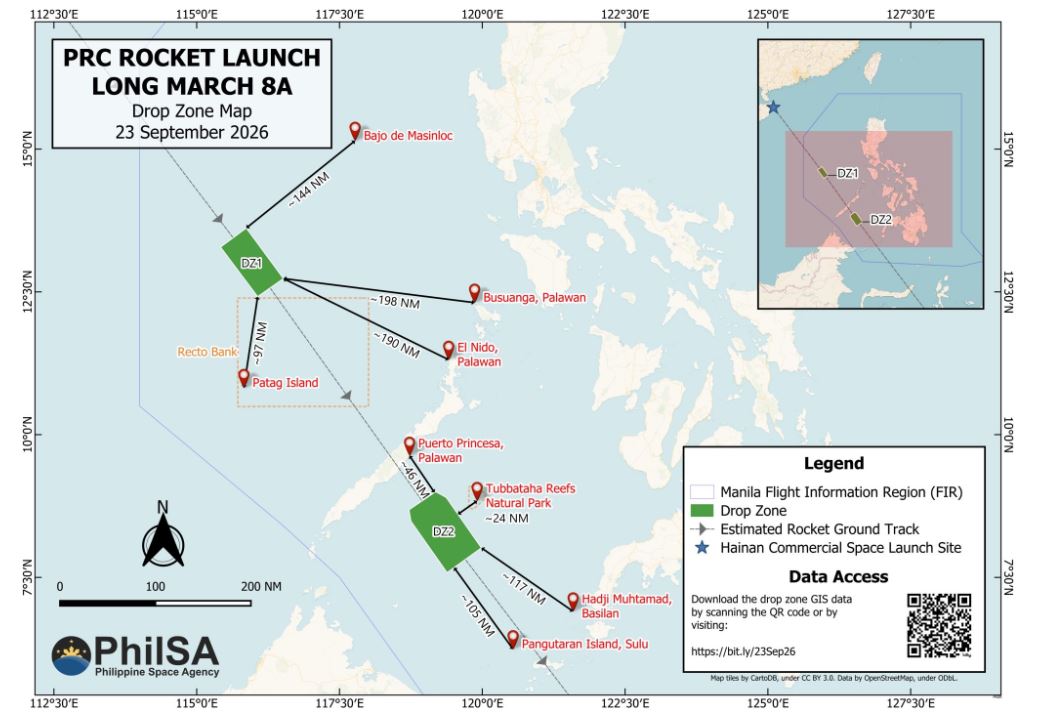
The Philippine Space Agency (PhilSA) confirmed the launch of China’s Long March 8A rocket, warning that debris from the launch may have fallen within designated drop zones in Philippine waters.
PhilSA urged the public to report suspected rocket debris to local authorities and warned against retrieving or approaching the material, which may contain remnants of toxic rocket fuel.
The rocket was launched from the Hainan International Commercial Launch Center in Wenchang, Hainan, at around 9:33 p.m. on Wednesday, September 23, PST.
"Details of the rocket drop zone were disclosed through a Notice to Airmen (NOTAM) warning of an aerospace flight activity," the agency said.
PhilSA said expected debris was projected to fall within two drop zones. The first, located within the Philippines’ exclusive economic zone, is about 97 nautical miles from Patag Island, 144 nautical miles from Bajo de Masinloc, 190 nautical miles from El Nido, Palawan, and 198 nautical miles from Busuanga, Palawan.
The second drop zone is within Philippine archipelagic waters and is about 46 nautical miles from Puerto Princesa, 24 nautical miles from the Tubbataha Reefs Natural Park, 105 nautical miles from Pangutaran, Sulu, and 117 nautical miles from Hadji Muhtamad, Basilan.
PhilSA said rocket components such as boosters and fairings are designed to separate and fall back to Earth during the launch process. While the debris was not projected to fall on land or inhabited areas, it could pose risks to ships, aircraft, fishing boats and other vessels in the drop zones.
The agency also said debris could drift at sea and wash ashore, while an uncontrolled re-entry of the rocket’s upper stages could not be ruled out. —LDF, GMA News

