

 GMA Brandtalk
 Tracking
 Archives

PhilSA confirms rocket launch from China, debris expected
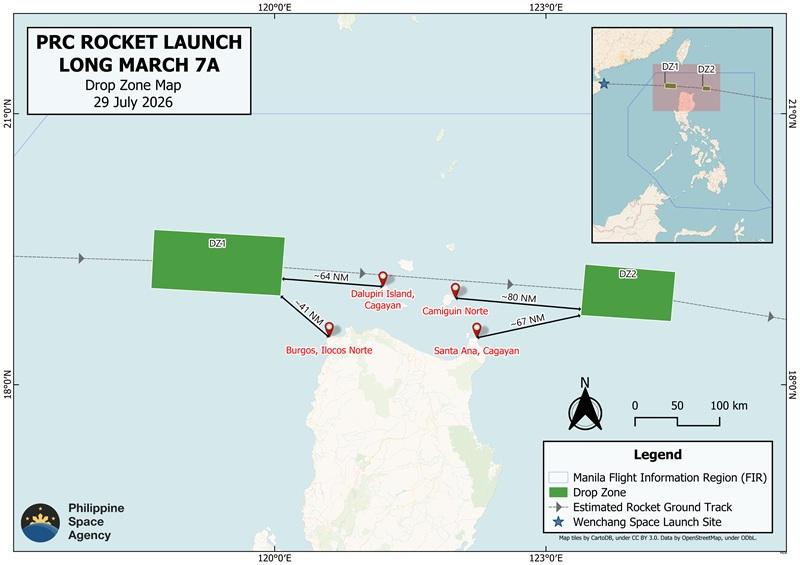
The Philippine Space Agency (PhilSA) on Wednesday confirmed the launch of a rocket from China while its debris may found several nautical miles away from Philippine shores.
According to the PhilSA, the rocket was fired from Wenchang Space Launch Site in Wenchang, Hainan at around 7:50 p.m., Philippine Standard time on Wednesday.
“PhilSA confirms the launch of the Long March 7A rocket from the People's Republic of China,” the agency said in a statement.
Debris from the rocket can be found approximately 41 nautical miles away from Burgos, Ilocos Norte and 64 nautical miles away from Dalupiri Island, Cagayan for the first drop zone.
In the second drop zone, the debris could be found 67 nautical miles away from Santa Ana, Cagayan, and 80 nautical miles away from Camiguin Norte.
The PhilSA said the details of the rocket drop zones were disclosed through a Notice to Airmen warning of an “aerospace flight activity.”
Citizens should inform authorities if they were to find these debris, PhilSA said. The public were also cautioned against touching the materials.
Manila’s space agency said unburned debris from rockets are designed to be discarded as the rocket enters space.
“While not projected to fall on land features or inhabited areas, falling debris poses danger and potential risk to ships, aircraft, fishing boats, and other vessels that will pass through the drop zone. There is also a possibility for the debris to float around the area and wash toward nearby coasts,” PhilSA said.
PhilSA also said that it could not rule out the possibility of the rocket’s upper stages could have an uncontrolled re-entry into the atmosphere.
The agency further explained that with global launching rates increasing, the debris from these staging events also continue to be a growing hazard to not just spacecrafts, but civil aviation and the population on the ground.
“The Philippines invites international partners to explore how our region can develop coordinated protocols and capabilities that protect both our space assets and our people on the ground,” PhilSA said. — Jean Mangaluz/BAP, GMA News

