

 GMA Brandtalk
 Tracking
 Archives

ADVERTISEMENT
Filtered By: Scitech
SciTech
'Lost pyramids' in Egypt discovered via Google Earth
Researchers may have "stumbled" on two possible pyramid complexes in Egypt, with the help of a satellite imagery survey by Google Earth.
Satellite archaeology researcher Angela Micol of Maiden, N.C. said the sites, located 90 miles apart, have mounds with intriguing features and orientations.
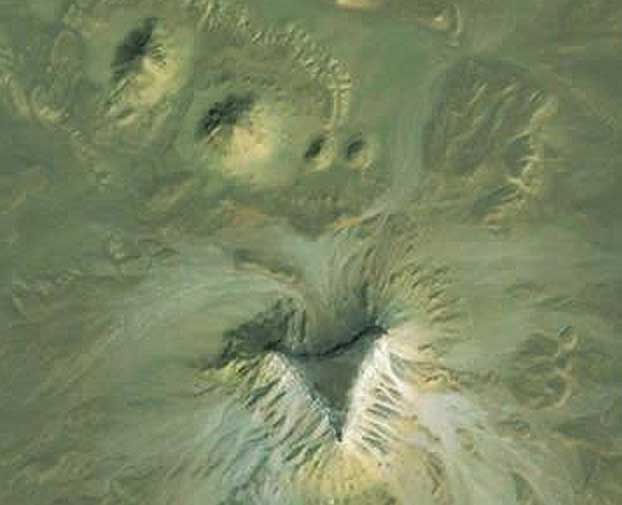
A report on Discovery News said one of the sites in Upper Egypt, just 12 miles from Abu Sidhum city along the Nile, has four mounds each with a larger, triangular-shaped plateau.
Two larger mounds at this site are about 250 feet wide, with two smaller mounds about 100 feet wide, Discovery News added.
Source: Google Earth
Micol had in the past located several possible archaeological sites with Google Earth, including a potential underwater city off the coast of the Yucatan peninsula, Discovery News said.
It added Micol believes the use of infrared imagery will allow scientists to see the extent of the complexes in greater detail.
She said the sites have been sent to Egyptologists and researchers for further investigation and "ground truthing."
Discovery News said the site complex is arranged in a very clear formation with the large mound extending 620 feet wide, about three times the size of the Great Pyramid.
When zooming in on the top of the triangular formation, two circular, 20-foot-wide features appear almost in the center of the triangle.
"Upon closer examination of the formation, this mound appears to have a very flat top and a curiously symmetrical triangular shape that has been heavily eroded with time," Discovery News quoted Micol as saying on her website Google Earth Anomalies.
The second possible pyramid complex is about 90 miles north near the Fayoum oasis, containing a four-sided truncated mound about 150 feet wide.
"It has a distinct square center which is very unusual for a mound of this size and it almost seems pyramidal when seen from above," Micol said.
Also, the site has three smaller mounds in a very clear formation, "similar to the diagonal alignment of the Giza Plateau pyramids," Micol said.
"The color of the mounds is dark and similar to the material composition of Dimai's walls which are made of mudbrick and stone," Micol added.
Verified as undiscovered
Discovery News quoted Micol as saying both sites have been verified as undiscovered by Egyptologist and pyramid expert Nabil Selim.
Selim's findings had included the pyramid called Sinki at Abydos and the Dry Moat surrounding the Step pyramid complex at Saqqara.
Discovery News said Selim found the smaller 100-foot mounds at the site near Abu Sidhum are a similar size as the 13th Dynasty Egyptian pyramids, if a square base can be discovered.
"The images speak for themselves. It's very obvious what the sites may contain but field research is needed to verify they are, in fact, pyramids," Micol said. — TJD, GMA News

